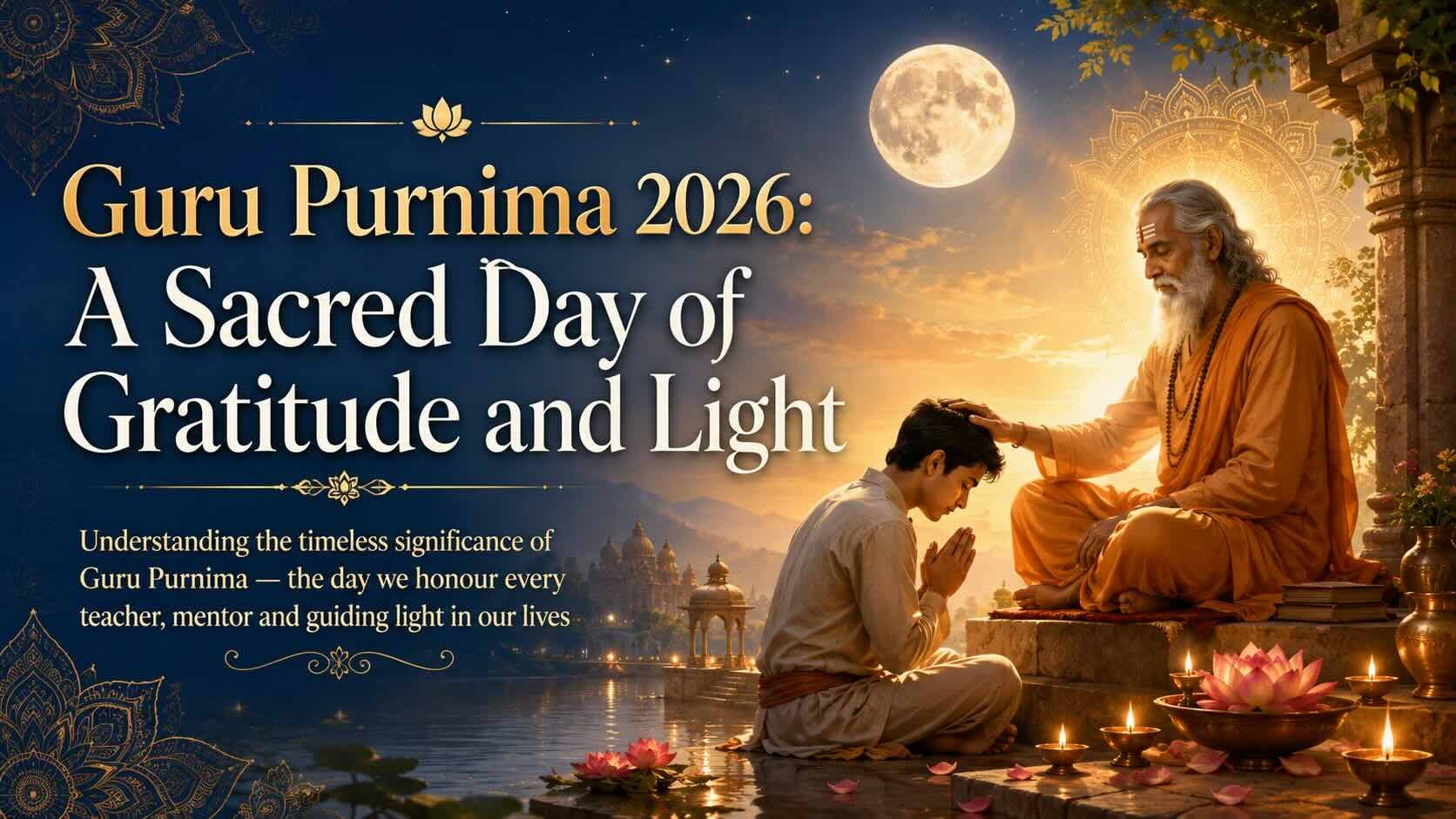
Guru Purnima 2026: A Sacred Day of Gratitude and Light
Understanding the timeless significance of Guru Purnima — the day we honour every teacher, mentor and guiding light in our lives

Updated : 8 hours ago
 View Complete Article
Guru Purnima 2026: A Sacred Day of Gratitude and Light
On the full moon of Ashadha, India pauses. Homes grow quiet, temples fill with soft chants, and hearts turn towards those who have shaped us — our Gurus. Guru Purnima 2026 falls on 29 July. It is not merely a festival; it is a gentle reminder that every step of growth begins with someone who chose to light a lamp for us.
What is Guru Purnima?
Guru Purnima is the sacred day dedicated to honouring the Guru — the one who removes the darkness of ignorance. The word ‘Guru’ itself comes from ‘Gu’ (darkness) and ‘Ru’ (remover). Celebrated by Hindus, Buddhists and Jains across India, Nepal and Bhutan, this full-moon day invites us to express gratitude to every teacher, mentor, parent and silent guide who has walked with us.
Vyasa Purnima — The Birth of a Timeless Guru
This day is also known as Vyasa Purnima, marking the birth of Maharishi Veda Vyasa. Born to Sage Parashara and Satyavati, Vyasa compiled the four Vedas, authored the Mahabharata, and gifted humanity the eighteen Puranas and the Brahma Sutras. He stands as the eternal symbol of the Guru-Shishya tradition — the sacred bond between teacher and disciple that has carried knowledge across generations.
The Deeper Spiritual Meaning
In the yogic tradition, Guru Purnima is the day when Adiyogi Shiva first turned towards his seven disciples — the Saptarishis — and transmitted the science of yoga. It is believed that the alignment of the moon on this night creates a special receptivity in the human system. For seekers, this is the most powerful day of the year to open oneself to grace, to sit in silence, and to renew the commitment to inner growth.
How Guru Purnima is Observed
Traditional observances remain simple and heartfelt. Disciples offer flowers, fruits and a quiet pranam to their Guru. Many observe a day of silence or light fasting. Schools and ashrams organise special gatherings where students express gratitude. Charity, meditation, and the beginning of new spiritual practices are considered especially auspicious. In modern times, the day has expanded beautifully — people thank school teachers, college professors, workplace mentors, and even the wise elders of their family.
A Day for Every Seeker
Guru Purnima does not belong only to those who have a formal spiritual Guru. It belongs to anyone who has ever been lifted by another’s wisdom. The neighbour who shared a life lesson, the book that arrived at the right moment, the parent who taught patience by example — all are Gurus in their own quiet way. The day simply asks us to pause, remember, and say thank you.
Guru Purnima — FAQs
1. When is Guru Purnima in 2026?
Guru Purnima 2026 is observed on 29 July, the full moon day of the Hindu month of Ashadha.
2. Why is it also called Vyasa Purnima?
It marks the birth anniversary of Maharishi Veda Vyasa, the sage who compiled the Vedas and authored the Mahabharata. Hence the day is also known as Vyasa Purnima.
3. Who can be considered a Guru?
Anyone who removes darkness — a spiritual master, a school teacher, a parent, a mentor, or even life itself when it teaches with compassion. The essence is the transmission of light.
4. How can one celebrate Guru Purnima simply?
Sit quietly for a few minutes, remember those who guided you, offer a silent thank you, light a diya, or perform a small act of kindness in their honour. No elaborate ritual is required — sincerity is enough.
5. Is Guru Purnima only a Hindu festival?
While deeply rooted in Hindu tradition, Guru Purnima is also observed by Buddhists and Jains. Its spirit of gratitude towards teachers is universal.
A quiet note, written with folded hands…
Namaste,
On this gentle full-moon night of Guru Purnima, I sit with a peaceful heart and offer my deepest pranam to every Guru who has walked beside me.
To the teachers who patiently opened the first doors of knowledge… to the mentors who believed in me before I believed in myself… to the elders whose silence taught more than words… and to every unseen hand that steadied me when the path grew dark — thank you.
You did not merely give information. You gave direction. You gave courage. You gave light.
Whatever little good I may ever do, whatever small light I may carry forward, it is only the reflection of the lamps you once lit for me.
With endless gratitude and a quiet mind,
Prabhakar Jha
🙏


