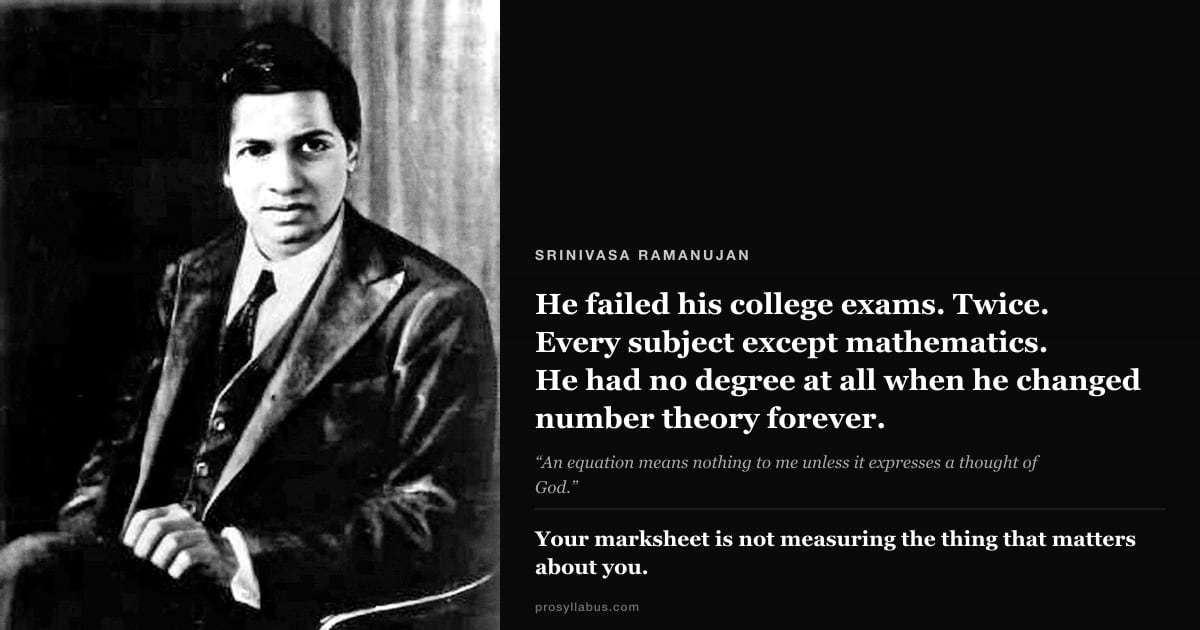
Srinivasa Ramanujan failed his college exams. Twice.
He had no degree, no formal training and no job when he sent a letter of wild, unproven theorems to Cambridge. He was right about almost all of them.
Updated : 23 hours ago
 View Complete Article
In 1904 Srinivasa Ramanujan won a scholarship to Government Arts College in Kumbakonam. He lost it within a year. Not because he could not do the work, but because he would not do any work that was not mathematics. He failed English. He failed physiology. He sat the Fellow of Arts examination and failed it, then sat it again and failed it again.
He spent the next several years without a degree and without an income, filling notebooks with results nobody had asked for. He was, by every measure the system had, a failure. He took a clerk’s job at the Madras Port Trust for twenty rupees a month.
The letter
In January 1913 he posted a letter to G. H. Hardy at Cambridge: nine pages of theorems, most of them stated without any proof at all. Hardy’s first reaction was that it was a hoax. He looked again. Some of the results were already known. Some were wrong. And some, he later wrote, "defeated me completely; I had never seen anything in the least like them before."
They had to be true, Hardy decided, because no one would have had the imagination to invent them.
What the exams could not see
Ramanujan died in 1920, at thirty-two. He left behind notebooks containing roughly 3,900 results. Mathematicians were still proving the last of them in the 1990s, seventy years after his death. His work now sits inside string theory and black-hole physics, fields that did not exist while he was alive.
The examinations he failed were not wrong about his English. They were simply not measuring the thing that mattered about him.


