Complete Solutions and Summary of Biological Classification – NCERT Class 11, Biology, Chapter 2 – Summary, Questions, Answers, Extra Questions
Comprehensive summary and explanation of Chapter 2 'Biological Classification', covering R.H. Whittaker’s five kingdom classification, criteria for classification, features of Monera, Protista, Fungi, Plantae, and Animalia, characteristics and importance of archaebacteria, eubacteria, viruses, viroids, prions, lichens, as well as economic and ecological significance; includes all solved NCERT questions and extra practice material.
Updated: 8 months ago
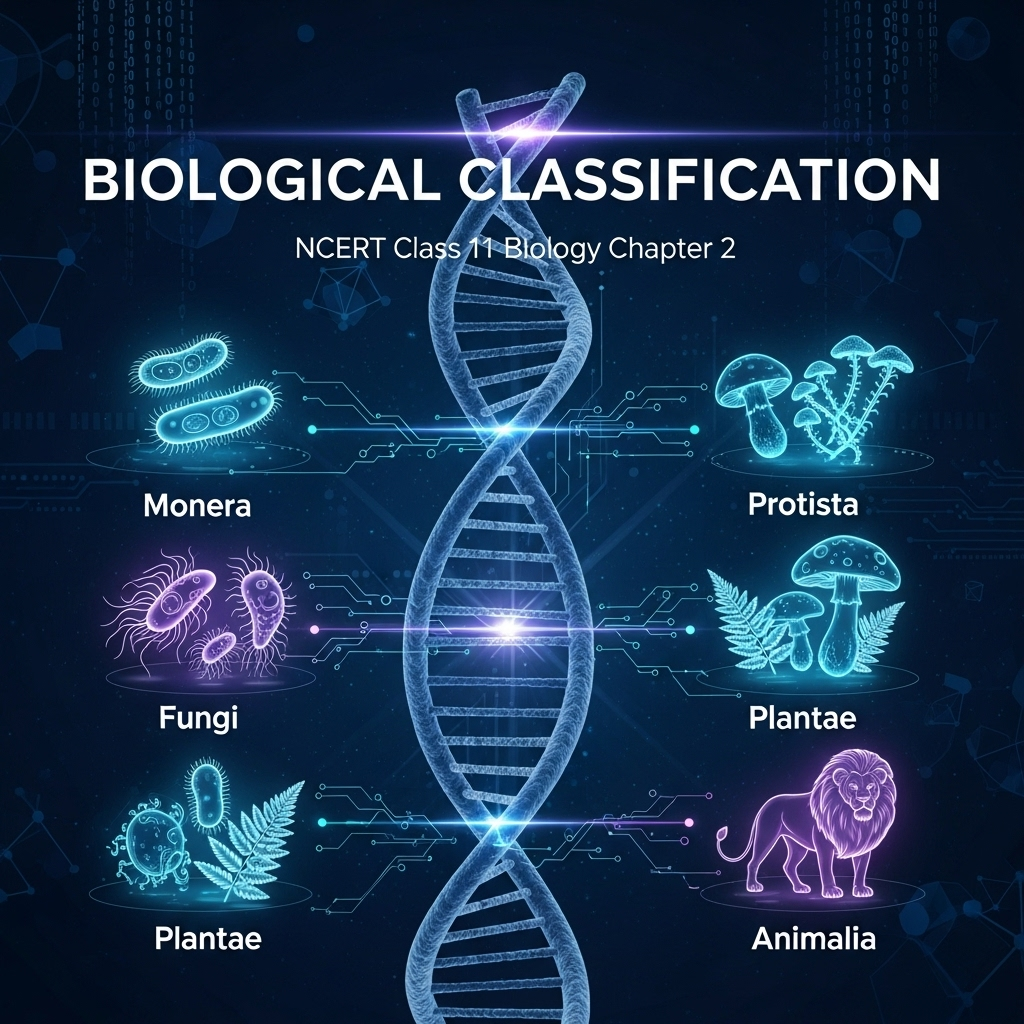
Biological Classification
Chapter 2: Biology - Ultimate Study Guide | NCERT Class 11 Notes, Questions, Examples & Quiz 2025
Full Chapter Summary & Detailed Notes - Biological Classification Class 11 NCERT
Overview & Key Concepts
- Chapter Goal: Understand the need for classification, historical attempts, and Whittaker's Five Kingdom system. Exam Focus: Characteristics of kingdoms, subgroups like bacteria, protists, fungi. 2025 Updates: Emphasis on evolutionary relationships and three-domain system. Fun Fact: R.H. Whittaker proposed the five kingdoms in 1969, revolutionizing taxonomy. Core Idea: Organisms are classified based on cell structure, nutrition, reproduction to reflect phylogeny. Real-World: Helps in identifying pathogens, agriculture, and biodiversity conservation.
- Wider Scope: Links to evolution, microbiology, and ecology; foundation for understanding life diversity.
Introduction: History of Classification
- Since civilization's dawn, humans classified organisms instinctively for food, shelter, clothing – not scientifically. Aristotle attempted scientific basis using morphology: plants into trees, shrubs, herbs; animals by red blood presence.
- Linnaeus' Two Kingdom system (Plantae, Animalia) included all but failed to distinguish eukaryotes/prokaryotes, unicellular/multicellular, photosynthetic/non-photosynthetic (e.g., algae vs. fungi).
- Two Kingdom was inadequate as many organisms didn't fit (e.g., bacteria, fungi). Need arose for criteria like cell structure, wall nature, nutrition mode, habitat, reproduction, evolution.
- Classification systems evolved; Plantae/Animalia constant, but inclusions changed. Number/nature of kingdoms varied by scientists.
- R.H. Whittaker (1969) proposed Five Kingdoms: Monera, Protista, Fungi, Plantae, Animalia. Criteria: cell structure, organization, nutrition, reproduction, phylogeny (Table 2.1).
- Three-domain system (later) divides Monera into two domains, eukaryotes in third – six kingdoms total. Studied in higher classes.
- Five Kingdom issues: Earlier systems grouped prokaryotes/eukaryotes, unicellular/multicellular (e.g., Chlamydomonas/Spirogyra as algae), heterotrophs/autotrophs despite wall differences (fungi chitin, plants cellulose).
- Fungi separated; prokaryotes in Monera; unicellular eukaryotes in Protista (e.g., Chlamydomonas/Chlorella with Paramoecium/Amoeba).
- Changes due to improved understanding; future changes possible. Modern systems phylogenetic, based on evolution.
- Chapter covers Monera, Protista, Fungi; Plantae/Animalia in Chapters 3/4.
2.1 Kingdom Monera
- Bacteria sole members; most abundant microbes, everywhere – soil, extreme habitats (hot springs, deserts, snow, oceans). Many parasitic.
- Shapes: Coccus (spherical), Bacillus (rod), Vibrium (comma), Spirillum (spiral) – Figure 2.1.
- Simple structure, complex behavior; extensive metabolic diversity. Autotrophic (photosynthetic/chemosynthetic) or heterotrophic (majority).
- 2.1.1 Archaebacteria: Harsh habitats – halophiles (salty), thermoacidophiles (hot springs), methanogens (marshy, ruminant guts for methane/biogas). Different cell wall for survival.
- 2.1.2 Eubacteria: 'True bacteria'; rigid cell wall, flagellum if motile. Cyanobacteria (blue-green algae) photosynthetic with chlorophyll a; unicellular/colonial/filamentous, gelatinous sheath, blooms in polluted water. Fix nitrogen in heterocysts (e.g., Nostoc, Anabaena) – Figure 2.2.
- Chemosynthetic autotrophs oxidize inorganics (nitrates/nitrites/ammonia) for ATP; recycle nutrients (N, P, Fe, S).
- Heterotrophic: Decomposers, abundant. Impact humans: Curd from milk, antibiotics, N-fixation in legumes. Pathogens: Cholera, typhoid, tetanus, citrus canker.
- Reproduction: Fission (Figure 2.3), spores under unfavorable, primitive sexual (DNA transfer).
- Mycoplasma: Lack cell wall, smallest living cells, anaerobic; pathogenic in animals/plants.
2.2 Kingdom Protista
- Single-celled eukaryotes; boundaries unclear (some photosynthetic as 'plants'). Include Chrysophytes, Dinoflagellates, Euglenoids, Slime moulds, Protozoans. Primarily aquatic; link to plants/animals/fungi.
- Eukaryotic: Nucleus, organelles; some flagella/cilia. Reproduce asexually/sexually (cell fusion, zygote).
- 2.2.1 Chrysophytes: Diatoms/golden algae (desmids); fresh/marine, planktonic, photosynthetic. Diatom walls: Two overlapping silica shells (soap box), indestructible – 'diatomaceous earth' (gritty, for polishing/filtration). Chief ocean producers.
- 2.2.2 Dinoflagellates: Marine, photosynthetic; colors from pigments (yellow/green/brown/blue/red). Stiff cellulose plates; two flagella (longitudinal/transverse). Red tides (Gonyaulax) – toxins kill fish – Figure 2.4(a).
- 2.2.3 Euglenoids: Fresh/stagnant water; pellicle (protein layer) for flexibility, not cell wall. Two flagella (short/long). Photosynthetic in light, heterotrophic in dark (predators). Pigments like higher plants. Example: Euglena – Figure 2.4(b).
- 2.2.4 Slime Moulds: Saprophytic; move on decaying twigs/leaves, engulf organics. Form plasmodium (spread feet); unfavorable – fruiting bodies with spores (resistant, air-dispersed) – Figure 2.4(c).
- 2.2.5 Protozoans: Heterotrophs, predators/parasites; primitive animal relatives. Groups: Amoeboid (pseudopodia, e.g., Amoeba/Entamoeba parasites); Flagellated (flagella, e.g., Trypanosoma – sleeping sickness); Ciliated (cilia, gullet, e.g., Paramoecium – Figure 2.4(d)); Sporozoans (spore stage, e.g., Plasmodium – malaria).
2.3 Kingdom Fungi
- Heterotrophic; diverse morphology/habitat (moist bread, rotten fruits, mushrooms, toadstools, mustard white spots – parasitic). Yeast for bread/beer; diseases (Puccinia wheat rust); antibiotics (Penicillium). Cosmopolitan; warm/humid growth. Refrigerate food to prevent infections.
- Mostly filamentous (hyphae network = mycelium); coenocytic (multinucleate) or septate. Walls: chitin/polysaccharides. Saprophytes/parasites/symbiotic (lichens/mycorrhiza).
- Reproduction: Vegetative (fragmentation/fission/budding); Asexual (conidia/sporangiospores/zoospores in fruiting bodies); Sexual (oospores/ascospores/basidiospores). Cycle: Plasmogamy (protoplasm fusion), karyogamy (nuclei fusion), meiosis in zygote for haploid spores.
- Dikaryon phase in some (ascomycetes/basidiomycetes): n+n cells before diploid. Basis for classes: Mycelium morphology, spore/fruiting bodies.
- 2.3.1 Phycomycetes: Aquatic/decaying wood, damp/parasitic. Aseptate/coenocytic mycelium. Asexual: Zoospores/aplanospores in sporangium. Sexual: Zygospore (isogamous/anisogamous/oogamous). Examples: Mucor, Rhizopus (bread mould), Albugo (mustard parasite) – Figure 2.5(a).
- 2.3.2 Ascomycetes: Sac-fungi; multicellular (Penicillium) or unicellular (yeast/Saccharomyces). Saprophytic/decomposers/parasitic/coprophilous. Branched/septate mycelium. Asexual: Conidia on conidiophores. Sexual: Ascospores in asci (ascocarps). Examples: Aspergillus (Figure 2.5(b)), Claviceps, Neurospora (biochemical/genetic); edibles: morels/truffles.
- 2.3.3 Basidiomycetes: Mushrooms/bracket fungi/puffballs; soil/logs/stumps/parasites (rusts/smuts). Branched/septate mycelium. Asexual spores rare; vegetative fragmentation. Plasmogamy by somatic cell fusion (dikaryotic → basidium). Karyogamy/meiosis in basidium → basidiospores on basidiocarps. Examples: Agaricus (mushroom – Figure 2.5(c)), Ustilago (smut), Puccinia (rust).
- 2.3.4 Deuteromycetes: Imperfect fungi; only asexual/vegetative known. Sexual discovered → moved to ascomycetes/basidiomycetes. Asexual: Conidia; septate/branched mycelium. Saprophytes/parasites/decomposers (mineral cycling). Examples: Alternaria, Colletotrichum, Trichoderma.
2.4 Kingdom Plantae
- Eukaryotic, chlorophyll-containing (plants); some partially heterotrophic (insectivorous like Bladderwort/Venus fly trap, parasites like Cuscuta).
- Eukaryotic cells: Chloroplasts, cellulose wall. Includes algae, bryophytes, pteridophytes, gymnosperms, angiosperms.
- Life cycle: Alternation of generations – diploid sporophytic (free/dependent), haploid gametophytic. Varies by group. Details in Chapter 3.
2.5 Kingdom Animalia
- Heterotrophic eukaryotes; multicellular, no cell walls. Depend on plants for food. Holozoic nutrition; digest in internal cavity, store glycogen/fat.
- Definite growth to adults; shape/size. Higher forms: Sensory/neuromotor, locomotion. Sexual: Copulation, embryological development. Phyla in Chapter 4.
2.6 Viruses, Viroids, Prions and Lichens
- Not in Five Kingdoms; acellular. Viruses: Non-cellular, crystalline outside cells; obligate parasites. Infect → replicate, kill host. Living or non-living?
- History: Ivanowsky (1892) tobacco mosaic; Beijerinck (1898) 'contagium vivum fluidum'; Stanley (1935) crystallized proteins. Genetic: RNA/DNA (not both); nucleoprotein. Plant viruses: ssRNA; animal: ss/dsRNA or dsDNA; bacteriophages: dsDNA.
- Capsid: Protein coat (capsomeres – helical/polyhedral). Diseases: Mumps, smallpox, herpes, influenza, AIDS; plants: Mosaic, leaf rolling/curling, yellowing, dwarfing – Figure 2.6.
- Viroids: Diener (1971) potato spindle tuber; free low MW RNA, no protein.
- Prions: Abnormally folded proteins; size like viruses. Diseases: BSE (mad cow), CJD in humans.
- Lichens: Symbiotic algae (phycobiont autotrophic) + fungi (mycobiont heterotrophic). Algae food, fungi shelter/nutrients/water. Close association; pollution indicators (absent in polluted areas).
Summary
- Aristotle/Linnaeus classifications; Whittaker's Five Kingdoms based on cell, organization, nutrition, reproduction, phylogeny.
- Monera: Prokaryotes, bacteria diverse. Protista: Unicellular eukaryotes. Fungi: Heterotrophic, diverse reproduction. Plantae: Autotrophic, alternation. Animalia: Heterotrophic, multicellular.
- Viruses etc.: Acellular, not kingdoms.
Why This Guide Stands Out
Complete chapter coverage: Notes, examples, Q&A (all NCERT + extras), quiz. Student-centric, exam-ready for 2025. Free & ad-free.
Key Themes & Tips
- Classification Evolution: From two to five kingdoms.
- Kingdom Features: Table 2.1 key.
- Subgroups: Learn examples, figures.
- Tip: Memorize Table 2.1; draw figures for reproduction.
Exam Case Studies
Questions on kingdom differences, bacteria shapes, fungi classes.
Project & Group Ideas
- Observe local fungi/bacteria; discuss pollution via lichens.


As an Amazon Associate, ProSyllabus earns from qualifying purchases. Prices shown are subject to change.
Test your CBSE Class 11 Annual Assessment prep
Quizzes
10 questions · ~10 minutes · instant rank & AI diagnosis
Accountancy (Class 11) Practice Quiz | CBSE Class 11 Annual Assessment
Sets and Venn Operations Fundamentals — Free CBSE Class 11 Annual Assessment Quiz
Class 11 English — The Tale of Melon City (Practice Quiz)
Class 11 English — Birth (Practice Quiz)
Class 11 English — Mother's Day (Practice Quiz)
Class 11 English — The Address (Practice Quiz)
Class 11 English — The Summer of the Beautiful White Horse (Practice Quiz)
Class 11 English — Father to Son (Practice Quiz)
Class 11 English — Silk Road (Practice Quiz)
Class 11 English — The Adventure (Practice Quiz)
Class 11 English — Childhood (Practice Quiz)
Class 11 English — The Ailing Planet: the Green Movement's Role (Practice Quiz)
Class 11 English — The Voice of the Rain (Practice Quiz)
Class 11 English — The Laburnum Top (Practice Quiz)
Class 11 English — Discovering Tut: the Saga Continues (Practice Quiz)
Class 11 English — We're Not Afraid to Die... if We Can All Be Together (Practice Quiz)
Class 11 English — A Photograph (Practice Quiz)
Class 11 English — The Portrait of a Lady (Practice Quiz)
Class 11 Psychology — Motivation and Emotion (Practice Quiz)
Class 11 Psychology — Thinking (Practice Quiz)
Class 11 Psychology — Human Memory (Practice Quiz)
Class 11 Psychology — Learning (Practice Quiz)
Class 11 Psychology — Sensory, Attentional and Perceptual Processes (Practice Quiz)
Class 11 Psychology — Human Development (Practice Quiz)
Class 11 Psychology — Methods of Enquiry in Psychology (Practice Quiz)
Class 11 Psychology — What is Psychology? (Practice Quiz)
Class 11 Sociology — Indian Sociologists (Practice Quiz)
Class 11 Sociology — Introducing Western Sociologists (Practice Quiz)
Class 11 Sociology — Environment and Society (Practice Quiz)
Class 11 Sociology — Social Change and Social Order in Rural and Urban Society (Practice Quiz)
Class 11 Sociology — Social Structure, Stratification and Social Processes in Society (Practice Quiz)
Class 11 Sociology — Doing Sociology: Research Methods (Practice Quiz)
Class 11 Sociology — Culture and Socialisation (Practice Quiz)
Class 11 Sociology — Understanding Social Institutions (Practice Quiz)
Class 11 Sociology — Terms, Concepts and Their Use in Sociology (Practice Quiz)
Class 11 Sociology — Sociology and Society (Practice Quiz)
Class 11 Political Science — The Philosophy of the Constitution (Practice Quiz)
Class 11 Political Science — Constitution as a Living Document (Practice Quiz)
Class 11 Political Science — Local Governments (Practice Quiz)
Class 11 Political Science — Federalism (Practice Quiz)
Class 11 Political Science — Judiciary (Practice Quiz)
Class 11 Political Science — Legislature (Practice Quiz)
Class 11 Political Science — Executive (Practice Quiz)
Class 11 Political Science — Election and Representation (Practice Quiz)
Class 11 Political Science — Rights in the Indian Constitution (Practice Quiz)
Class 11 Political Science — Constitution: Why and How? (Practice Quiz)
Class 11 Political Science — Secularism (Practice Quiz)
Class 11 Political Science — Nationalism (Practice Quiz)
Class 11 Political Science — Citizenship (Practice Quiz)
Class 11 Political Science — Rights (Practice Quiz)
Class 11 Political Science — Social Justice (Practice Quiz)
Class 11 Political Science — Equality (Practice Quiz)
Class 11 Political Science — Freedom (Practice Quiz)
Class 11 Political Science — Political Theory: An Introduction (Practice Quiz)
Class 11 Geography — Natural Hazards and Disasters (Practice Quiz)
Class 11 Geography — Natural Vegetation (Practice Quiz)
Class 11 Geography — Climate (Practice Quiz)
Class 11 Geography — Drainage System (Practice Quiz)
Class 11 Geography — Structure and Physiography (Practice Quiz)
Class 11 Geography — India – Location (Practice Quiz)
Class 11 Geography — Biodiversity and Conservation (Practice Quiz)
Class 11 Geography — Movements of Ocean Water (Practice Quiz)
Class 11 Geography — Water (Oceans) (Practice Quiz)
Class 11 Geography — World Climate and Climate Change (Practice Quiz)
Class 11 Geography — Water in the Atmosphere (Practice Quiz)
Class 11 Geography — Atmospheric Circulation and Weather Systems (Practice Quiz)
Class 11 Geography — Solar Radiation, Heat Balance and Temperature (Practice Quiz)
Class 11 Geography — Composition and Structure of Atmosphere (Practice Quiz)
Class 11 Geography — Landforms and their Evolution (Practice Quiz)
Class 11 Geography — Geomorphic Processes (Practice Quiz)
Class 11 Geography — Distribution of Oceans and Continents (Practice Quiz)
Class 11 Geography — Interior of the Earth (Practice Quiz)
Class 11 Geography — The Origin and Evolution of the Earth (Practice Quiz)
Class 11 Geography — Geography as a Discipline (Practice Quiz)
Class 11 History — Paths to Modernisation (Practice Quiz)
Class 11 History — Displacing Indigenous Peoples (Practice Quiz)
Class 11 History — Changing Cultural Traditions (Practice Quiz)
Class 11 History — The Three Orders (Practice Quiz)
Class 11 History — Nomadic Empires (Practice Quiz)
Class 11 History — An Empire Across Three Continents (Practice Quiz)
Class 11 History — Writing and City Life (Practice Quiz)
Class 11 Economics — Comparative Development Experiences of India and its Neighbours (Practice Quiz)
Class 11 Economics — Environment and Sustainable Development (Practice Quiz)
Class 11 Economics — Employment: Growth, Informalisation and Other Issues (Practice Quiz)
Class 11 Economics — Rural Development (Practice Quiz)
Class 11 Economics — Human Capital Formation in India (Practice Quiz)
Class 11 Economics — Liberalisation, Privatisation and Globalisation: An Appraisal (Practice Quiz)
Class 11 Economics — Indian Economy 1950-1990 (Practice Quiz)
Class 11 Economics — Indian Economy on the Eve of Independence (Practice Quiz)
Class 11 Economics — Use of Statistical Tools (Practice Quiz)
Class 11 Economics — Index Numbers (Practice Quiz)
Class 11 Economics — Correlation (Practice Quiz)
Class 11 Economics — Measures of Central Tendency (Practice Quiz)
Class 11 Economics — Presentation of Data (Practice Quiz)
Class 11 Economics — Organisation of Data (Practice Quiz)
Class 11 Economics — Collection of Data (Practice Quiz)
Class 11 Economics — Introduction (Practice Quiz)
Class 11 Business Studies — International Business (Practice Quiz)
Class 11 Business Studies — Internal Trade (Practice Quiz)
Class 11 Business Studies — MSME and Business Entrepreneurship (Practice Quiz)
Class 11 Business Studies — Sources of Business Finance (Practice Quiz)
Class 11 Business Studies — Formation of a Company (Practice Quiz)
Class 11 Business Studies — Social Responsibilities of Business and Business Ethics (Practice Quiz)
Class 11 Business Studies — Emerging Modes of Business (Practice Quiz)
Class 11 Business Studies — Business Services (Practice Quiz)
Class 11 Business Studies — Private, Public and Global Enterprises (Practice Quiz)
Class 11 Business Studies — Forms of Business Organisation (Practice Quiz)
Class 11 Business Studies — Business, Trade and Commerce (Practice Quiz)
Class 11 Accountancy — Financial Statements - II (Practice Quiz)
Class 11 Accountancy — Financial Statements - I (Practice Quiz)
Class 11 Accountancy — Depreciation, Provisions and Reserves (Practice Quiz)
Class 11 Accountancy — Trial Balance and Rectification of Errors (Practice Quiz)
Class 11 Accountancy — Bank Reconciliation Statement (Practice Quiz)
Class 11 Accountancy — Recording of Transactions - II (Practice Quiz)
Class 11 Accountancy — Recording of Transactions - I (Practice Quiz)
Class 11 Accountancy — Theory Base of Accounting (Practice Quiz)
Class 11 Accountancy — Introduction to Accounting (Practice Quiz)
Class 11 Maths — Probability (Practice Quiz)
Class 11 Maths — Statistics (Practice Quiz)
Class 11 Maths — Limits and Derivatives (Practice Quiz)
Class 11 Maths — Introduction to Three Dimensional Geometry (Practice Quiz)
Class 11 Maths — Conic Sections (Practice Quiz)
Class 11 Maths — Straight Lines (Practice Quiz)
Class 11 Maths — Sequences and Series (Practice Quiz)
Class 11 Maths — Binomial Theorem (Practice Quiz)
Class 11 Maths — Permutations and Combinations (Practice Quiz)
Class 11 Maths — Linear Inequalities (Practice Quiz)
Class 11 Maths — Complex Numbers and Quadratic Equations (Practice Quiz)
Class 11 Maths — Relations and Functions (Practice Quiz)
Class 11 Maths — Sets (Practice Quiz)
Class 11 Biology — Chemical Coordination and Integration (Practice Quiz)
Class 11 Biology — Neural Control and Coordination (Practice Quiz)
Class 11 Biology — Locomotion and Movement (Practice Quiz)
Class 11 Biology — Excretory Products and their Elimination (Practice Quiz)
Class 11 Biology — Body Fluids and Circulation (Practice Quiz)
Class 11 Biology — Breathing and Exchange of Gases (Practice Quiz)
Class 11 Biology — Plant Growth and Development (Practice Quiz)
Class 11 Biology — Respiration in Plants (Practice Quiz)
Class 11 Biology — Photosynthesis in Higher Plants (Practice Quiz)
Class 11 Biology — Cell Cycle and Cell Division (Practice Quiz)
Class 11 Biology — Biomolecules (Practice Quiz)
Class 11 Biology — Cell: The Unit of Life (Practice Quiz)
Class 11 Biology — Structural Organisation in Animals (Practice Quiz)
Class 11 Biology — Anatomy of Flowering Plants (Practice Quiz)
Class 11 Biology — Morphology of Flowering Plants (Practice Quiz)
Class 11 Biology — Animal Kingdom (Practice Quiz)
Class 11 Biology — Plant Kingdom (Practice Quiz)
Class 11 Biology — Biological Classification (Practice Quiz)
Class 11 Biology — The Living World (Practice Quiz)
Class 11 Chemistry — Hydrocarbons (Practice Quiz)
Class 11 Chemistry — Organic Chemistry – Some Basic Principles and Techniques (Practice Quiz)
Class 11 Chemistry — Redox Reactions (Practice Quiz)
Class 11 Chemistry — Equilibrium (Practice Quiz)
Class 11 Chemistry — Chemical Bonding and Molecular Structure (Practice Quiz)
Class 11 Chemistry — Classification of Elements and Periodicity in Properties (Practice Quiz)
Class 11 Chemistry — Some Basic Concepts of Chemistry (Practice Quiz)
Class 11 Physics — Waves (Practice Quiz)
Class 11 Physics — Oscillations (Practice Quiz)
Class 11 Physics — Kinetic Theory (Practice Quiz)
Class 11 Chemistry — Thermodynamics (Practice Quiz)
Class 11 Physics — Thermal Properties of Matter (Practice Quiz)
Class 11 Physics — Mechanical Properties of Fluids (Practice Quiz)
Class 11 Physics — Mechanical Properties of Solids (Practice Quiz)
Class 11 Physics — Gravitation (Practice Quiz)
Class 11 Physics — Systems of Particles and Rotational Motion (Practice Quiz)
Class 11 Physics — Work, Energy and Power (Practice Quiz)
Class 11 Physics — Motion in a Plane (Practice Quiz)
Class 11 Physics — Motion in a Straight Line (Practice Quiz)
Class 11 Physics — Units and Measurement (Practice Quiz)
Class 11 Maths — Trigonometric Functions (Practice Quiz)
Class 11 Chemistry — Structure of Atom (Practice Quiz)
Class 11 Physics — Laws of Motion (Practice Quiz)
Business Studies (Class 11) Practice Quiz | CBSE Class 11 Annual Assessment
Economics (Class 11) Practice Quiz | CBSE Class 11 Annual Assessment
Humanities Subjects Practice Quiz | CBSE Class 11 Annual Assessment
Motion in a Straight Line Practice Quiz | CBSE Class 11 Annual Assessment
Thermodynamic Processes and Laws Advanced Challenge | CBSE Class 11 Annual Assessment

Group Discussions
No forum posts available.


