Complete Solutions and Summary of Cell Cycle and Cell Division – NCERT Class 11, Biology, Chapter 10 – Summary, Questions, Answers, Extra Questions
Concise summary of cell growth and division processes including cell cycle phases, mitosis, meiosis, and their biological significance with NCERT exercises.
Updated: 8 months ago
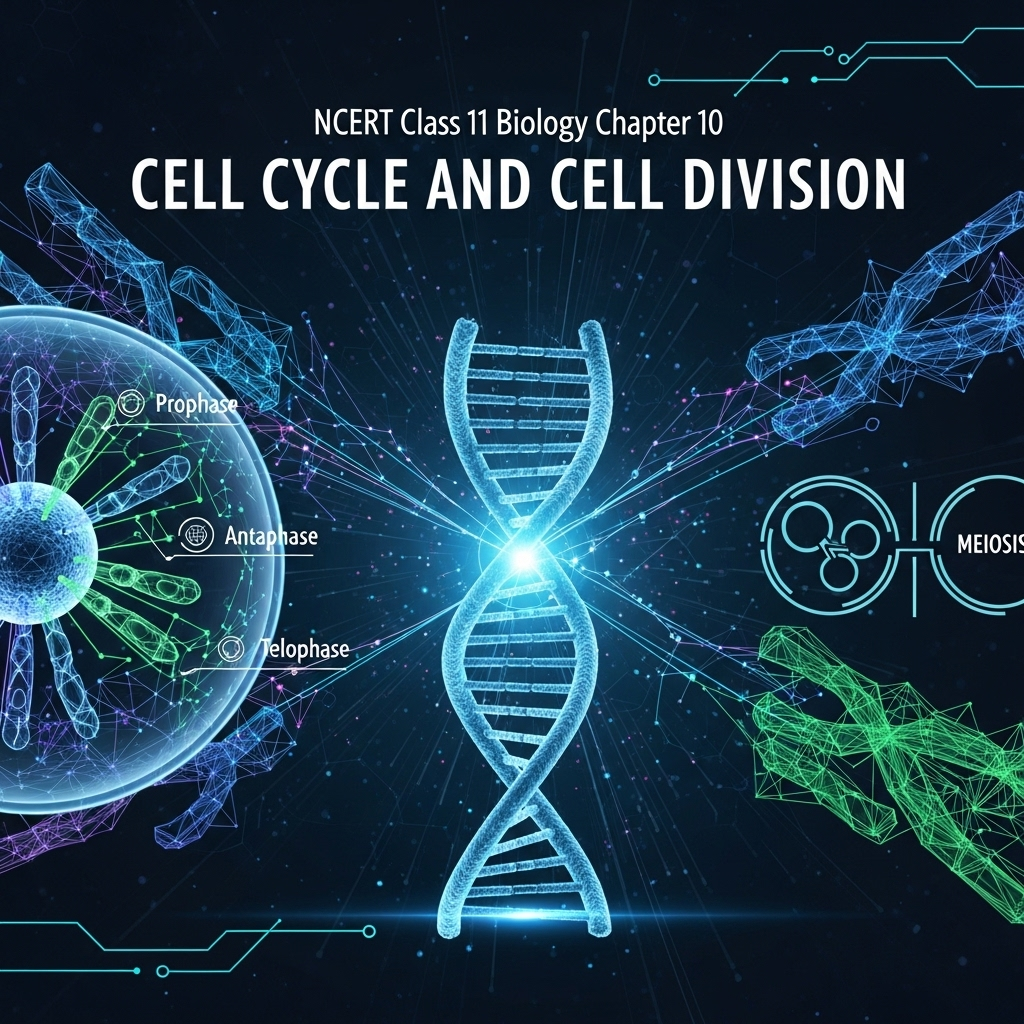
Cell Cycle and Cell Division
Chapter 10: Biology - Ultimate Study Guide | NCERT Class 11 Notes, Questions, Examples & Quiz 2025
Full Chapter Summary & Detailed Notes - Cell Cycle and Cell Division Class 11 NCERT
Overview & Key Concepts
- Chapter Goal: Understand how cells grow and divide through cell cycle, mitosis, and meiosis. Exam Focus: Phases of cell cycle, significance of divisions, diagrams. 2025 Updates: Emphasis on cell cycle checkpoints and cancer links. Fun Fact: Human cells divide about 50 times before senescence (Hayflick limit). Core Idea: All organisms start from a single cell; division ensures growth, repair, reproduction. Real-World: Cancer from uncontrolled division; stem cell therapy uses division principles.
- Wider Scope: Links to genetics, development, evolution; basis for biotechnology like cloning.
Introduction: Growth and Reproduction in Living Organisms
- All organisms, even largest, start from a single cell. Growth and reproduction are key characteristics. Cells divide into two, with parental cell giving two daughter cells.
- Newly formed cells grow and divide, forming populations from a single parental cell and progeny. Cycles of growth and division form structures with millions of cells.
- Cell division vital in all living organisms. Involves DNA replication and cell growth in coordinated way for correct division and intact genomes in progeny.
- Cell cycle: Sequence where cell duplicates genome, synthesizes constituents, divides into two daughter cells.
- Cell growth (cytoplasmic increase) continuous, but DNA synthesis only in specific stage. Replicated chromosomes distributed during division under genetic control.
- Real-World: Understanding cell cycle helps in treating diseases like cancer, where division is unregulated.
- Examples: Unicellular organisms reproduce by division; multicellular use for growth/repair.
10.1 Cell Cycle
- Important process involving division, DNA replication, growth. Must be coordinated for intact genomes.
- Cell cycle in human cells ~24 hours; yeast ~90 minutes. Divided into interphase and M phase.
- M phase: Actual division (mitosis), lasts ~1 hour in 24-hour cycle. Interphase: Preparation phase, >95% of cycle.
- Interphase subphases: G1 (growth, no DNA replication), S (DNA synthesis, DNA doubles from 2C to 4C, chromosomes same), G2 (protein synthesis, growth).
- In animal cells, centriole duplicates in S phase. G0: Quiescent stage for non-dividing cells (e.g., heart cells), metabolically active but no proliferation unless needed.
- Mitosis in diploid somatic cells in animals; haploid in some (e.g., male honey bees). In plants, both haploid/diploid cells divide by mitosis (e.g., alternation of generations).
- Detailed Discussion: G1 longest in many cells; S critical for replication fidelity. Errors lead to mutations. Checkpoints ensure progression.
- Examples: Onion root tip cells for mitosis study; 16 chromosomes at G1, after S still 16 but 4C DNA, after M 2C.
- Real-World: Chemotherapy targets S phase to stop cancer cell division.
10.1.1 Phases of Cell Cycle
- Typical eukaryotic cycle illustrated by human cells in culture. Duration varies by organism/cell type.
- Interphase: Between M phases, includes cell growth, DNA replication. G1: Post-mitosis to DNA replication start, metabolic activity.
- S phase: DNA doubles, centriole duplicates in animals. G2: Preparation for mitosis, protein synthesis.
- M phase: Nuclear division (karyokinesis), cytoplasmic division (cytokinesis).
- G0: Inactive stage for some adult cells (e.g., neurons), replace lost cells if needed.
- Detailed Discussion: Interphase not resting; active preparation. DNA content: G1 2C, S 4C, G2 4C, M back to 2C.
- Examples: Plants/animals grow lifelong? Plants yes via meristems; animals no, but some cells divide (e.g., skin).
- Figure 10.1: Diagrammatic view of cell cycle showing two cells from one.
- Real-World: Stem cells in G0 can be activated for regeneration.
10.2 M Phase
- Most dramatic period; reorganization of cell components. Equational division, same chromosome number in parent/progeny.
- Divided into prophase, metaphase, anaphase, telophase (karyokinesis). Progressive process, no clear lines.
- Detailed Discussion: Ensures equal distribution of genetic material. Errors cause aneuploidy.
- Examples: Studied in onion root tips (16 chromosomes).
- Real-World: Mitotic index measures division rate in tissues.
10.2.1 Prophase
- First stage after S/G2. Chromatin condenses into chromosomes (two chromatids, centromere).
- Centrosomes (duplicated in interphase) move to opposite poles, radiate asters. Forms mitotic apparatus with spindle.
- End: No Golgi, ER, nucleolus, nuclear envelope.
- Detailed Discussion: Condensation untangles DNA. Visible under microscope.
- Examples: Chromosomes intertwined before; compact mitotic form.
- Figure 10.2 a: Early prophase stages.
- Real-World: Prophase inhibitors used in research.
10.2.2 Metaphase
- Nuclear envelope disintegrates, chromosomes spread. Condensation complete, morphology studied.
- Chromosomes: Two chromatids, centromere with kinetochores for spindle attachment.
- Align at equator (metaphase plate): One chromatid to one pole, sister to opposite.
- Detailed Discussion: Ensures proper segregation. Spindle checkpoint here.
- Examples: Best for chromosome counting.
- Figure 10.2 b: Metaphase view.
- Real-World: Colchicine disrupts spindle, arrests at metaphase for karyotyping.
10.2.3 Anaphase
- Chromosomes split at centromere; daughter chromosomes migrate to poles.
- Centromere leads, arms trail.
- Detailed Discussion: Shortening of microtubules pulls chromosomes.
- Examples: Synchronous split.
- Figure 10.2 c: Anaphase stages.
- Real-World: Anaphase errors cause nondisjunction, e.g., Down syndrome.
10.2.4 Telophase
- Chromosomes decondense at poles, lose individuality.
- Nuclear envelope, nucleolus, Golgi, ER reform.
- Detailed Discussion: Reverse of prophase.
- Examples: Two daughter nuclei form.
- Figure 10.2 d: Telophase view.
- Real-World: Marks end of karyokinesis.
10.2.5 Cytokinesis
- Cytoplasmic division after karyokinesis. Animal: Furrow in plasma membrane deepens, joins center.
- Plant: Cell-plate from center outward, forms middle lamella. Inextensible wall dictates mechanism.
- Organelles distributed. Sometimes no cytokinesis, forms syncytium (e.g., coconut endosperm).
- Detailed Discussion: Ensures two complete cells. Actin in animals, vesicles in plants.
- Examples: Multinucleate in some organisms.
- Figure 10.2 e: Cytokinesis in animal/plant.
- Real-World: Cytokinesis failure in cancer cells leads to multinucleation.
10.3 Significance of Mitosis
- Usually in diploid cells; haploid in some plants/insects. Produces identical diploid daughters.
- Growth of multicellular organisms; restores nucleo-cytoplasmic ratio after growth.
- Cell repair: Replaces epidermis, gut lining, blood cells. Meristematic divisions for plant growth.
- Detailed Discussion: Maintains genetic stability. Essential for asexual reproduction.
- Examples: Haploid/diploid insects; continuous plant growth.
- Real-World: Wound healing via mitosis.
10.4 Meiosis
- Specialized division reduces chromosome number by half for haploid gametes. Restores diploidy in fertilization.
- During gametogenesis. Key: Two divisions, one DNA replication.
- Meiosis I: Reductional (homologous separate). Meiosis II: Equational (sister chromatids separate).
- Detailed Discussion: Ensures genetic variation via recombination/crossing over.
- Examples: Four haploid cells from one diploid.
- Real-World: Basis of sexual reproduction diversity.
10.4.1 Meiosis I
- Prophase I: Longest, complex. Substages: Leptotene (chromosomes visible, compact), Zygotene (synapsis, bivalents via synaptonemal complex), Pachytene (crossing over at recombination nodules, recombinase enzyme), Diplotene (dissolution, chiasmata visible), Diakinesis (terminalization, spindle assembly, nucleolus/nuclear envelope break).
- Metaphase I: Bivalents align at equator, microtubules attach to kinetochores.
- Anaphase I: Homologous separate, chromatids together.
- Telophase I: Nuclear membrane/nucleolus reappear, cytokinesis forms dyad. Interkinesis: Short, no DNA replication.
- Detailed Discussion: Prophase I key for variation. Chiasmata hold until separation.
- Examples: Diplotene lasts months in oocytes.
- Figure 10.3: Meiosis I stages.
- Real-World: Meiotic errors cause trisomy.
10.4.2 Meiosis II
- Prophase II: Nuclear membrane disappears, chromosomes compact.
- Metaphase II: Align at equator, microtubules to kinetochores.
- Anaphase II: Centromere splits, chromatids to poles.
- Telophase II: Nuclear envelope forms, cytokinesis yields tetrad (four haploid cells).
- Detailed Discussion: Resembles mitosis, but on haploid cells.
- Examples: Results in genetic variation.
- Figure 10.4: Meiosis II stages.
- Real-World: Sperm/egg formation.
10.5 Significance of Meiosis
- Conserves species-specific chromosome number across generations. Reduces by half, restored in fertilization.
- Increases genetic variability via crossing over, independent assortment. Essential for evolution.
- Detailed Discussion: Variations drive adaptation/natural selection.
- Examples: Population diversity from one generation to next.
- Real-World: Hybrid vigor in breeding.
Summary
- Cells from preexisting cells via division. Zygote starts life cycle; division continues.
- Cell cycle: Interphase (G1, S, G2), M phase (mitosis). Mitosis: Equational, conserves number.
- Meiosis: Reductional for gametes, restores diploidy. Phases detailed.
Why This Guide Stands Out
Complete chapter coverage: Notes, examples, Q&A (all NCERT + extras), quiz. Student-centric, exam-ready for 2025. Free & ad-free.
Key Themes & Tips
- Cell Cycle: Growth, division phases.
- Mitosis: Equational for growth/repair.
- Meiosis: Reductional for variation.
- Tip: Draw diagrams; memorize phases with mnemonics (PMAT).
Exam Case Studies
Questions on phases, DNA content, significance.
Project & Group Ideas
- Model cell cycle; discuss cancer links.


As an Amazon Associate, ProSyllabus earns from qualifying purchases. Prices shown are subject to change.
Test your CBSE Class 11 Annual Assessment prep
Quizzes
10 questions · ~10 minutes · instant rank & AI diagnosis
Accountancy (Class 11) Practice Quiz | CBSE Class 11 Annual Assessment
Sets and Venn Operations Fundamentals — Free CBSE Class 11 Annual Assessment Quiz
Class 11 English — The Tale of Melon City (Practice Quiz)
Class 11 English — Birth (Practice Quiz)
Class 11 English — Mother's Day (Practice Quiz)
Class 11 English — The Address (Practice Quiz)
Class 11 English — The Summer of the Beautiful White Horse (Practice Quiz)
Class 11 English — Father to Son (Practice Quiz)
Class 11 English — Silk Road (Practice Quiz)
Class 11 English — The Adventure (Practice Quiz)
Class 11 English — Childhood (Practice Quiz)
Class 11 English — The Ailing Planet: the Green Movement's Role (Practice Quiz)
Class 11 English — The Voice of the Rain (Practice Quiz)
Class 11 English — The Laburnum Top (Practice Quiz)
Class 11 English — Discovering Tut: the Saga Continues (Practice Quiz)
Class 11 English — We're Not Afraid to Die... if We Can All Be Together (Practice Quiz)
Class 11 English — A Photograph (Practice Quiz)
Class 11 English — The Portrait of a Lady (Practice Quiz)
Class 11 Psychology — Motivation and Emotion (Practice Quiz)
Class 11 Psychology — Thinking (Practice Quiz)
Class 11 Psychology — Human Memory (Practice Quiz)
Class 11 Psychology — Learning (Practice Quiz)
Class 11 Psychology — Sensory, Attentional and Perceptual Processes (Practice Quiz)
Class 11 Psychology — Human Development (Practice Quiz)
Class 11 Psychology — Methods of Enquiry in Psychology (Practice Quiz)
Class 11 Psychology — What is Psychology? (Practice Quiz)
Class 11 Sociology — Indian Sociologists (Practice Quiz)
Class 11 Sociology — Introducing Western Sociologists (Practice Quiz)
Class 11 Sociology — Environment and Society (Practice Quiz)
Class 11 Sociology — Social Change and Social Order in Rural and Urban Society (Practice Quiz)
Class 11 Sociology — Social Structure, Stratification and Social Processes in Society (Practice Quiz)
Class 11 Sociology — Doing Sociology: Research Methods (Practice Quiz)
Class 11 Sociology — Culture and Socialisation (Practice Quiz)
Class 11 Sociology — Understanding Social Institutions (Practice Quiz)
Class 11 Sociology — Terms, Concepts and Their Use in Sociology (Practice Quiz)
Class 11 Sociology — Sociology and Society (Practice Quiz)
Class 11 Political Science — The Philosophy of the Constitution (Practice Quiz)
Class 11 Political Science — Constitution as a Living Document (Practice Quiz)
Class 11 Political Science — Local Governments (Practice Quiz)
Class 11 Political Science — Federalism (Practice Quiz)
Class 11 Political Science — Judiciary (Practice Quiz)
Class 11 Political Science — Legislature (Practice Quiz)
Class 11 Political Science — Executive (Practice Quiz)
Class 11 Political Science — Election and Representation (Practice Quiz)
Class 11 Political Science — Rights in the Indian Constitution (Practice Quiz)
Class 11 Political Science — Constitution: Why and How? (Practice Quiz)
Class 11 Political Science — Secularism (Practice Quiz)
Class 11 Political Science — Nationalism (Practice Quiz)
Class 11 Political Science — Citizenship (Practice Quiz)
Class 11 Political Science — Rights (Practice Quiz)
Class 11 Political Science — Social Justice (Practice Quiz)
Class 11 Political Science — Equality (Practice Quiz)
Class 11 Political Science — Freedom (Practice Quiz)
Class 11 Political Science — Political Theory: An Introduction (Practice Quiz)
Class 11 Geography — Natural Hazards and Disasters (Practice Quiz)
Class 11 Geography — Natural Vegetation (Practice Quiz)
Class 11 Geography — Climate (Practice Quiz)
Class 11 Geography — Drainage System (Practice Quiz)
Class 11 Geography — Structure and Physiography (Practice Quiz)
Class 11 Geography — India – Location (Practice Quiz)
Class 11 Geography — Biodiversity and Conservation (Practice Quiz)
Class 11 Geography — Movements of Ocean Water (Practice Quiz)
Class 11 Geography — Water (Oceans) (Practice Quiz)
Class 11 Geography — World Climate and Climate Change (Practice Quiz)
Class 11 Geography — Water in the Atmosphere (Practice Quiz)
Class 11 Geography — Atmospheric Circulation and Weather Systems (Practice Quiz)
Class 11 Geography — Solar Radiation, Heat Balance and Temperature (Practice Quiz)
Class 11 Geography — Composition and Structure of Atmosphere (Practice Quiz)
Class 11 Geography — Landforms and their Evolution (Practice Quiz)
Class 11 Geography — Geomorphic Processes (Practice Quiz)
Class 11 Geography — Distribution of Oceans and Continents (Practice Quiz)
Class 11 Geography — Interior of the Earth (Practice Quiz)
Class 11 Geography — The Origin and Evolution of the Earth (Practice Quiz)
Class 11 Geography — Geography as a Discipline (Practice Quiz)
Class 11 History — Paths to Modernisation (Practice Quiz)
Class 11 History — Displacing Indigenous Peoples (Practice Quiz)
Class 11 History — Changing Cultural Traditions (Practice Quiz)
Class 11 History — The Three Orders (Practice Quiz)
Class 11 History — Nomadic Empires (Practice Quiz)
Class 11 History — An Empire Across Three Continents (Practice Quiz)
Class 11 History — Writing and City Life (Practice Quiz)
Class 11 Economics — Comparative Development Experiences of India and its Neighbours (Practice Quiz)
Class 11 Economics — Environment and Sustainable Development (Practice Quiz)
Class 11 Economics — Employment: Growth, Informalisation and Other Issues (Practice Quiz)
Class 11 Economics — Rural Development (Practice Quiz)
Class 11 Economics — Human Capital Formation in India (Practice Quiz)
Class 11 Economics — Liberalisation, Privatisation and Globalisation: An Appraisal (Practice Quiz)
Class 11 Economics — Indian Economy 1950-1990 (Practice Quiz)
Class 11 Economics — Indian Economy on the Eve of Independence (Practice Quiz)
Class 11 Economics — Use of Statistical Tools (Practice Quiz)
Class 11 Economics — Index Numbers (Practice Quiz)
Class 11 Economics — Correlation (Practice Quiz)
Class 11 Economics — Measures of Central Tendency (Practice Quiz)
Class 11 Economics — Presentation of Data (Practice Quiz)
Class 11 Economics — Organisation of Data (Practice Quiz)
Class 11 Economics — Collection of Data (Practice Quiz)
Class 11 Economics — Introduction (Practice Quiz)
Class 11 Business Studies — International Business (Practice Quiz)
Class 11 Business Studies — Internal Trade (Practice Quiz)
Class 11 Business Studies — MSME and Business Entrepreneurship (Practice Quiz)
Class 11 Business Studies — Sources of Business Finance (Practice Quiz)
Class 11 Business Studies — Formation of a Company (Practice Quiz)
Class 11 Business Studies — Social Responsibilities of Business and Business Ethics (Practice Quiz)
Class 11 Business Studies — Emerging Modes of Business (Practice Quiz)
Class 11 Business Studies — Business Services (Practice Quiz)
Class 11 Business Studies — Private, Public and Global Enterprises (Practice Quiz)
Class 11 Business Studies — Forms of Business Organisation (Practice Quiz)
Class 11 Business Studies — Business, Trade and Commerce (Practice Quiz)
Class 11 Accountancy — Financial Statements - II (Practice Quiz)
Class 11 Accountancy — Financial Statements - I (Practice Quiz)
Class 11 Accountancy — Depreciation, Provisions and Reserves (Practice Quiz)
Class 11 Accountancy — Trial Balance and Rectification of Errors (Practice Quiz)
Class 11 Accountancy — Bank Reconciliation Statement (Practice Quiz)
Class 11 Accountancy — Recording of Transactions - II (Practice Quiz)
Class 11 Accountancy — Recording of Transactions - I (Practice Quiz)
Class 11 Accountancy — Theory Base of Accounting (Practice Quiz)
Class 11 Accountancy — Introduction to Accounting (Practice Quiz)
Class 11 Maths — Probability (Practice Quiz)
Class 11 Maths — Statistics (Practice Quiz)
Class 11 Maths — Limits and Derivatives (Practice Quiz)
Class 11 Maths — Introduction to Three Dimensional Geometry (Practice Quiz)
Class 11 Maths — Conic Sections (Practice Quiz)
Class 11 Maths — Straight Lines (Practice Quiz)
Class 11 Maths — Sequences and Series (Practice Quiz)
Class 11 Maths — Binomial Theorem (Practice Quiz)
Class 11 Maths — Permutations and Combinations (Practice Quiz)
Class 11 Maths — Linear Inequalities (Practice Quiz)
Class 11 Maths — Complex Numbers and Quadratic Equations (Practice Quiz)
Class 11 Maths — Relations and Functions (Practice Quiz)
Class 11 Maths — Sets (Practice Quiz)
Class 11 Biology — Chemical Coordination and Integration (Practice Quiz)
Class 11 Biology — Neural Control and Coordination (Practice Quiz)
Class 11 Biology — Locomotion and Movement (Practice Quiz)
Class 11 Biology — Excretory Products and their Elimination (Practice Quiz)
Class 11 Biology — Body Fluids and Circulation (Practice Quiz)
Class 11 Biology — Breathing and Exchange of Gases (Practice Quiz)
Class 11 Biology — Plant Growth and Development (Practice Quiz)
Class 11 Biology — Respiration in Plants (Practice Quiz)
Class 11 Biology — Photosynthesis in Higher Plants (Practice Quiz)
Class 11 Biology — Cell Cycle and Cell Division (Practice Quiz)
Class 11 Biology — Biomolecules (Practice Quiz)
Class 11 Biology — Cell: The Unit of Life (Practice Quiz)
Class 11 Biology — Structural Organisation in Animals (Practice Quiz)
Class 11 Biology — Anatomy of Flowering Plants (Practice Quiz)
Class 11 Biology — Morphology of Flowering Plants (Practice Quiz)
Class 11 Biology — Animal Kingdom (Practice Quiz)
Class 11 Biology — Plant Kingdom (Practice Quiz)
Class 11 Biology — Biological Classification (Practice Quiz)
Class 11 Biology — The Living World (Practice Quiz)
Class 11 Chemistry — Hydrocarbons (Practice Quiz)
Class 11 Chemistry — Organic Chemistry – Some Basic Principles and Techniques (Practice Quiz)
Class 11 Chemistry — Redox Reactions (Practice Quiz)
Class 11 Chemistry — Equilibrium (Practice Quiz)
Class 11 Chemistry — Chemical Bonding and Molecular Structure (Practice Quiz)
Class 11 Chemistry — Classification of Elements and Periodicity in Properties (Practice Quiz)
Class 11 Chemistry — Some Basic Concepts of Chemistry (Practice Quiz)
Class 11 Physics — Waves (Practice Quiz)
Class 11 Physics — Oscillations (Practice Quiz)
Class 11 Physics — Kinetic Theory (Practice Quiz)
Class 11 Chemistry — Thermodynamics (Practice Quiz)
Class 11 Physics — Thermal Properties of Matter (Practice Quiz)
Class 11 Physics — Mechanical Properties of Fluids (Practice Quiz)
Class 11 Physics — Mechanical Properties of Solids (Practice Quiz)
Class 11 Physics — Gravitation (Practice Quiz)
Class 11 Physics — Systems of Particles and Rotational Motion (Practice Quiz)
Class 11 Physics — Work, Energy and Power (Practice Quiz)
Class 11 Physics — Motion in a Plane (Practice Quiz)
Class 11 Physics — Motion in a Straight Line (Practice Quiz)
Class 11 Physics — Units and Measurement (Practice Quiz)
Class 11 Maths — Trigonometric Functions (Practice Quiz)
Class 11 Chemistry — Structure of Atom (Practice Quiz)
Class 11 Physics — Laws of Motion (Practice Quiz)
Business Studies (Class 11) Practice Quiz | CBSE Class 11 Annual Assessment
Economics (Class 11) Practice Quiz | CBSE Class 11 Annual Assessment
Humanities Subjects Practice Quiz | CBSE Class 11 Annual Assessment
Motion in a Straight Line Practice Quiz | CBSE Class 11 Annual Assessment
Thermodynamic Processes and Laws Advanced Challenge | CBSE Class 11 Annual Assessment

Group Discussions
No forum posts available.


