Class 7 Maths Ch 5: Parallel and Intersecting Lines – learn intersecting, linear pair, vertically opposite, perpendicular and parallel lines with intuitive activities, notes, solved examples and quiz for CBSE Exam
Complete Chapter 5 guide: understanding lines on a plane (tables, paper, boards), intersecting lines and the four angles they form, linear pairs that sum to 180° and vertically opposite angles that are always equal, perpendicular lines forming right angles, and parallel lines that never meet, with hands‑on paper‑folding activities, real‑life examples, reasoning‑based “proof” ideas and practice questions for CBSE Class 7 Maths
Updated: just now

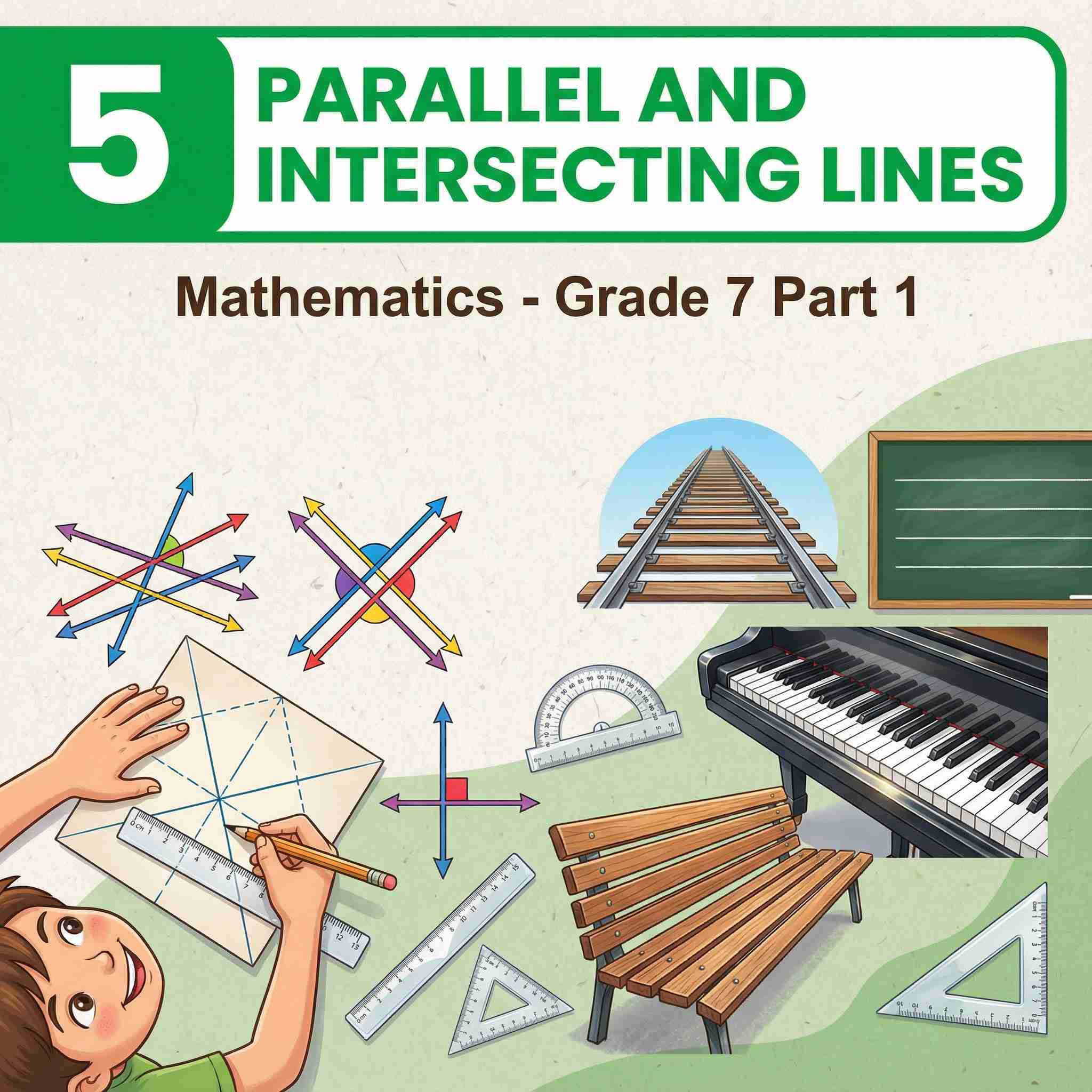
Parallel and Intersecting Lines
Class 7 Mathematics Chapter 5 | Complete Guide | Transversals, Corresponding Angles, Alternate Angles 2025
Chapter at a Glance – Parallel and Intersecting Lines
This chapter explores the relationships between lines on a plane surface, including intersecting lines, parallel lines, perpendicular lines, and the properties of angles formed by transversals.
Main Topics Covered
- Intersecting lines and angles formed
- Vertically opposite angles and linear pairs
- Perpendicular lines (lines meeting at 90°)
- Parallel lines (lines that never meet)
- Transversals and the angles they form
- Corresponding angles with parallel lines
- Alternate angles with parallel lines
- Interior angles on the same side of transversal
- Drawing parallel lines using set squares
Key Takeaways for Exams
Vertically Opposite Angles
Always equal when two lines intersect.
Linear Pairs
Adjacent angles that add up to 180°.
Perpendicular Lines
Intersect at 90° (right angles).
Parallel Lines
Never meet, lie on same plane.
Corresponding Angles
Equal when transversal crosses parallel lines.
Alternate Angles
Equal when transversal crosses parallel lines.
Key Concepts & Rules – Parallel and Intersecting Lines
Important definitions, properties of angles, and rules for parallel lines for quick reference.
Key Rules
- Intersecting Lines: Two lines that meet at a point form 4 angles.
- Vertically Opposite Angles: Always equal to each other.
- Linear Pair: Adjacent angles formed by intersecting lines; sum = 180°.
- Perpendicular Lines: Intersect at 90°; all four angles are right angles.
- Parallel Lines: Lines on same plane that never intersect.
- Transversal: A line that intersects two or more lines.
- Corresponding Angles: Equal if lines are parallel.
- Alternate Angles: Equal if lines are parallel.
- Interior Angles (Same Side): Sum = 180° if lines are parallel.
Angle Relationships
| Angle Type | Property | Condition |
|---|---|---|
| Vertically Opposite | Equal | Any intersecting lines |
| Linear Pair | Sum = 180° | Adjacent angles on a line |
| Corresponding | Equal | Transversal on parallel lines |
| Alternate | Equal | Transversal on parallel lines |
| Interior (Same Side) | Sum = 180° | Transversal on parallel lines |
Golden Lines for Exams
"When corresponding angles are equal, lines are parallel; When lines are parallel, corresponding and alternate angles are equal."
Concept Cards – Quick Explanations
Intersecting Lines
Two lines meeting at a point form 4 angles.
Exam Tip: Check vertically opposite angles are equal.
Vertically Opposite Angles
Opposite angles formed by intersecting lines are always equal.
Linear Pairs
Adjacent angles on a straight line always sum to 180°.
Perpendicular Lines
Lines intersecting at 90°; all four angles are right angles.
Parallel Lines
Lines that never meet on a plane surface.
Transversal
A line crossing two or more lines, forming 8 angles.
Corresponding Angles
In same position at each intersection; equal if parallel.
Alternate Angles
On opposite sides of transversal; equal if parallel.
Examples + Solutions
Example 1: Finding Angles with Intersecting Lines
Problem: Two lines intersect. If one angle is 120°, find all other angles.
Solution:
- Let ∠a = 120°
- ∠b = 180° - 120° = 60° (linear pair)
- ∠c = 120° (vertically opposite to ∠a)
- ∠d = 60° (vertically opposite to ∠b)
Answer: The four angles are 120°, 60°, 120°, 60°.
Example 2: Parallel Lines and Transversal (from textbook)
Problem: Parallel lines l and m are intersected by transversal t. If ∠6 = 135°, find all other angles.
Solution:
- ∠6 = 135°
- ∠2 = 135° (corresponding angle)
- ∠8 = 135° (vertically opposite to ∠6)
- ∠4 = 135° (corresponding to ∠8)
- ∠5 = 180° - 135° = 45° (linear pair with ∠6)
- ∠1 = 45° (corresponding to ∠5)
- ∠7 = 45° (vertically opposite to ∠5)
- ∠3 = 45° (corresponding to ∠7)
Answer: Angles 2, 4, 6, 8 = 135°; Angles 1, 3, 5, 7 = 45°
Example 3: Are Lines Parallel? (from textbook)
Problem: Lines l and m are intersected by transversal t. If ∠a = 120° and ∠f = 70°, are lines parallel?
Solution:
- ∠a = 120°, so ∠b = 180° - 120° = 60° (linear pair)
- ∠b and ∠f are corresponding angles
- ∠b = 60° but ∠f = 70°
- Since corresponding angles are NOT equal, lines are NOT parallel
Answer: No, lines l and m are not parallel.
Example 4: Interior Angles (from textbook)
Problem: Parallel lines l and m are intersected by transversal t. If ∠3 = 50°, find ∠6.
Solution:
- ∠3 = 50°
- ∠2 = 180° - 50° = 130° (linear pair with ∠3)
- ∠2 and ∠6 are corresponding angles
- Since lines are parallel, ∠6 = ∠2 = 130°
- Alternatively: ∠3 + ∠6 = 180° (interior angles same side)
- 50° + ∠6 = 180°, so ∠6 = 130°
Answer: ∠6 = 130°
Example 5: Quadrilateral with Parallel Sides (from textbook)
Problem: AB || CD and AD || BC. ∠DAC = 65° and ∠ADC = 60°. Find ∠CAB, ∠ABC, and ∠BCD.
Solution:
- AB || CD with transversal AD
- ∠ADC + ∠DAB = 180° (interior angles)
- 60° + ∠DAB = 180°, so ∠DAB = 120°
- ∠DAB = ∠DAC + ∠CAB
- 120° = 65° + ∠CAB, so ∠CAB = 55°
- AD || BC with transversal CD
- ∠ADC + ∠BCD = 180°
- 60° + ∠BCD = 180°, so ∠BCD = 120°
- Similarly, ∠ABC = 60°
Answer: ∠CAB = 55°, ∠ABC = 60°, ∠BCD = 120°
Figure it Out Solutions (All Solved)
Activity 1: Measuring Intersecting Lines
Draw two lines so they intersect. Measure the four angles.
Pattern Observed:
- Vertically opposite angles are equal
- Adjacent angles (linear pairs) add up to 180°
- If ∠a = 120°, then ∠b = 60°, ∠c = 120°, ∠d = 60°
Activity 2: Paper Folding - Parallel Lines
Fold paper horizontally, then vertically. How many parallel lines?
- First horizontal fold: 2 parallel lines (top and bottom edges)
- Second horizontal fold: 3 parallel lines
- Third horizontal fold: 4 parallel lines
- Pattern: n folds create n+1 parallel horizontal lines
- Vertical fold creates lines perpendicular to horizontal lines
- Diagonal fold: Cannot create parallel to diagonal without special construction
Page 113: Perpendicular Lines
1. Draw lines perpendicular to given lines on dot paper
Use a set square or protractor to draw lines at 90° to the given lines. Mark with square symbol.
2. Mark parallel lines and perpendicular lines
(a) Spotted perpendicular lines by checking if angles are 90°
(b) Spotted parallel lines by checking if they never meet and maintain equal distance
3. Draw different sets of parallel lines on dot paper
Draw multiple horizontal, vertical, and diagonal parallel line sets. Use dots as endpoints.
4. Draw lines parallel to given line segments
(a) Yes, some are challenging, especially diagonal ones
(b) Diagonal lines at angles other than 45° are harder
(c) Use visual judgment and maintain equal spacing
5. Which line is parallel to line a — line b or line c?
Decide by checking which line maintains equal distance from line a and never meets it. Use corresponding angles with a transversal to verify.
Page 119: Drawing Parallel Lines
Draw a line parallel to l through point A
Method 1: Draw perpendicular from A to line l. Then draw perpendicular to this line through A.
Method 2: Use set square - slide along ruler to maintain same angle.
Paper Folding Method: Fold perpendicular through A, then fold perpendicular to that through A again.
Page 123-125: Finding Angles
1. Find the marked angles
- a° with 48°: a = 180° - 48° = 132° (linear pair)
- b° with 52°: b = 52° (vertically opposite)
- c° with 81°, 99°: c = 180° - 81° = 99° (corresponding angles)
- d° with 81°, 99°: d = 81° (alternate angles)
- e° with 97°, 83°, 69°: e = 180° - 97° = 83° (linear pair)
- f° with 132°: f = 180° - 132° = 48° (interior angles same side)
- g° with 58°, 122°: g = 58° (corresponding angles)
- h° with 75°, 120°: h = 180° - 75° = 105°, then 180° - 120° = 60°, so h = 60°
- i° with 54°, 56°, 70°: Sum of angles = 180°, so i = 180° - 54° - 56° = 70°
- j° with 27°, 97°, 124°: j = 180° - 27° = 153°
2. Find angle a
- With 42°, 100°, 62°: a = 100° (vertically opposite to angle between 42° and given)
- With 110°, 35°: a = 180° - 110° - 35° = 35°
- With 67°: a = 180° - 67° = 113° (linear pair)
3. Find x and y
With 65°: x = 180° - 65° = 115° (linear pair), y = 65° (vertically opposite)
With 78°, 53°: x = 78° (corresponding), y = 180° - 78° - 53° = 49°
4. ∠ABC = 45°, ∠IKJ = 78°. Find ∠GEH, ∠HEF, ∠FED
- ∠GEH = 45° (corresponding to ∠ABC)
- ∠HEF = 78° (corresponding to ∠IKJ)
- ∠FED = 180° - 45° - 78° = 57°
5. AB || CD, CD || EF, EA ⊥ AB. ∠BEF = 55°, find x and y
- EA ⊥ AB means ∠EAB = 90°
- ∠BEF = 55°
- Since AB || CD: x = 90° (corresponding angle to ∠EAB)
- Since CD || EF: y = 180° - 55° = 125° (interior angles)
6. Find ∠NOP
Draw lines parallel to LM and PQ through N and O.
- Using 40°, 96°, 52°
- ∠NOP = 180° - 40° - 52° = 88°
Extra Practice Questions (Exam-Ready) – Chapter 5 Parallel and Intersecting Lines
20+ Questions • Categorized by Marks • With Detailed Solutions • Difficulty Tags
1-Mark Questions (Very Short Answer)
1. What are vertically opposite angles?
2. Define linear pair of angles.
3. When are two lines perpendicular?
4. What are parallel lines?
5. If ∠a = 65°, find its vertically opposite angle.
2-Mark Questions (Short Answer)
6. Two lines intersect. One angle is 75°. Find all four angles.
7. What is a transversal?
8. Define corresponding angles.
9. If two parallel lines are cut by transversal, ∠1 = 110°. Find corresponding angle.
10. Maximum distinct angles when transversal crosses two lines?
3-Mark Questions (Reasoning / Explanation)
11. Prove vertically opposite angles are equal.
12. How to check if two lines are parallel using transversal?
13. Parallel lines cut by transversal. ∠3 = 70°. Find ∠6 using interior angle property.
14. Why can two straight lines intersect at only one point?
15. Explain alternate angles with diagram.
4–5 Mark Questions (Application / Word Problems)
16. Lines l || m, transversal t. ∠2 = 125°. Find all 8 angles.
17. AB || CD, transversal PQ. ∠APQ = 50°, ∠PQC = 130°. Are lines parallel? Justify.
18. In quadrilateral ABCD, AB || DC and AD || BC. ∠A = 80°. Find all angles.
19. Three parallel lines cut by two transversals. ∠1 = 60°. Find 8 other angles.
20. How to draw parallel line through point using paper folding?
Common Mistakes & How to Avoid
Mistake 1: Confusing Angle Types
Mixing up corresponding and alternate angles.
Avoid: Remember position - corresponding in same position, alternate on opposite sides.
Mistake 2: Assuming Lines are Parallel
Not checking if corresponding angles are equal.
Avoid: Always verify angle equality before concluding lines are parallel.
Mistake 3: Wrong Linear Pair Calculation
Not adding to exactly 180°.
Avoid: Linear pairs ALWAYS sum to 180° on a straight line.
Mistake 4: Vertically Opposite ≠ Adjacent
Confusing vertically opposite with adjacent angles.
Avoid: Vertically opposite are across from each other, not next to each other.
Mistake 5: Interior Angles Wrong Side
Adding interior angles on different sides.
Avoid: Interior angles sum to 180° only on SAME side of transversal.
Mistake 6: Perpendicular = Parallel
Confusing perpendicular with parallel.
Avoid: Perpendicular lines MEET at 90°; parallel lines NEVER meet.
Quick Revision One-Pager & Mind Map
| Concept | Key Points |
|---|---|
| Intersecting Lines | Meet at point; form 4 angles; vertically opposite equal |
| Linear Pairs | Adjacent angles; sum = 180° |
| Perpendicular | Intersect at 90°; all angles are right angles |
| Parallel Lines | Never meet; same plane |
| Transversal | Crosses two+ lines; forms 8 angles |
| Corresponding | Same position; equal if parallel |
| Alternate | Opposite sides; equal if parallel |
| Interior Same Side | Sum = 180° if parallel |
Mind Map
Central: Lines and Angles
- Intersecting Lines:
- Vertically opposite angles (equal)
- Linear pairs (sum 180°)
- Perpendicular (90°)
- Parallel Lines:
- Never meet
- Transversals create patterns
- Corresponding angles equal
- Alternate angles equal
- Interior same side sum 180°
- How to Test:
- Check corresponding angles
- Check alternate angles
- Use set square to draw
- Paper folding method
Interactive Quiz – 15 Questions

Group Discussions
No forum posts available.
Easily Share with Your Tribe