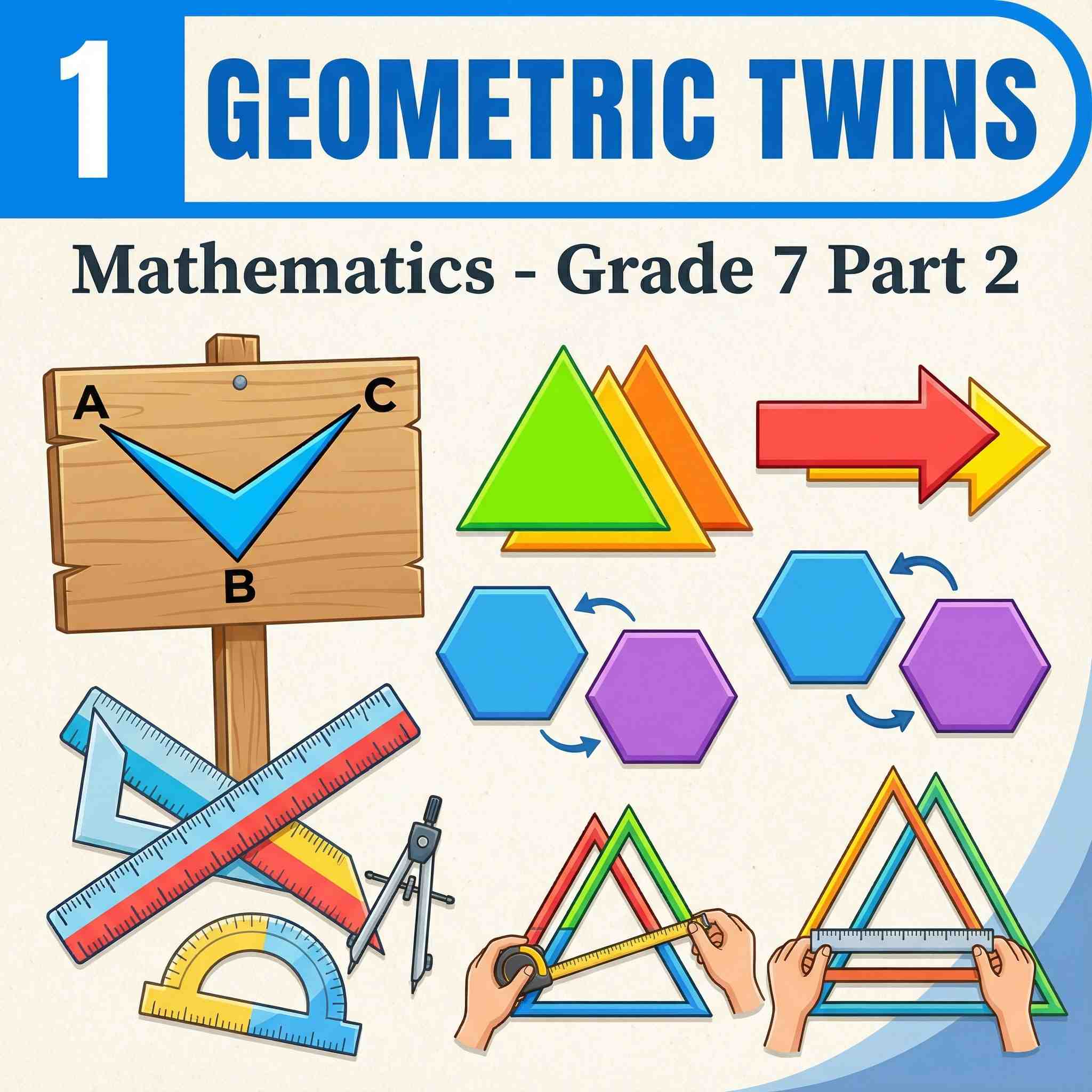
Complete Chapter 1 (Part II) guide: understanding congruent figures (same shape and size), how to check congruence by superimposing, congruence of triangles using Side-Side-Side (SSS), Side-Angle-Side (SAS), and Angle-Side-Angle (ASA) criteria, why Angle-Angle-Angle (AAA) and Side-Side-Angle (SSA) are not sufficient for congruence, identifying corresponding parts (CPCT) and writing congruence statements correctly, plus solved examples, construction steps and practice questions for CBSE Class 7 Maths
Updated: 5 months ago
Categories: Class 7 Mathematics, NCERT Maths Notes 2025, Geometry & Congruence, Triangle Constructions, CBSE Exam Preparation, Practice Questions & Quizzes
Tags: class 7 maths chapter 1 part 2 notes, geometric twins class 7, congruence of triangles meaning, congruent figures definition same shape and size, sss congruence criterion side side side, sas congruence criterion side angle side, asa congruence criterion angle side angle, rhs congruence rule right angle hypotenuse side, why aaa is not a congruence criterion, corresponding parts of congruent triangles cpct, writing congruence symbolic form, constructing congruent triangles steps, ganita prakash grade 7 part 2 chapter 1, cbse class 7 mathematics geometry part 2, ncert geometric twins solutions, extra questions mcq worksheet, class 7 maths blog summary quiz
Class 7 Mathematics Chapter 1 | Complete Guide | Congruence of figures, triangles, SSS SAS ASA AAS RHS conditions 2025
Chapter at a Glance – Geometric Twins
This chapter introduces congruence of figures and focuses on congruence of triangles using various conditions, along with properties of isosceles and equilateral triangles.
Main Topics Covered
Understanding congruent figures and how to recreate them
Congruence tests for circles and rectangles
Congruence of triangles: SSS, SAS, ASA, AAS, RHS conditions
Corresponding parts of congruent triangles
Properties of isosceles triangles (base angles equal)
Properties of equilateral triangles (all angles 60°)
Applications of congruent triangles in real life
Key Takeaways for Exams
Congruent Figures
Same shape and size, can be superimposed after rotation or flip
SSS Condition
Three sides equal → congruent
SAS Condition
Two sides and included angle equal → congruent
ASA Condition
Two angles and included side equal → congruent
AAS Condition
Two angles and non-included side equal → congruent
RHS Condition
Right angle, hypotenuse, one leg equal → congruent
Isosceles Triangle
Angles opposite equal sides are equal
Equilateral Triangle
All angles = 60°
Key Conditions & Rules – Geometric Twins
Important conditions for congruence and properties of triangles.
Congruence Conditions for Triangles
Condition
Description
When to Use
SSS
All three sides equal
When all side lengths are known and equal
SAS
Two sides and included angle equal
When two sides and the angle between them match
ASA
Two angles and included side equal
When two angles and the side between them match
AAS
Two angles and non-included side equal
When two angles and a side not between them match
RHS
Right angle, hypotenuse, one leg equal
For right-angled triangles
Other Rules
Figure
Congruence Check
Circle
Equal radii
Rectangle
Equal lengths and breadths
Triangle Properties
Isosceles Triangle: Angles opposite equal sides are equal
Equilateral Triangle: All angles are 60°
Corresponding Parts: In congruent triangles, corresponding vertices, sides, angles match
SSA: Does not always guarantee congruence (ambiguous case)
AAA: Similar but not necessarily congruent (same shape, different size)
Concept Cards – Quick Explanations
Congruent Figures
Exact copies: same shape and size. Can rotate/flip to superimpose.
SSS Condition
Three equal sides determine unique triangle shape and size.
SAS Condition
Two sides and included angle fix the triangle.
ASA Condition
Two angles and included side determine the triangle.
AAS Condition
Two angles and non-included side (third angle determined by sum 180°).
RHS Condition
For right triangles: right angle, hypotenuse, one leg.
Isosceles Property
Base angles equal (prove using altitude creating congruent triangles).
Equilateral Property
All angles 60° (from isosceles property thrice).
Corresponding Parts
In ≅ triangles, match vertices by order in notation (e.g., ΔABC ≅ ΔXYZ means A-X, B-Y, C-Z).
SSA Limitation
Can lead to two different triangles (ambiguous case).
AAA Limitation
Similar triangles, same shape but possibly different size.
Examples + Solutions
Example 1: Recreating a Symbol
Problem: Recreate a V-shaped symbol with arms AB=4cm, BC=8cm.
Solution: Side lengths alone allow multiple shapes. Add ∠ABC=80° to fix shape and size.
Explanation: Figures with same sides but different angles are not congruent.
Example 2: Congruent Figures Check
Problem: Check if two shapes can be superimposed after rotation/flip.
Solution: Use tracing paper to trace and overlay, allowing rotation and flip.
Explanation: Congruent if they fit exactly.
Example 3: Triangle with Sides 4cm, 6cm, 8cm
Problem: Is side lengths sufficient for unique triangle?
Solution: Construction shows two intersection points, but triangles are congruent (symmetric).
Explanation: SSS condition guarantees congruence.
Example 4: Rectangle Diagonals
Problem: In rectangle ABCD, show ΔABD ≅ ΔCDB.
Solution: AB=CD, AD=CB, BD common. SSS condition.
Explanation: Corresponding vertices: A-C, B-D, D-B? Correct: A-C, B-D, D-B no, adjust to ΔABD ≅ ΔCBD with A-C, B-B no, wait chapter has ΔABD ≅ ΔCDB with A-C, B-D, D-B.
Example 5: Midpoint O in AD and BC
Problem: O midpoint AD and BC. Find AB, CD lengths.
Solution: AO=OD, BO=OC, ∠AOB=∠DOC (vert opp). SAS, so AB=DC.
Explanation: Corresponding sides equal.
Example 6: Isosceles Triangle
Problem: AB=AC, ∠A=80°. Find ∠B, ∠C.
Solution: Altitude AD to BC. ΔADB ≅ ΔADC by RHS (AB=AC, ∠ADB=∠ADC=90°, AD common). So ∠B=∠C. Sum 180°, so ∠B=∠C=50°.
Example 7: Equilateral Angles
Problem: Find angles in equilateral triangle.
Solution: All sides equal, so all angles equal (from isosceles property). 3 angles = 180°, each 60°.
Figure it Out Solutions (All Solved)
Section 1.1 - Page 3
1. Check if the two figures are congruent.
No, one is straight line, other has kink. Cannot superimpose even with rotation/flip.