Class 7 Maths (Part II) Chapter 2 : Operations with Integers | Number Puzzles, Token Model for Multiplication, Division Rules & Practical Problems
Complete Chapter 2 (Part II) guide: Rakesh's number puzzles (sum and difference), modelling integer movement on a line (carrom strikes, direction), using colored tokens (positive/negative) to understand addition, subtraction and multiplication, rules for multiplying and dividing integers (signs logic), properties like commutativity, associativity and distributivity, Collatz conjecture with integers, temperature drops, plus solved examples and practice questions for CBSE Class 7 Maths
Updated: 6 months ago
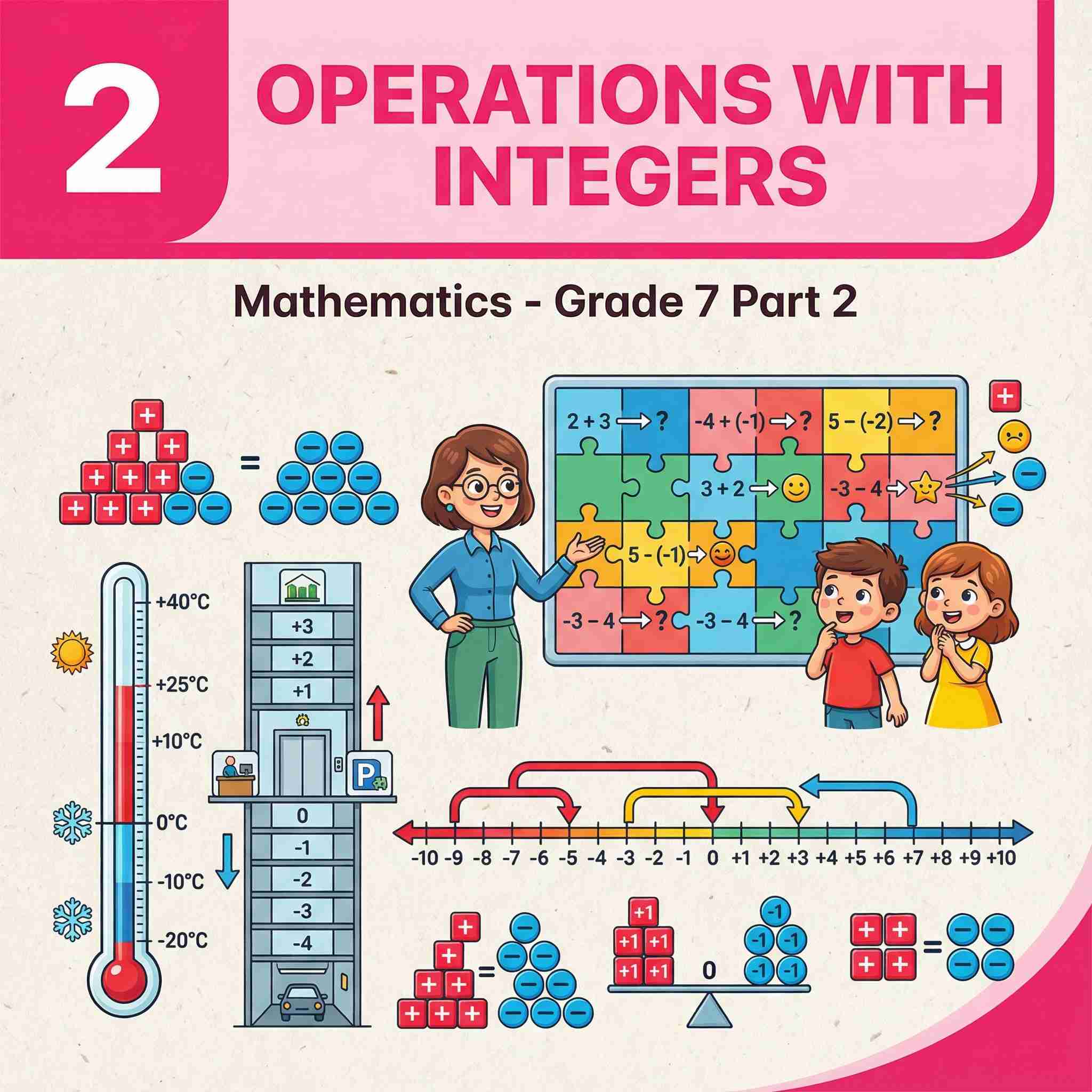
Operations with Integers
Class 7 Mathematics Chapter 2 | Complete Guide | Operations on positive and negative numbers 2025
Chapter at a Glance – Operations with Integers
This chapter recaps integers and explores operations like addition, subtraction, multiplication, and division using models like tokens and number lines.
Main Topics Covered
- Recap of integers using puzzles and carrom coin model
- Addition and subtraction with token model
- Multiplication of integers using token model for all sign combinations
- Patterns in integer multiplication
- Division of integers and rules for signs
- Properties: commutative, associative, distributive
- Expressions with integers and pick the pattern
- Applications in exams, elevators, temperature, profit/loss
- Magic grids and Terhüchü game
Key Takeaways for Exams
Sign Rules Multiplication
(+) × (+) = (+), (-) × (-) = (+), (+) × (-) = (-)
Sign Rules Division
Same as multiplication for quotient signs
Additive Inverse
-a for a, used in subtraction as addition of inverse
Commutative
a × b = b × a
Associative
(a × b) × c = a × (b × c)
Distributive
a × (b + c) = a × b + a × c
Identity
1 × a = a, -1 × a = -a
Token Model
Green +, red -, zero pairs for operations


As an Amazon Associate, ProSyllabus earns from qualifying purchases. Prices shown are subject to change.
Test your CBSE Class 7 Annual Assessment prep
Quizzes
10 questions · ~10 minutes · instant rank & AI diagnosis
Integers and Rational Numbers Fundamentals | CBSE Class 7 Annual Assessment
Class 7 Social Science — Banks and the Magic of Finance (Practice Quiz)
Class 7 Social Science — Infrastructure: Engine of India's Development (Practice Quiz)
Class 7 Social Science — The State, the Government, and You (Practice Quiz)
Class 7 Social Science — India, a Home to Many (Practice Quiz)
Class 7 Social Science — Turning Tides: 11th and 12th Centuries (Practice Quiz)
Class 7 Social Science — Empires and Kingdoms: 6th to 10th Centuries (Practice Quiz)
Class 7 Social Science — India and Her Neighbours (Practice Quiz)
Class 7 Social Science — The Story of Indian Farming (Practice Quiz)
Class 7 Social Science — Understanding Markets (Practice Quiz)
Class 7 Social Science — From Barter to Money (Practice Quiz)
Class 7 Social Science — The Constitution of India — An Introduction (Practice Quiz)
Class 7 Social Science — From the Rulers to the Ruled: Types of Governments (Practice Quiz)
Class 7 Social Science — How the Land Becomes Sacred (Practice Quiz)
Class 7 Social Science — The Gupta Era: An Age of Tireless Creativity (Practice Quiz)
Class 7 Social Science — The Age of Reorganisation (Practice Quiz)
Class 7 Social Science — The Rise of Empires (Practice Quiz)
Class 7 Social Science — New Beginnings: Cities and States (Practice Quiz)
Class 7 Social Science — Climates of India (Practice Quiz)
Class 7 Social Science — Understanding the Weather (Practice Quiz)
Class 7 Social Science — Geographical Diversity of India (Practice Quiz)
Class 7 Sanskrit — परिशिष्टम् २ — धातुरूपाणि एवं सन्धि-परिचयः (Practice Quiz)
Class 7 Sanskrit — परिशिष्टम् १ — शब्दरूपाणि (Practice Quiz)
Class 7 Sanskrit — वर्णमात्रा-परिचयः (Practice Quiz)
Class 7 Sanskrit — वीराङ्गना पन्नाधाया (Practice Quiz)
Class 7 Sanskrit — द्वीपेषु रम्यः द्वीपोऽण्डमानः (Practice Quiz)
Class 7 Sanskrit — दशमः कः? (Practice Quiz)
Class 7 Sanskrit — अन्नाद् भवन्ति भूतानि (Practice Quiz)
Class 7 Sanskrit — हितं मनोहारि च दुर्लभं वचः (Practice Quiz)
Class 7 Sanskrit — ईशावास्यम् इदं सर्वम् (Practice Quiz)
Class 7 Sanskrit — क्रीडाम वयं श्लोकान्त्याक्षरीम् (Practice Quiz)
Class 7 Sanskrit — सेवा हि परमो धर्मः (Practice Quiz)
Class 7 Sanskrit — न लभ्यते चेत् आम्लं द्राक्षाफलम् (Practice Quiz)
Class 7 Sanskrit — मित्राय नमः (Practice Quiz)
Class 7 Sanskrit — नित्यं पिबामः सुभाषितरसम् (Practice Quiz)
Class 7 Sanskrit — वन्दे भारतमातरम् (Practice Quiz)
Class 7 Hindi — मीरा के पद (Practice Quiz)
Class 7 Hindi — चिड़िया (Practice Quiz)
Class 7 Hindi — बिरजू महाराज से साक्षात्कार (Practice Quiz)
Class 7 Hindi — वर्षा-बहार (Practice Quiz)
Class 7 Hindi — गिरिधर कविराय की कुंडलियाँ (Practice Quiz)
Class 7 Hindi — नहीं होना बीमार (Practice Quiz)
Class 7 Hindi — पानी रे पानी (Practice Quiz)
Class 7 Hindi — फूल और काँटा (Practice Quiz)
Class 7 Hindi — तीन बुद्धिमान (Practice Quiz)
Class 7 Hindi — माँ, कह एक कहानी (Practice Quiz)
Class 7 English — Bravehearts (Practice Quiz)
Class 7 English — Travel and Adventure (Practice Quiz)
Class 7 English — Dreams and Discoveries (Practice Quiz)
Class 7 English — Wit and Humour (Practice Quiz)
Class 7 English — Learning Together (Practice Quiz)
Class 7 Maths — Finding the Unknown (Practice Quiz)
Class 7 Maths — Constructions and Tilings (Practice Quiz)
Class 7 Maths — Connecting the Dots… (Practice Quiz)
Class 7 Maths — Another Peek Beyond the Point (Practice Quiz)
Class 7 Maths — Finding Common Ground (Practice Quiz)
Class 7 Maths — Operations with Integers (Practice Quiz)
Class 7 Maths — Geometric Twins (Practice Quiz)
Class 7 Maths — Working with Fractions (Practice Quiz)
Class 7 Maths — A Tale of Three Intersecting Lines (Practice Quiz)
Class 7 Maths — Number Play (Practice Quiz)
Class 7 Maths — Parallel and Intersecting Lines (Practice Quiz)
Class 7 Maths — Expressions Using Letter-Numbers (Practice Quiz)
Class 7 Maths — A Peek Beyond the Point (Practice Quiz)
Class 7 Maths — Arithmetic Expressions (Practice Quiz)
Class 7 Maths — Large Numbers Around Us (Practice Quiz)
Class 7 Science — Earth, Moon, and the Sun (Practice Quiz)
Class 7 Science — Light: Shadows and Reflections (Practice Quiz)
Class 7 Science — Life Processes in Plants (Practice Quiz)
Class 7 Science — Life Processes in Animals (Practice Quiz)
Class 7 Science — Measurement of Time and Motion (Practice Quiz)
Class 7 Science — Heat Transfer in Nature (Practice Quiz)
Class 7 Science — Adolescence: A Stage of Growth and Change (Practice Quiz)
Class 7 Science — Changes Around Us: Physical and Chemical (Practice Quiz)
Class 7 Science — The World of Metals and Non-metals (Practice Quiz)
Class 7 Science — Electricity: Circuits and their Components (Practice Quiz)
Class 7 Science — Exploring Substances: Acidic, Basic, and Neutral (Practice Quiz)
Class 7 Science — The Ever-Evolving World of Science (Practice Quiz)
Simple Equations and Applications Practice Quiz | CBSE Class 7 Annual Assessment
Visualising Solid Shapes Advanced Challenge | CBSE Class 7 Annual Assessment
Tracing Changes Through Time Fundamentals | CBSE Class 7 Annual Assessment
Nutrition in Plants Fundamentals | CBSE Class 7 Annual Assessment

Group Discussions
No forum posts available.


