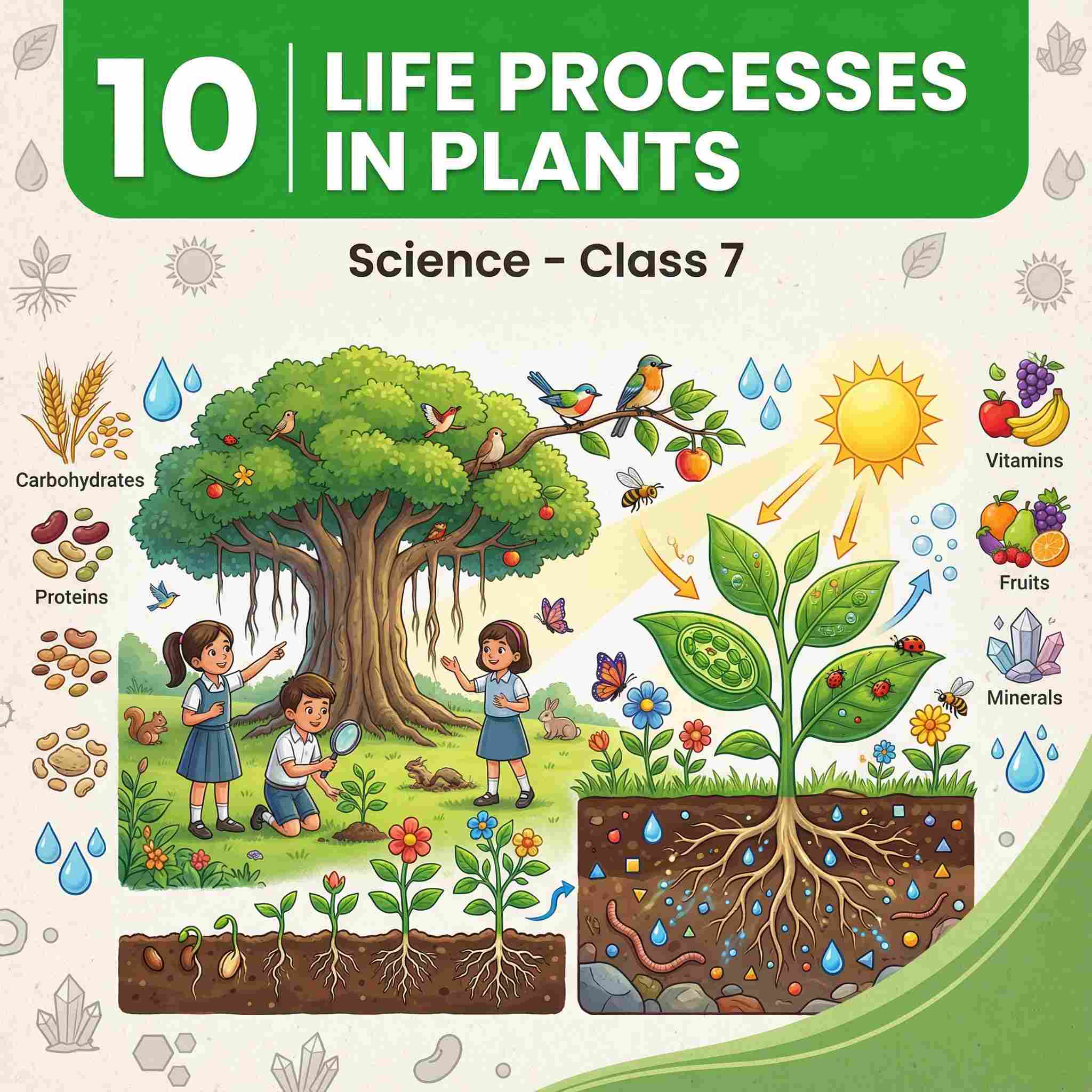
Full Chapter Summary & Detailed Notes - Life Processes in Plants
Introduction
Plants, like animals, are living organisms that grow and need food. Unlike animals, plants do not eat ready-made food. They make their own food through a process called photosynthesis. This chapter explains how plants grow, how they prepare their food, and how they transport water and nutrients.
10.1 How Do Plants Grow?
When a plant grows, we observe:
New leaves and branches appear
Height of the plant increases
Stem becomes thicker
Students often think water, sunlight, or soil nutrients help growth. To test this, we perform Activity 10.1.
Activity 10.1 – Role of Sunlight and Water in Plant Growth
Pot
Condition
Expected Result after 2 weeks
A
In direct sunlight + regular water
Maximum growth, healthy green leaves, many new leaves, increased height
All important terms from "Life Processes in Plants" with detailed explanations, examples, exam notes, and diagrams reference.
Autotrophic Nutrition
Detailed Explanation: Mode of nutrition in which organisms make their own food from simple inorganic substances (CO₂, H₂O) using sunlight energy. Plants are the best example.
Example: All green plants, algae, some bacteria.
Exam Note: Opposite of heterotrophic nutrition (animals, fungi, non-green plants). Most frequently asked difference in exams.
Key Point: Only autotrophs can convert solar energy into chemical energy.
Photosynthesis
Detailed Explanation: The process by which green plants use sunlight, CO₂ and water to synthesize glucose (food) and release oxygen as by-product.
Balanced Equation: 6CO₂ + 6H₂O → C₆H₁₂O₆ + 6O₂ (in presence of sunlight + chlorophyll)
Site: Chloroplasts in leaf cells
Exam Note: Must remember raw materials, products, and conditions. Often asked: "Why is photosynthesis called food-making factory of plant?"
Chlorophyll
Detailed Explanation: Green pigment present in chloroplasts that absorbs sunlight (mainly red & blue wavelengths) and converts it into chemical energy.
Reason for green colour: Reflects green light.
Exam Note: Absence → no photosynthesis → yellow/white leaves (chlorosis). Activity 10.1 Pot C shows yellow leaves due to lack of chlorophyll synthesis in dark.
Stomata
Detailed Explanation: Tiny pores mainly on lower surface of leaves surrounded by guard cells. Allow exchange of gases (CO₂ in, O₂ out) and water vapour during transpiration.
Number: Thousands per leaf
Exam Note: Open in day (for photosynthesis), partially closed at night. Guard cells control opening/closing by changing shape with water content.
Xylem
Detailed Explanation: Vascular tissue that transports water and dissolved minerals from roots to leaves (upward movement only). Made of dead tubular cells.
Driving force: Transpiration pull
Exam Note: Compare with phloem. Often asked: "Which tissue carries water upwards?"
Phloem
Detailed Explanation: Living vascular tissue that transports food (glucose/sucrose) from leaves to all parts of plant (both directions).
Process: Translocation
Exam Note: Remember direction: Xylem = one way up, Phloem = both ways. Damage to phloem → food starvation in roots.
Transpiration
Detailed Explanation: Loss of water in the form of water vapour from aerial parts (mainly leaves) through stomata.
Benefits: Creates suction pull for water transport, cools the plant, maintains turgidity.
Exam Note: Excessive transpiration → wilting (like Pot B in Activity 10.1). Most water absorbed by roots is lost through transpiration.
Parasitic Nutrition
Detailed Explanation: Mode where organism derives food from another living organism (host) without killing it. No chlorophyll.
(ii) The process by which plants make their food is
(c) photosynthesis
(iii) The tiny pores present on the surface of leaves are called
(b) stomata
(iv) The tissue that transports food in plants is
(c) phloem
(v) Loss of water in the form of vapour from aerial parts of the plant is known as
(a) transpiration
2. Fill in the blanks.
(i) Plants take carbon dioxide from air through stomata.
(ii) The green pigment in leaves is chlorophyll.
(iii) Water is transported in plants through xylem.
(iv) Cuscuta is an example of a parasite.
(v) Pitcher plant is an insectivorous plant.
3. Give one word for the following.
(i) Food-making process in plants → photosynthesis
(ii) Green pigment that traps sunlight → chlorophyll
(iii) Loss of water vapour from leaves → transpiration
(iv) Plant that traps insects → insectivorous plant
(v) Relationship where both organisms benefit → symbiosis
4. State whether the following statements are True or False.
(i) Plants need sunlight and water for growth. → True
(ii) Photosynthesis takes place only at night. → False (mainly in day)
(iii) Xylem transports food from leaves to other parts. → False (phloem does)
(iv) Transpiration helps in upward movement of water. → True
(v) Mushroom is an autotrophic plant. → False (saprophyte)
5. Short Answer Questions
(a) What is photosynthesis?
The process by which green plants use sunlight, carbon dioxide and water in the presence of chlorophyll to make their own food (glucose) and release oxygen.
(b) Write the balanced equation of photosynthesis.
6CO₂ + 6H₂O → C₆H₁₂O₆ + 6O₂ (sunlight + chlorophyll)
(c) Why was the plant in Pot C yellow in Activity 10.1?
No sunlight → no chlorophyll synthesis → leaves turned yellow (chlorosis).
(d) Name two special modes of nutrition in plants.
Parasitic (Cuscuta) and insectivorous (Pitcher plant, Venus flytrap).
6. Long Answer Questions
(a) Explain the role of sunlight and water in plant growth with reference to Activity 10.1.
Pot A (sunlight + water) → maximum healthy growth.
Pot B (sunlight but no water) → wilted/died.
Pot C (water but no sunlight) → yellow leaves, poor growth.
Conclusion: Sunlight is needed for photosynthesis (food making) and chlorophyll formation; water is needed for photosynthesis, transport and maintaining turgidity.
(b) Differentiate between xylem and phloem.
Xylem
Phloem
Transports water & minerals
Transports food (glucose)
From roots → leaves (upward)
Leaves → all parts (both directions)
Made of dead cells
Made of living cells
No translocation of food
Translocates food
(c) Describe any two special types of nutrition in plants with examples.
• Parasitic: Cuscuta (amarbel) has no chlorophyll; it twines around host plant and absorbs ready food through haustoria.
• Insectivorous: Pitcher plant – leaf modified into pitcher with digestive juices; insects fall in and are digested for nitrogen.
7. Give reasons.
(i) Leaves are green in colour.
→ Because they contain the green pigment chlorophyll.
(ii) Excessive transpiration causes wilting.
→ Loss of too much water makes cells flaccid; plant loses turgidity and droops.
(iii) Plants kept in dark become yellow.
→ No sunlight → no new chlorophyll formation → existing chlorophyll breaks down → leaves turn yellow.
8. Draw a labelled diagram of a leaf showing stomata.
(Students should draw a leaf with lower epidermis showing guard cells and stomatal pore.)
Key Concepts - In-Depth Exploration (Chapter 10)
Core ideas explained with examples, common confusions, and exam connections for "Life Processes in Plants".
Photosynthesis
Process: CO2 + H2O → Glucose + O2 Example: Green leaves in sun Exam Note: Needs light/chlorophyll Confusion: Happens only in day
Autotrophic Nutrition
Definition: Self-made food Example: Most plants Exam Trick: Vs heterotrophic
Transpiration
Process: Water evaporation from leaves Example: Pulls water up Key Point: Cooling effect
Xylem & Phloem
Xylem: Water up Phloem: Food down Exam Must-Know: Vascular tissues
Respiration
Process: Glucose + O2 → CO2 + H2O + energy Example: Night/day
Exam Master Tips:
Mnemonics: "SWCN" = Sunlight, Water, CO2, Nutrients for growth
Growth Needs: Sun + Water (Activity 10.1)
Photosynthesis: Light energy to chemical
Most Asked: Activity results, photosynthesis equation
Historical & Social Insights - Plant Life Processes
Evolution of understanding plant nutrition and growth.
3 attempts on CBSE Class 7 Annual Assessment quizzes
HIMAKSHI GUPTA . scored 2/10 on Integers and Rational Numbers Naavya Agarwal scored 0/10 on Integers and Rational Numbers Anshika Yadav scored 0/10 on Integers and Rational Numbers HIMAKSHI GUPTA . scored 2/10 on Integers and Rational Numbers Naavya Agarwal scored 0/10 on Integers and Rational Numbers Anshika Yadav scored 0/10 on Integers and Rational Numbers
#1
Integers and Rational Numbers Fundamentals | CBSE Class 7 Annual Assessment
10 Qs · ~10 min
#2
Class 7 Social Science — Banks and the Magic of Finance (Practice Quiz)
10 Qs · ~10 min
#3
Class 7 Social Science — Infrastructure: Engine of India's Development (Practice Quiz)
10 Qs · ~10 min
#4
Class 7 Social Science — The State, the Government, and You (Practice Quiz)
10 Qs · ~10 min
#5
Class 7 Social Science — India, a Home to Many (Practice Quiz)
10 Qs · ~10 min
#6
Class 7 Social Science — Turning Tides: 11th and 12th Centuries (Practice Quiz)
10 Qs · ~10 min
#7
Class 7 Social Science — Empires and Kingdoms: 6th to 10th Centuries (Practice Quiz)
10 Qs · ~10 min
#8
Class 7 Social Science — India and Her Neighbours (Practice Quiz)
10 Qs · ~10 min
#9
Class 7 Social Science — The Story of Indian Farming (Practice Quiz)
10 Qs · ~10 min
#10
Class 7 Social Science — Understanding Markets (Practice Quiz)
10 Qs · ~10 min
#11
Class 7 Social Science — From Barter to Money (Practice Quiz)
10 Qs · ~10 min
#12
Class 7 Social Science — The Constitution of India — An Introduction (Practice Quiz)
10 Qs · ~10 min
#13
Class 7 Social Science — From the Rulers to the Ruled: Types of Governments (Practice Quiz)
10 Qs · ~10 min
#14
Class 7 Social Science — How the Land Becomes Sacred (Practice Quiz)
10 Qs · ~10 min
#15
Class 7 Social Science — The Gupta Era: An Age of Tireless Creativity (Practice Quiz)
10 Qs · ~10 min
#16
Class 7 Social Science — The Age of Reorganisation (Practice Quiz)
10 Qs · ~10 min
#17
Class 7 Social Science — The Rise of Empires (Practice Quiz)
10 Qs · ~10 min
#18
Class 7 Social Science — New Beginnings: Cities and States (Practice Quiz)
10 Qs · ~10 min
#19
Class 7 Social Science — Climates of India (Practice Quiz)
10 Qs · ~10 min
#20
Class 7 Social Science — Understanding the Weather (Practice Quiz)
10 Qs · ~10 min
#21
Class 7 Social Science — Geographical Diversity of India (Practice Quiz)
10 Qs · ~10 min
#22
Class 7 Sanskrit — परिशिष्टम् २ — धातुरूपाणि एवं सन्धि-परिचयः (Practice Quiz)
10 Qs · ~10 min
#23
Class 7 Sanskrit — परिशिष्टम् १ — शब्दरूपाणि (Practice Quiz)
10 Qs · ~10 min
#24
Class 7 Sanskrit — वर्णमात्रा-परिचयः (Practice Quiz)
10 Qs · ~10 min
#25
Class 7 Sanskrit — वीराङ्गना पन्नाधाया (Practice Quiz)
10 Qs · ~10 min
#26
Class 7 Sanskrit — द्वीपेषु रम्यः द्वीपोऽण्डमानः (Practice Quiz)
10 Qs · ~10 min
#27
Class 7 Sanskrit — दशमः कः? (Practice Quiz)
10 Qs · ~10 min
#28
Class 7 Sanskrit — अन्नाद् भवन्ति भूतानि (Practice Quiz)
10 Qs · ~10 min
#29
Class 7 Sanskrit — हितं मनोहारि च दुर्लभं वचः (Practice Quiz)
10 Qs · ~10 min
#30
Class 7 Sanskrit — ईशावास्यम् इदं सर्वम् (Practice Quiz)
10 Qs · ~10 min
#31
Class 7 Sanskrit — क्रीडाम वयं श्लोकान्त्याक्षरीम् (Practice Quiz)
10 Qs · ~10 min
#32
Class 7 Sanskrit — सेवा हि परमो धर्मः (Practice Quiz)
10 Qs · ~10 min
#33
Class 7 Sanskrit — न लभ्यते चेत् आम्लं द्राक्षाफलम् (Practice Quiz)
10 Qs · ~10 min
#34
Class 7 Sanskrit — मित्राय नमः (Practice Quiz)
10 Qs · ~10 min
#35
Class 7 Sanskrit — नित्यं पिबामः सुभाषितरसम् (Practice Quiz)
10 Qs · ~10 min
#36
Class 7 Sanskrit — वन्दे भारतमातरम् (Practice Quiz)
10 Qs · ~10 min
#37
Class 7 Hindi — मीरा के पद (Practice Quiz)
10 Qs · ~10 min
#38
Class 7 Hindi — चिड़िया (Practice Quiz)
10 Qs · ~10 min
#39
Class 7 Hindi — बिरजू महाराज से साक्षात्कार (Practice Quiz)
10 Qs · ~10 min
#40
Class 7 Hindi — वर्षा-बहार (Practice Quiz)
10 Qs · ~10 min
#41
Class 7 Hindi — गिरिधर कविराय की कुंडलियाँ (Practice Quiz)
10 Qs · ~10 min
#42
Class 7 Hindi — नहीं होना बीमार (Practice Quiz)
10 Qs · ~10 min
#43
Class 7 Hindi — पानी रे पानी (Practice Quiz)
10 Qs · ~10 min
#44
Class 7 Hindi — फूल और काँटा (Practice Quiz)
10 Qs · ~10 min
#45
Class 7 Hindi — तीन बुद्धिमान (Practice Quiz)
10 Qs · ~10 min
#46
Class 7 Hindi — माँ, कह एक कहानी (Practice Quiz)
10 Qs · ~10 min
#47
Class 7 English — Bravehearts (Practice Quiz)
10 Qs · ~10 min
#48
Class 7 English — Travel and Adventure (Practice Quiz)
10 Qs · ~10 min
#49
Class 7 English — Dreams and Discoveries (Practice Quiz)
10 Qs · ~10 min
#50
Class 7 English — Wit and Humour (Practice Quiz)
10 Qs · ~10 min
#51
Class 7 English — Learning Together (Practice Quiz)
10 Qs · ~10 min
#52
Class 7 Maths — Finding the Unknown (Practice Quiz)
10 Qs · ~10 min
#53
Class 7 Maths — Constructions and Tilings (Practice Quiz)
10 Qs · ~10 min
#54
Class 7 Maths — Connecting the Dots… (Practice Quiz)
10 Qs · ~10 min
#55
Class 7 Maths — Another Peek Beyond the Point (Practice Quiz)
10 Qs · ~10 min
#56
Class 7 Maths — Finding Common Ground (Practice Quiz)
10 Qs · ~10 min
#57
Class 7 Maths — Operations with Integers (Practice Quiz)
10 Qs · ~10 min
#58
Class 7 Maths — Geometric Twins (Practice Quiz)
10 Qs · ~10 min
#59
Class 7 Maths — Working with Fractions (Practice Quiz)
10 Qs · ~10 min
#60
Class 7 Maths — A Tale of Three Intersecting Lines (Practice Quiz)
10 Qs · ~10 min
#61
Class 7 Maths — Number Play (Practice Quiz)
10 Qs · ~10 min
#62
Class 7 Maths — Parallel and Intersecting Lines (Practice Quiz)
10 Qs · ~10 min
#63
Class 7 Maths — Expressions Using Letter-Numbers (Practice Quiz)
10 Qs · ~10 min
#64
Class 7 Maths — A Peek Beyond the Point (Practice Quiz)
10 Qs · ~10 min
#65
Class 7 Maths — Arithmetic Expressions (Practice Quiz)
10 Qs · ~10 min
#66
Class 7 Maths — Large Numbers Around Us (Practice Quiz)
10 Qs · ~10 min
#67
Class 7 Science — Earth, Moon, and the Sun (Practice Quiz)
10 Qs · ~10 min
#68
Class 7 Science — Light: Shadows and Reflections (Practice Quiz)
10 Qs · ~10 min
#69
Class 7 Science — Life Processes in Plants (Practice Quiz)
10 Qs · ~10 min
#70
Class 7 Science — Life Processes in Animals (Practice Quiz)
10 Qs · ~10 min
#71
Class 7 Science — Measurement of Time and Motion (Practice Quiz)
10 Qs · ~10 min
#72
Class 7 Science — Heat Transfer in Nature (Practice Quiz)
10 Qs · ~10 min
#73
Class 7 Science — Adolescence: A Stage of Growth and Change (Practice Quiz)
10 Qs · ~10 min
#74
Class 7 Science — Changes Around Us: Physical and Chemical (Practice Quiz)
10 Qs · ~10 min
#75
Class 7 Science — The World of Metals and Non-metals (Practice Quiz)
10 Qs · ~10 min
#76
Class 7 Science — Electricity: Circuits and their Components (Practice Quiz)
10 Qs · ~10 min
#77
Class 7 Science — Exploring Substances: Acidic, Basic, and Neutral (Practice Quiz)
10 Qs · ~10 min
#78
Class 7 Science — The Ever-Evolving World of Science (Practice Quiz)
10 Qs · ~10 min
#79
Simple Equations and Applications Practice Quiz | CBSE Class 7 Annual Assessment