Class 7 Science Chapter 4: The World of Metals and Non-metals | Complete NCERT Notes, Activities, Questions & Answers
Full Chapter Summary with Properties Tables, All Activities 4.1-4.8 Solved Step-by-Step, NCERT "Let Us Enhance Our Learning" Questions, 20+ Extra Practice Questions & Answers, Quick Revision Notes, Mnemonics, Real-Life Examples for CBSE Board Exams
Updated: 6 months ago
Categories: Class 7 Science, NCERT Notes, Metals and Non-metals, CBSE Exam Preparation, Science Study Guides, Curiosity Textbook, Properties of Metals, Rusting and Corrosion, Chapter 4 Notes, Activity Solutions, Revision Notes
Tags: class 7 science chapter 4, metals and non-metals notes, ncert class 7 science, properties of metals, rusting of iron, malleability ductility sonority, metal oxides basic, non-metal oxides acidic, cbse class 7 notes 2025, chapter 4 science guide, iron pillar delhi, galvanisation, conductors insulators, activity 4.1 4.5 solutions, let us enhance our learning answers, science revision notes, exam preparation class 7, curiosity textbook notes
The World of Metals and Non-metals - Class 7 Science Chapter 4 Ultimate Study Guide 2025
The World of Metals and Non-metals
Chapter 4: Curiosity Textbook of Science - Grade 7 | Ultimate Study Guide | NCERT Class 7 Notes, Activities, Examples & Extra Q&A 2025
Full Chapter Summary & Detailed Notes - The World of Metals and Non-metals
Overview & Chapter Goal
Chapter Goal: Understand what metals and non-metals are, compare their properties, and see how these properties decide their uses in daily life. Focus on malleability, ductility, sonority, conduction, corrosion, and importance of non-metals.
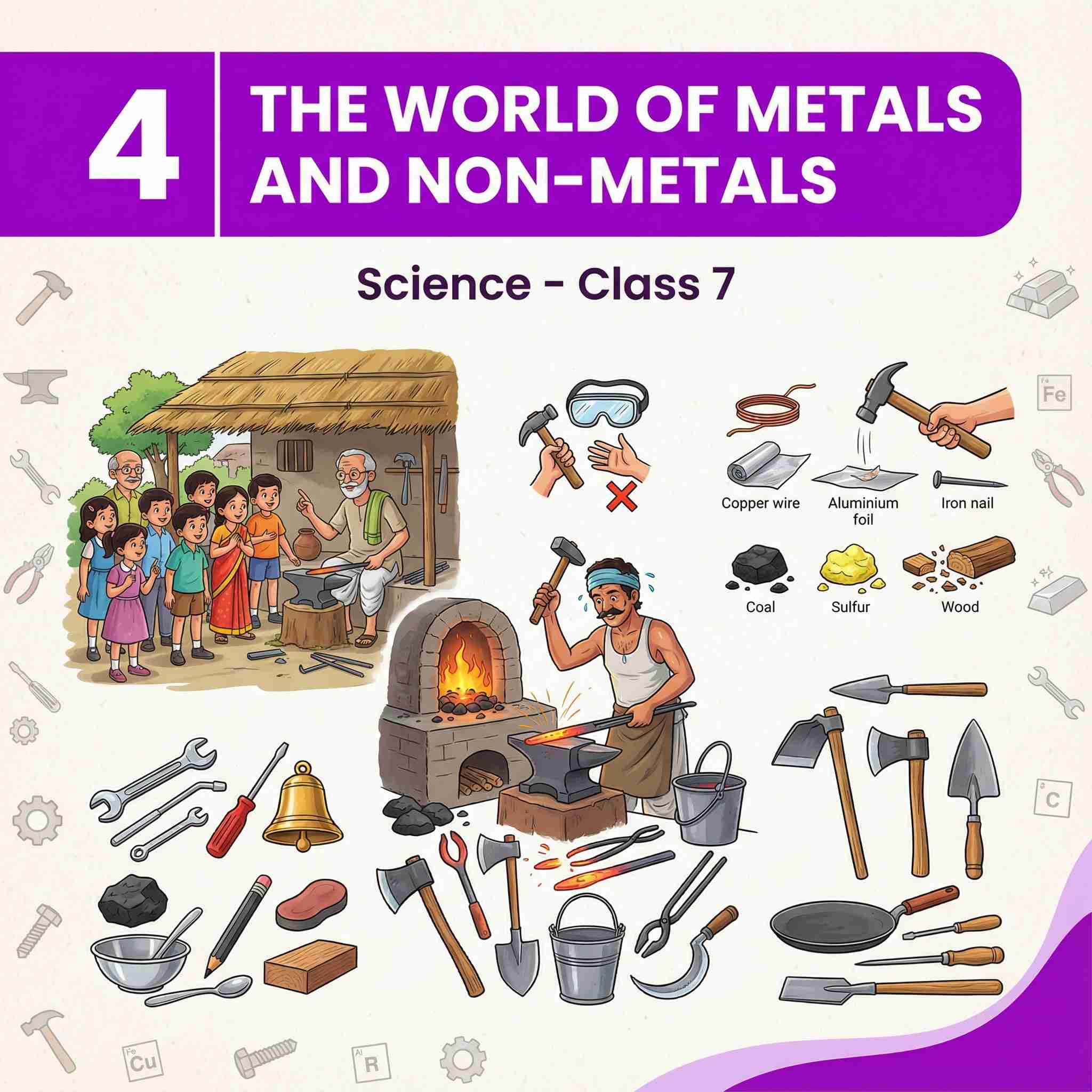
Story Start: Yashwant and Anandi visit an ironsmith in Rajasthan and watch how an iron block is heated and beaten into tools like axes and spades. This leads to questions like: “Can all materials be beaten into sheets like this?”
Exam Focus (2025): Properties table (lustrous/non-lustrous, malleable/brittle, conductor/insulator), rusting and prevention, difference between metals and non-metals, NCERT “Let Us Enhance Our Learning” questions, and daily life applications.
Fig. 4.1: Ironsmith at Work
Children observe an ironsmith heating iron till red hot and beating it into flat tools; this shows malleability of metals.
4.1 Properties of Materials
Malleability
Metals like copper, aluminium, and iron are hard, lustrous, and malleable—they can be beaten into thin sheets without breaking. Thin foils of silver and aluminium (for sweets and wrapping food) are examples of malleability.
Non-metals like coal and sulfur are brittle—they break into pieces when hammered instead of flattening. Wood is neither malleable nor brittle in this sense.
Ductility
Ductility means the ability of a material to be drawn into thin wires. Copper and aluminium wires used in electrical wiring and strings in instruments like veena, sitar, violin are ductile metals.
Gold is extremely ductile; a very small mass can be drawn into a very long wire. Coal and sulfur cannot be drawn into wires, so they are not ductile.
Sonority
When a metal spoon or coin is dropped, it makes a clear ringing sound. This property of producing a ringing sound is called sonority; metals are sonorous.
Coal and wood give dull sounds on dropping; they are not sonorous. School bells, temple bells, and ghungroos use metals for this reason.
Conduction of Heat and Electricity
Metals like copper and aluminium are good conductors of heat; they quickly become hot when their lower parts are placed in hot water. That is why cooking vessels are metal, while handles are wood or plastic (poor conductors).
Metals are good conductors of electricity, so wires for circuits are made of metals like copper and aluminium. Materials like wood, coal, eraser, plastic, and nylon rope are poor conductors and do not let the bulb glow in a tester.
4.2 Effect of Air and Water on Metals: Rusting and Corrosion
Iron objects develop brown deposits when exposed to moist air (air + water). Experiments with nails in bottles A (dry air), B (only boiled water + oil), and C (air + water) show that rust forms only when both air and water are present.
The brown deposit on iron is called rust, and the process is called rusting. Gradual damage of metal surfaces due to air, water, and other substances is called corrosion (like green coating on copper and black coating on silver).
Rusting causes huge economic loss; prevention methods include painting, oiling, greasing, and coating iron with zinc (galvanisation, studied in higher grades).
Bottles A, B, C Setup
Dry air (A) and only water (B) do not cause rust; moist air (C) causes rust on iron nails, proving that both air and water are needed.
4.3 Effect of Air and Water on Other Metals
Burning magnesium ribbon in air produces a dazzling white flame and forms magnesium oxide, a white powder. Its solution in water turns red litmus blue, showing that metal oxides are generally basic in nature.
Reactive metals like sodium react vigorously with oxygen and water, releasing a lot of heat. Sodium is stored in kerosene to prevent dangerous reaction with moisture and air.
4.4 Substances that Behave Differently from Metals: Non-metals
When sulfur is burnt in air, sulfur dioxide gas is formed. Its solution in water turns blue litmus red, showing that oxides of non-metals are generally acidic.
Sulfur does not react with water the way metals do. Non-metals like sulfur and phosphorus are usually dull, soft, not malleable, not ductile, non-sonorous, and poor conductors of heat and electricity.
Phosphorus is stored in water because it catches fire in air easily. Non-metals like oxygen, hydrogen, nitrogen, and carbon are elements and are different from materials like plastic or glass (which are not elements).
4.5 Are Non-metals Essential in Everyday Life?
Oxygen is a non-metal essential for respiration; without it, living beings cannot survive. It is also used in medical care and industries.
Carbon is a basic building block of life; it is present in proteins, fats, and carbohydrates. Nitrogen is important for plant growth and is used in fertilisers.
Chlorine is used in water purification, and iodine solution is applied on wounds as an antiseptic. Non-metals play crucial roles in health, agriculture, and hygiene.
In a Nutshell (Textbook Style Points)
Metals are generally lustrous, malleable, ductile, sonorous, and good conductors of heat and electricity; non-metals are usually non-lustrous, brittle (if solid), and poor conductors.
Metals form basic oxides with oxygen; non-metals form acidic oxides. Metals can corrode; rusting of iron is a special case of corrosion in moist air.
Metals and non-metals are elements and act as building blocks of matter. Both categories are essential in everyday life and modern technology.
Metals in Indian History and Technology
Use of iron tools greatly improved agriculture and tools in ancient India. The famous Iron Pillar of Delhi shows advanced metallurgical skills that resisted rusting for more than a thousand years.
Important terms from “The World of Metals and Non-metals” with simple meanings and examples for quick revision.
Metal
A substance that is generally hard, lustrous, malleable, ductile, sonorous, and a good conductor of heat and electricity. Example: Iron, copper, aluminium.
Non-metal
A substance that is usually dull (non-lustrous), not malleable, not ductile, not sonorous, and a poor conductor of heat and electricity. Example: Sulfur, phosphorus, carbon, oxygen.
Malleability
Property of a material by which it can be beaten into thin sheets without breaking. Metals like gold, silver, aluminium are malleable.
Ductility
Property of a material by which it can be drawn into thin wires. Copper and aluminium are ductile; coal is not.
Sonority
Property of metals that allows them to produce a clear ringing sound when struck. Bells and ghungroos use sonorous metals.
Conductor of Heat
A material that allows heat to pass through it easily. Metals like copper and aluminium are good conductors of heat.
Conductor of Electricity
A material that allows electric current to flow through it easily. Metal wires in circuits are conductors of electricity.
Poor Conductor / Insulator
A material that does not allow heat or electricity to pass through it easily. Wood, plastic, rubber, and coal are poor conductors.
Metallic Lustre
Shiny appearance of metals due to their surface reflecting light. Copper, aluminium, and iron show metallic lustre.
Brittle
Property of a material that breaks into pieces when hammered instead of flattening. Coal and sulfur are brittle.
Rust
Brown, flaky deposit formed on iron when it reacts with moist air (air + water). The process is called rusting.
Rusting
Process of formation of rust on iron objects when exposed to both water and air for some time.
Corrosion
Gradual deterioration of metal surfaces due to reaction with air, water, or other substances. Example: Rusting of iron, green coating on copper.
Galvanisation
Method of protecting iron from rusting by coating it with a thin layer of zinc metal (introduced here, studied in detail in higher classes).
Metal Oxide
Compound formed when a metal reacts with oxygen. Metal oxides are generally basic in nature (e.g., magnesium oxide).
Non-metal Oxide
Compound formed when a non-metal reacts with oxygen. These oxides are generally acidic in nature (e.g., sulfur dioxide forming an acid in water).
Element
A substance that cannot be broken down into simpler substances by chemical means. Metals and non-metals are both elements.
Alloy
Mixture of two or more metals, or a metal and a non-metal, to improve properties. Example: Steel (iron + carbon).
Silica Gel
Drying agent placed with iron nails in bottle A to absorb moisture and keep air dry, used in pouches inside bottles and boxes.
Tip: : “Metal = shiny, hard, malleable, ductile, conductor; Non-metal = usually dull, brittle, insulator, essential in life (O, N, C).”
Text Book Activity, Questions & Extra Answers
NCERT Activities + “Let Us Enhance Our Learning” questions,extra exam-style questions for more practice.
Important Activities Snapshot
Activity 4.1: Malleability Check
Steps & Observations:
Take pieces of copper, aluminium, an iron nail, a piece of coal, a lump of sulfur, and a block of wood.
Observe lustre and hardness; then beat each with a hammer on a hard surface to see if it flattens or breaks.
Metals (copper, aluminium, iron) are lustrous, hard, and flatten into sheets (malleable); coal and sulfur break (brittle); wood neither flattens nor breaks in the same way.
Activity 4.3 & 4.4: Conduction of Heat and Electricity
Key Ideas:
Heat conduction: A metal spoon gets hotter faster than a wooden spoon in hot water, showing that metals conduct heat better than wood.
Electric conduction: In a tester circuit, materials like aluminium foil, iron nail, and copper wire make the bulb glow (good conductors); sulfur, coal, wood, stone, eraser, and nylon do not (poor conductors).
Activity 4.5: Rusting of Iron
Conclusion:
Bottle A (dry air + silica gel) and Bottle B (only boiled water + oil layer) do not show brown deposits on nails.
Bottle C (air + water) shows brown rust. So, both air and water are necessary for rusting of iron.
NCERT “Let Us Enhance Our Learning” – Solved Questions
1. Which metal is commonly used to make food packaging materials as it is cheaper and its thin sheets can be folded easily into any shape?
Answer:
(i) Aluminium – It is light, relatively cheap, malleable, and can be made into thin foils for packing food.
2. Which of the following metal catches fire when it comes in contact with water?
Answer:
(iv) Sodium – It reacts vigorously with water and oxygen, so it is stored in kerosene.
3. State with reasons whether the following statements are True or False.
Answers:
(i) Aluminium and copper are examples of non-metals used for making utensils and statues. → False (They are metals, not non-metals.)
(ii) Metals form oxides when combined with oxygen, the solution of which turns blue litmus paper to red. → False (Metal oxides are generally basic and turn red litmus blue.)
(iii) Oxygen is a non-metal essential for respiration. → True
(iv) Copper vessels are used for boiling water because they are good conductors of electricity. → False (They are used mainly because they conduct heat well.)
4. Why are only a few metals suitable for making jewellery?
Answer:
Jewellery needs metals that are shiny, malleable, do not corrode easily, and are safe for skin. Metals like gold and silver have high lustre, are highly malleable, and resist corrosion, so they are preferred.
5. Match the uses of metals and non-metals.
Answer (Column I → Column II):
(i) Used in electrical wiring → PEPORC (Copper)
(ii) Most malleable and ductile → OGDL (Gold)
(iii) Living organisms cannot survive without it. → ENXYGO (Oxygen)
(iv) Plants grow healthy when fertilisers containing it are added to the soil. → TENGOINR (Nitrogen)
(v) Used in water purification → NECOHIRL (Chlorine)
6. What happens when oxygen reacts with magnesium and sulfur? What are the main differences in the nature of products formed?
Answer:
Magnesium (a metal) reacts with oxygen to form magnesium oxide, which is basic in nature and turns red litmus blue.
Sulfur (a non-metal) reacts with oxygen to form sulfur dioxide, which forms an acidic solution in water and turns blue litmus red.
Thus, metal oxides are generally basic, whereas non-metal oxides are generally acidic.
Extra Practice Questions (Exam Booster)
7. Why are cooking utensils usually made of metals but their handles are made of wood or plastic?
Answer:
Metals are good conductors of heat, so they heat food efficiently when placed on a flame.
Wood and plastic are poor conductors of heat, so they keep the handles cool enough to hold safely.
8. Give two differences between metals and non-metals based on (a) lustre, (b) malleability.
Answer:
Lustre: Metals are usually shiny (lustrous); non-metals are mostly dull (non-lustrous).
Malleability: Metals can be beaten into thin sheets (malleable); non-metals are generally brittle and break when hammered.
9. Why does the Iron Pillar of Delhi attract scientists’ interest?
Answer:
It was made more than 1600 years ago, is very large and heavy, yet it shows almost no rust despite long exposure to air and rain.
This shows advanced ancient Indian knowledge of metallurgy and methods to protect iron from corrosion.
10. An ironsmith heats iron before making tools. Why is heating necessary in this process?
Answer:
Heating makes the iron softer and easier to shape. A hot, red-hot iron block can be beaten and bent without cracking.
This uses the malleability of iron and reduces the force needed to shape tools like axes and spades.
11. You are given three iron nails, each dipped in oil, water, and vinegar. Which iron nail is least likely to rust, and why?
Answer:
The nail completely covered with oil is least likely to rust because the oil layer keeps out air and moisture.
Rusting needs both air and water; oil prevents contact with both, so corrosion is minimised.
12. Why cannot sulfur be used to protect iron from rusting by coating it over iron (instead of zinc)?
Answer:
Sulfur is a non-metal, is brittle, and does not form a strong, protective, tightly sticking metallic layer on iron.
Zinc is a metal that bonds better to iron, forms a continuous protective coat, and can also react preferentially (sacrificial protection), which sulfur cannot do effectively.
13. Explain why metals like copper and aluminium are widely recycled.
Answer:
These metals are used in large quantities for utensils, wires, and machinery, and recycling them saves natural resources and energy.
Recycling also reduces waste and environmental damage, making it important for sustainability.
14. How do properties of metals and non-metals decide their uses in smartphones or electronics?
Answer:
Metals like copper and aluminium are used for wiring and circuits because they conduct electricity well.
Non-metals (in plastics, glass, and silicon components) act as insulators, screens, and semiconductors, controlling how current flows and protecting users.
Key Concepts - In-Depth Exploration
Core ideas of metals and non-metals explained with steps, examples, and common mistakes.
Recognising Metals vs Non-metals
Steps: Observe lustre, hardness, sound, and conduction. Lustrous, hard, sonorous, and conducting materials are usually metals. Dull, brittle, non-sonorous, and poor conductors are usually non-metals.
Malleability & Ductility
Steps: Beat with hammer (malleability), draw into wire (ductility). Metals flatten without breaking and form wires; non-metals break or crumble. Pitfall: Do not test by tasting or unsafe handling.
Heat & Electricity Conduction
Steps: Use hot water and spoons for heat; use a tester circuit for electricity. Metals quickly transfer heat and make bulbs glow; wood, plastic, and rubber do not.
Rusting and Corrosion
Steps: Compare nails in dry air, only water, and moist air. Rust only forms when both air and water are present. Prevention involves coating and keeping out moisture.
Oxides of Metals and Non-metals
Steps: Burn magnesium or sulfur in air, dissolve products in water, test with litmus. Metal oxides turn red litmus blue (basic); non-metal oxides turn blue litmus red (acidic).
Importance of Non-metals
Key idea: Non-metals like oxygen, nitrogen, carbon, chlorine, and iodine are vital for respiration, plant growth, body building, and water purification.
Elements & Alloys
Elements are basic building blocks; alloys combine metals (and sometimes non-metals) to improve strength, corrosion resistance, or other properties.
Real-Life Applications
Metals in transport, construction, and cooking; non-metals in breathing, fertilisers, medicines, and purification. Exam angle: connect property → use.
Historical & Holistic Lens
Metals in Early Civilisations
Harappans used metals like copper and gold for tools and jewellery.
Iron came into wide use later, but it greatly improved tools and agriculture.
Iron tools made ploughs stronger and more effective, boosting food production.
Iron Pillar of Delhi
Over 1600 years old, about 8 metres tall and extremely heavy.
Shows almost no rust despite being outdoors for centuries.
This proves that ancient Indian metallurgists had advanced techniques to control corrosion.
Metals, Industry & Economy
Metals and alloys are used in transport, construction, electronics, and energy sectors.
Recycling metals like iron and aluminium reduces waste and saves resources.
Modern technology, from planes to smartphones, depends on wisely using metals and non-metals.
Everyday Life Examples
Metals Around You
Kitchen: Steel and aluminium utensils, gas stove body (metals conduct heat well).
Home: Door handles, locks, keys, taps, railings, cycle frames (strong and durable).
School: Bell, lab stands, weights, wires (sonorous and conducting).
Non-metals in Daily Life
Breathing: Oxygen in air for respiration; carbon dioxide in exhaled air.
Fertiliser: Nitrogen compounds help plants grow better and increase crop yield.
Health: Iodine solution for wounds; chlorine in drinking water purification.
Mixed Use: Metals + Non-metals
Steel ropes in bridges: mixture of iron (metal) and carbon (non-metal) gives strength.
Smartphones: metals for wiring and casing; non-metal-based materials in screen and chips.
Electrician’s tools: metal tips for conduction; plastic grips for safety (insulation).
L-H-M-D-S-C → “Loud Hard Metal Drums Sound Cool” = Lustrous, Hard, Malleable, Ductile, Sonorous, Conductors.
Key Terms & Processes
Important term.
Rusting: Formation of brown rust on iron due to reaction with moist air (air + water) over time.
Corrosion: Slow damage of metal surfaces due to air, water, or other chemicals (rusting is one example).
Galvanisation: Coating iron with zinc to protect it from rusting.
Burning of Magnesium: Metal reacts with oxygen to form basic magnesium oxide.
Burning of Sulfur: Non-metal reacts with oxygen to form sulfur dioxide, giving an acidic solution in water.
Recycling of Metals: Collecting and reusing metals like iron and aluminium to reduce waste and save resources.
Scientific Skills Step-by-Step
Activities.
How to Test Malleability and Brittleness:
Beat small pieces of materials on a hard surface with a hammer and observe whether they flatten into sheets or break into pieces.
How to Test Conduction of Electricity:
Connect the material in a simple circuit with a bulb; if the bulb glows, it is a good conductor, otherwise a poor conductor.
How to Show Rusting Needs Air and Water:
Keep iron nails in (A) dry air, (B) only water (without air), and (C) air + water; rust appears only in (C), showing both are necessary.
How to Check Nature of Oxides:
Dissolve the oxide in water, then test with blue and red litmus to see if the solution is acidic (non-metal oxide) or basic (metal oxide).
3 attempts on CBSE Class 7 Annual Assessment quizzes
HIMAKSHI GUPTA . scored 2/10 on Integers and Rational Numbers Naavya Agarwal scored 0/10 on Integers and Rational Numbers Anshika Yadav scored 0/10 on Integers and Rational Numbers HIMAKSHI GUPTA . scored 2/10 on Integers and Rational Numbers Naavya Agarwal scored 0/10 on Integers and Rational Numbers Anshika Yadav scored 0/10 on Integers and Rational Numbers
#1
Integers and Rational Numbers Fundamentals | CBSE Class 7 Annual Assessment
10 Qs · ~10 min
#2
Class 7 Social Science — Banks and the Magic of Finance (Practice Quiz)
10 Qs · ~10 min
#3
Class 7 Social Science — Infrastructure: Engine of India's Development (Practice Quiz)
10 Qs · ~10 min
#4
Class 7 Social Science — The State, the Government, and You (Practice Quiz)
10 Qs · ~10 min
#5
Class 7 Social Science — India, a Home to Many (Practice Quiz)
10 Qs · ~10 min
#6
Class 7 Social Science — Turning Tides: 11th and 12th Centuries (Practice Quiz)
10 Qs · ~10 min
#7
Class 7 Social Science — Empires and Kingdoms: 6th to 10th Centuries (Practice Quiz)
10 Qs · ~10 min
#8
Class 7 Social Science — India and Her Neighbours (Practice Quiz)
10 Qs · ~10 min
#9
Class 7 Social Science — The Story of Indian Farming (Practice Quiz)
10 Qs · ~10 min
#10
Class 7 Social Science — Understanding Markets (Practice Quiz)
10 Qs · ~10 min
#11
Class 7 Social Science — From Barter to Money (Practice Quiz)
10 Qs · ~10 min
#12
Class 7 Social Science — The Constitution of India — An Introduction (Practice Quiz)
10 Qs · ~10 min
#13
Class 7 Social Science — From the Rulers to the Ruled: Types of Governments (Practice Quiz)
10 Qs · ~10 min
#14
Class 7 Social Science — How the Land Becomes Sacred (Practice Quiz)
10 Qs · ~10 min
#15
Class 7 Social Science — The Gupta Era: An Age of Tireless Creativity (Practice Quiz)
10 Qs · ~10 min
#16
Class 7 Social Science — The Age of Reorganisation (Practice Quiz)
10 Qs · ~10 min
#17
Class 7 Social Science — The Rise of Empires (Practice Quiz)
10 Qs · ~10 min
#18
Class 7 Social Science — New Beginnings: Cities and States (Practice Quiz)
10 Qs · ~10 min
#19
Class 7 Social Science — Climates of India (Practice Quiz)
10 Qs · ~10 min
#20
Class 7 Social Science — Understanding the Weather (Practice Quiz)
10 Qs · ~10 min
#21
Class 7 Social Science — Geographical Diversity of India (Practice Quiz)
10 Qs · ~10 min
#22
Class 7 Sanskrit — परिशिष्टम् २ — धातुरूपाणि एवं सन्धि-परिचयः (Practice Quiz)
10 Qs · ~10 min
#23
Class 7 Sanskrit — परिशिष्टम् १ — शब्दरूपाणि (Practice Quiz)
10 Qs · ~10 min
#24
Class 7 Sanskrit — वर्णमात्रा-परिचयः (Practice Quiz)
10 Qs · ~10 min
#25
Class 7 Sanskrit — वीराङ्गना पन्नाधाया (Practice Quiz)
10 Qs · ~10 min
#26
Class 7 Sanskrit — द्वीपेषु रम्यः द्वीपोऽण्डमानः (Practice Quiz)
10 Qs · ~10 min
#27
Class 7 Sanskrit — दशमः कः? (Practice Quiz)
10 Qs · ~10 min
#28
Class 7 Sanskrit — अन्नाद् भवन्ति भूतानि (Practice Quiz)
10 Qs · ~10 min
#29
Class 7 Sanskrit — हितं मनोहारि च दुर्लभं वचः (Practice Quiz)
10 Qs · ~10 min
#30
Class 7 Sanskrit — ईशावास्यम् इदं सर्वम् (Practice Quiz)
10 Qs · ~10 min
#31
Class 7 Sanskrit — क्रीडाम वयं श्लोकान्त्याक्षरीम् (Practice Quiz)
10 Qs · ~10 min
#32
Class 7 Sanskrit — सेवा हि परमो धर्मः (Practice Quiz)
10 Qs · ~10 min
#33
Class 7 Sanskrit — न लभ्यते चेत् आम्लं द्राक्षाफलम् (Practice Quiz)
10 Qs · ~10 min
#34
Class 7 Sanskrit — मित्राय नमः (Practice Quiz)
10 Qs · ~10 min
#35
Class 7 Sanskrit — नित्यं पिबामः सुभाषितरसम् (Practice Quiz)
10 Qs · ~10 min
#36
Class 7 Sanskrit — वन्दे भारतमातरम् (Practice Quiz)
10 Qs · ~10 min
#37
Class 7 Hindi — मीरा के पद (Practice Quiz)
10 Qs · ~10 min
#38
Class 7 Hindi — चिड़िया (Practice Quiz)
10 Qs · ~10 min
#39
Class 7 Hindi — बिरजू महाराज से साक्षात्कार (Practice Quiz)
10 Qs · ~10 min
#40
Class 7 Hindi — वर्षा-बहार (Practice Quiz)
10 Qs · ~10 min
#41
Class 7 Hindi — गिरिधर कविराय की कुंडलियाँ (Practice Quiz)
10 Qs · ~10 min
#42
Class 7 Hindi — नहीं होना बीमार (Practice Quiz)
10 Qs · ~10 min
#43
Class 7 Hindi — पानी रे पानी (Practice Quiz)
10 Qs · ~10 min
#44
Class 7 Hindi — फूल और काँटा (Practice Quiz)
10 Qs · ~10 min
#45
Class 7 Hindi — तीन बुद्धिमान (Practice Quiz)
10 Qs · ~10 min
#46
Class 7 Hindi — माँ, कह एक कहानी (Practice Quiz)
10 Qs · ~10 min
#47
Class 7 English — Bravehearts (Practice Quiz)
10 Qs · ~10 min
#48
Class 7 English — Travel and Adventure (Practice Quiz)
10 Qs · ~10 min
#49
Class 7 English — Dreams and Discoveries (Practice Quiz)
10 Qs · ~10 min
#50
Class 7 English — Wit and Humour (Practice Quiz)
10 Qs · ~10 min
#51
Class 7 English — Learning Together (Practice Quiz)
10 Qs · ~10 min
#52
Class 7 Maths — Finding the Unknown (Practice Quiz)
10 Qs · ~10 min
#53
Class 7 Maths — Constructions and Tilings (Practice Quiz)
10 Qs · ~10 min
#54
Class 7 Maths — Connecting the Dots… (Practice Quiz)
10 Qs · ~10 min
#55
Class 7 Maths — Another Peek Beyond the Point (Practice Quiz)
10 Qs · ~10 min
#56
Class 7 Maths — Finding Common Ground (Practice Quiz)
10 Qs · ~10 min
#57
Class 7 Maths — Operations with Integers (Practice Quiz)
10 Qs · ~10 min
#58
Class 7 Maths — Geometric Twins (Practice Quiz)
10 Qs · ~10 min
#59
Class 7 Maths — Working with Fractions (Practice Quiz)
10 Qs · ~10 min
#60
Class 7 Maths — A Tale of Three Intersecting Lines (Practice Quiz)
10 Qs · ~10 min
#61
Class 7 Maths — Number Play (Practice Quiz)
10 Qs · ~10 min
#62
Class 7 Maths — Parallel and Intersecting Lines (Practice Quiz)
10 Qs · ~10 min
#63
Class 7 Maths — Expressions Using Letter-Numbers (Practice Quiz)
10 Qs · ~10 min
#64
Class 7 Maths — A Peek Beyond the Point (Practice Quiz)
10 Qs · ~10 min
#65
Class 7 Maths — Arithmetic Expressions (Practice Quiz)
10 Qs · ~10 min
#66
Class 7 Maths — Large Numbers Around Us (Practice Quiz)
10 Qs · ~10 min
#67
Class 7 Science — Earth, Moon, and the Sun (Practice Quiz)
10 Qs · ~10 min
#68
Class 7 Science — Light: Shadows and Reflections (Practice Quiz)
10 Qs · ~10 min
#69
Class 7 Science — Life Processes in Plants (Practice Quiz)
10 Qs · ~10 min
#70
Class 7 Science — Life Processes in Animals (Practice Quiz)
10 Qs · ~10 min
#71
Class 7 Science — Measurement of Time and Motion (Practice Quiz)
10 Qs · ~10 min
#72
Class 7 Science — Heat Transfer in Nature (Practice Quiz)
10 Qs · ~10 min
#73
Class 7 Science — Adolescence: A Stage of Growth and Change (Practice Quiz)
10 Qs · ~10 min
#74
Class 7 Science — Changes Around Us: Physical and Chemical (Practice Quiz)
10 Qs · ~10 min
#75
Class 7 Science — The World of Metals and Non-metals (Practice Quiz)
10 Qs · ~10 min
#76
Class 7 Science — Electricity: Circuits and their Components (Practice Quiz)
10 Qs · ~10 min
#77
Class 7 Science — Exploring Substances: Acidic, Basic, and Neutral (Practice Quiz)
10 Qs · ~10 min
#78
Class 7 Science — The Ever-Evolving World of Science (Practice Quiz)
10 Qs · ~10 min
#79
Simple Equations and Applications Practice Quiz | CBSE Class 7 Annual Assessment