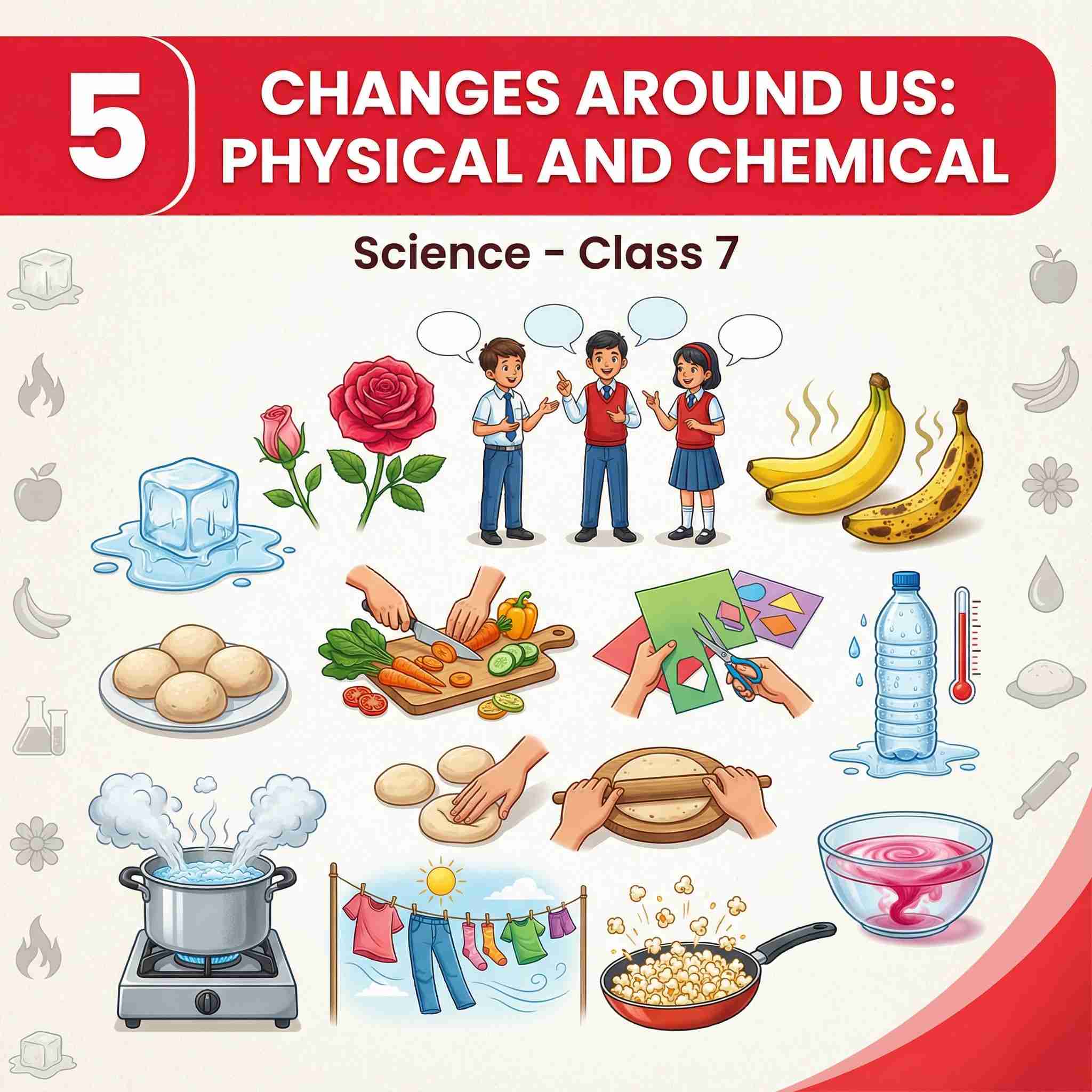
Class 7 Science Chapter 5: Changes Around Us Physical and Chemical | Complete NCERT Notes, Activities, 25+ Questions & Answers
Full Chapter Summary, Physical vs Chemical Changes, Reversible/Irreversible, All Activities 5.1-5.8 Solved Step-by-Step, NCERT "Let Us Enhance Our Learning" Questions, 25+ Extra Practice Questions & Answers, Fire Triangle, Rusting, Weathering, Revision Tables, Mnemonics for CBSE Board Exams
Updated: 6 months ago
Categories: Class 7 Science, NCERT Notes 2025, Physical Chemical Changes, CBSE Exam Preparation, Science Study Guides, Curiosity Textbook, Reversible Changes, Combustion Rusting, Activity Solutions, Revision Notes
Tags: class 7 science chapter 5, physical chemical changes class 7, ncert chapter 5 science, reversible irreversible changes, combustion rusting notes, activity 5.1 5.8 solutions, cbse class 7 science 2025, let us enhance our learning answers, fire triangle explained, lime water test co2, vinegar baking soda reaction, weathering erosion, magnesium burning, ignition temperature, bioluminescence fireflies, science revision notes, exam preparation class 7, curiosity textbook chapter 5, physical changes examples, chemical changes examples
Class 7 Science Chapter 5: Changes Around Us Physical and Chemical | Complete NCERT Notes, Activities, Questions & Answers 2025
Changes Around Us: Physical and Chemical
Class 7 Science Chapter 5 | Ultimate Study Guide | NCERT Class 7 Notes, Activities, Examples & Extra Q&A 2025
Full Chapter Summary & Detailed Notes - Changes Around Us: Physical and Chemical
Overview & Chapter Goal
To understand the difference between physical and chemical changes through observations and experiments.
To learn about reversible and irreversible changes, combustion, rusting, weathering, and erosion.
To explore how scientific investigation is done with activities and chemical equations.
Physical Changes
Changes that affect the appearance or state of a substance but do not form new substances. Examples include melting ice, boiling water, tearing paper.
Chemical Changes
Changes in which one or more new substances are formed through chemical reactions. Examples include rusting, combustion, baking soda and vinegar reaction.
Combustion
Rapid chemical reaction with oxygen producing heat and/or light, seen in burning magnesium or candle flame.
Rusting
Reaction of iron with moist air forming iron oxide (rust), a chemical change causing damage to metals.
Natural Changes
Weathering breaks rocks physically and chemically to form soil, while erosion moves sediments by wind and water.
Key Definitions & Terms - Complete Glossary
Physical Change
A change in size, shape, or state without forming a new substance.
Chemical Change
A change where new substances are formed with new properties.
Reversible Change
A change that can be undone, returning to original form.
Irreversible Change
A change that cannot be reversed, permanent formation of new substances.
Combustion
Chemical reaction with oxygen producing heat and light.
Rusting
Formation of iron oxide on iron due to reaction with moist air.
Weathering
Breakdown of rocks by physical and chemical processes.
Erosion
Movement of sediments by natural forces like water and wind.
Ignition Temperature
The minimum temperature at which a substance catches fire.
Bioluminescence
Production of light by living organisms without heat.
Text Book Activities, Questions & Extra Answers (25+ Questions)
3 attempts on CBSE Class 7 Annual Assessment quizzes
HIMAKSHI GUPTA . scored 2/10 on Integers and Rational Numbers Naavya Agarwal scored 0/10 on Integers and Rational Numbers Anshika Yadav scored 0/10 on Integers and Rational Numbers HIMAKSHI GUPTA . scored 2/10 on Integers and Rational Numbers Naavya Agarwal scored 0/10 on Integers and Rational Numbers Anshika Yadav scored 0/10 on Integers and Rational Numbers
#1
Integers and Rational Numbers Fundamentals | CBSE Class 7 Annual Assessment
10 Qs · ~10 min
#2
Class 7 Social Science — Banks and the Magic of Finance (Practice Quiz)
10 Qs · ~10 min
#3
Class 7 Social Science — Infrastructure: Engine of India's Development (Practice Quiz)
10 Qs · ~10 min
#4
Class 7 Social Science — The State, the Government, and You (Practice Quiz)
10 Qs · ~10 min
#5
Class 7 Social Science — India, a Home to Many (Practice Quiz)
10 Qs · ~10 min
#6
Class 7 Social Science — Turning Tides: 11th and 12th Centuries (Practice Quiz)
10 Qs · ~10 min
#7
Class 7 Social Science — Empires and Kingdoms: 6th to 10th Centuries (Practice Quiz)
10 Qs · ~10 min
#8
Class 7 Social Science — India and Her Neighbours (Practice Quiz)
10 Qs · ~10 min
#9
Class 7 Social Science — The Story of Indian Farming (Practice Quiz)
10 Qs · ~10 min
#10
Class 7 Social Science — Understanding Markets (Practice Quiz)
10 Qs · ~10 min
#11
Class 7 Social Science — From Barter to Money (Practice Quiz)
10 Qs · ~10 min
#12
Class 7 Social Science — The Constitution of India — An Introduction (Practice Quiz)
10 Qs · ~10 min
#13
Class 7 Social Science — From the Rulers to the Ruled: Types of Governments (Practice Quiz)
10 Qs · ~10 min
#14
Class 7 Social Science — How the Land Becomes Sacred (Practice Quiz)
10 Qs · ~10 min
#15
Class 7 Social Science — The Gupta Era: An Age of Tireless Creativity (Practice Quiz)
10 Qs · ~10 min
#16
Class 7 Social Science — The Age of Reorganisation (Practice Quiz)
10 Qs · ~10 min
#17
Class 7 Social Science — The Rise of Empires (Practice Quiz)
10 Qs · ~10 min
#18
Class 7 Social Science — New Beginnings: Cities and States (Practice Quiz)
10 Qs · ~10 min
#19
Class 7 Social Science — Climates of India (Practice Quiz)
10 Qs · ~10 min
#20
Class 7 Social Science — Understanding the Weather (Practice Quiz)
10 Qs · ~10 min
#21
Class 7 Social Science — Geographical Diversity of India (Practice Quiz)
10 Qs · ~10 min
#22
Class 7 Sanskrit — परिशिष्टम् २ — धातुरूपाणि एवं सन्धि-परिचयः (Practice Quiz)
10 Qs · ~10 min
#23
Class 7 Sanskrit — परिशिष्टम् १ — शब्दरूपाणि (Practice Quiz)
10 Qs · ~10 min
#24
Class 7 Sanskrit — वर्णमात्रा-परिचयः (Practice Quiz)
10 Qs · ~10 min
#25
Class 7 Sanskrit — वीराङ्गना पन्नाधाया (Practice Quiz)
10 Qs · ~10 min
#26
Class 7 Sanskrit — द्वीपेषु रम्यः द्वीपोऽण्डमानः (Practice Quiz)
10 Qs · ~10 min
#27
Class 7 Sanskrit — दशमः कः? (Practice Quiz)
10 Qs · ~10 min
#28
Class 7 Sanskrit — अन्नाद् भवन्ति भूतानि (Practice Quiz)
10 Qs · ~10 min
#29
Class 7 Sanskrit — हितं मनोहारि च दुर्लभं वचः (Practice Quiz)
10 Qs · ~10 min
#30
Class 7 Sanskrit — ईशावास्यम् इदं सर्वम् (Practice Quiz)
10 Qs · ~10 min
#31
Class 7 Sanskrit — क्रीडाम वयं श्लोकान्त्याक्षरीम् (Practice Quiz)
10 Qs · ~10 min
#32
Class 7 Sanskrit — सेवा हि परमो धर्मः (Practice Quiz)
10 Qs · ~10 min
#33
Class 7 Sanskrit — न लभ्यते चेत् आम्लं द्राक्षाफलम् (Practice Quiz)
10 Qs · ~10 min
#34
Class 7 Sanskrit — मित्राय नमः (Practice Quiz)
10 Qs · ~10 min
#35
Class 7 Sanskrit — नित्यं पिबामः सुभाषितरसम् (Practice Quiz)
10 Qs · ~10 min
#36
Class 7 Sanskrit — वन्दे भारतमातरम् (Practice Quiz)
10 Qs · ~10 min
#37
Class 7 Hindi — मीरा के पद (Practice Quiz)
10 Qs · ~10 min
#38
Class 7 Hindi — चिड़िया (Practice Quiz)
10 Qs · ~10 min
#39
Class 7 Hindi — बिरजू महाराज से साक्षात्कार (Practice Quiz)
10 Qs · ~10 min
#40
Class 7 Hindi — वर्षा-बहार (Practice Quiz)
10 Qs · ~10 min
#41
Class 7 Hindi — गिरिधर कविराय की कुंडलियाँ (Practice Quiz)
10 Qs · ~10 min
#42
Class 7 Hindi — नहीं होना बीमार (Practice Quiz)
10 Qs · ~10 min
#43
Class 7 Hindi — पानी रे पानी (Practice Quiz)
10 Qs · ~10 min
#44
Class 7 Hindi — फूल और काँटा (Practice Quiz)
10 Qs · ~10 min
#45
Class 7 Hindi — तीन बुद्धिमान (Practice Quiz)
10 Qs · ~10 min
#46
Class 7 Hindi — माँ, कह एक कहानी (Practice Quiz)
10 Qs · ~10 min
#47
Class 7 English — Bravehearts (Practice Quiz)
10 Qs · ~10 min
#48
Class 7 English — Travel and Adventure (Practice Quiz)
10 Qs · ~10 min
#49
Class 7 English — Dreams and Discoveries (Practice Quiz)
10 Qs · ~10 min
#50
Class 7 English — Wit and Humour (Practice Quiz)
10 Qs · ~10 min
#51
Class 7 English — Learning Together (Practice Quiz)
10 Qs · ~10 min
#52
Class 7 Maths — Finding the Unknown (Practice Quiz)
10 Qs · ~10 min
#53
Class 7 Maths — Constructions and Tilings (Practice Quiz)
10 Qs · ~10 min
#54
Class 7 Maths — Connecting the Dots… (Practice Quiz)
10 Qs · ~10 min
#55
Class 7 Maths — Another Peek Beyond the Point (Practice Quiz)
10 Qs · ~10 min
#56
Class 7 Maths — Finding Common Ground (Practice Quiz)
10 Qs · ~10 min
#57
Class 7 Maths — Operations with Integers (Practice Quiz)
10 Qs · ~10 min
#58
Class 7 Maths — Geometric Twins (Practice Quiz)
10 Qs · ~10 min
#59
Class 7 Maths — Working with Fractions (Practice Quiz)
10 Qs · ~10 min
#60
Class 7 Maths — A Tale of Three Intersecting Lines (Practice Quiz)
10 Qs · ~10 min
#61
Class 7 Maths — Number Play (Practice Quiz)
10 Qs · ~10 min
#62
Class 7 Maths — Parallel and Intersecting Lines (Practice Quiz)
10 Qs · ~10 min
#63
Class 7 Maths — Expressions Using Letter-Numbers (Practice Quiz)
10 Qs · ~10 min
#64
Class 7 Maths — A Peek Beyond the Point (Practice Quiz)
10 Qs · ~10 min
#65
Class 7 Maths — Arithmetic Expressions (Practice Quiz)
10 Qs · ~10 min
#66
Class 7 Maths — Large Numbers Around Us (Practice Quiz)
10 Qs · ~10 min
#67
Class 7 Science — Earth, Moon, and the Sun (Practice Quiz)
10 Qs · ~10 min
#68
Class 7 Science — Light: Shadows and Reflections (Practice Quiz)
10 Qs · ~10 min
#69
Class 7 Science — Life Processes in Plants (Practice Quiz)
10 Qs · ~10 min
#70
Class 7 Science — Life Processes in Animals (Practice Quiz)
10 Qs · ~10 min
#71
Class 7 Science — Measurement of Time and Motion (Practice Quiz)
10 Qs · ~10 min
#72
Class 7 Science — Heat Transfer in Nature (Practice Quiz)
10 Qs · ~10 min
#73
Class 7 Science — Adolescence: A Stage of Growth and Change (Practice Quiz)
10 Qs · ~10 min
#74
Class 7 Science — Changes Around Us: Physical and Chemical (Practice Quiz)
10 Qs · ~10 min
#75
Class 7 Science — The World of Metals and Non-metals (Practice Quiz)
10 Qs · ~10 min
#76
Class 7 Science — Electricity: Circuits and their Components (Practice Quiz)
10 Qs · ~10 min
#77
Class 7 Science — Exploring Substances: Acidic, Basic, and Neutral (Practice Quiz)
10 Qs · ~10 min
#78
Class 7 Science — The Ever-Evolving World of Science (Practice Quiz)
10 Qs · ~10 min
#79
Simple Equations and Applications Practice Quiz | CBSE Class 7 Annual Assessment