Class 7 Science Chapter 7: Heat Transfer in Nature | Complete NCERT Notes, Activities 7.1-7.5 Solved, Conduction Convection Radiation, Land Sea Breeze, Water Cycle
Categories: Class 7 Science, NCERT Notes, Heat Transfer, Conduction Convection Radiation, Land Sea Breeze, Water Cycle, CBSE Exam Preparation, Physics Concepts, Activities Solutions, Science Study Guides
Tags: class 7 science chapter 7 notes, heat transfer class 7, conduction convection radiation ncert, activity 7.1 metal strip pins, activity 7.2 paper cup convection, activity 7.3 coloured water, land sea breeze class 7, water cycle evaporation precipitation, poor conductors wool air clay, good conductors metals steel copper, radiation sun earth heat, sea breeze daytime land breeze night, aquifer groundwater infiltration, ncert chapter 7 science solutions, cbse class 7 science 2025, conduction pins fall order, convection current explanation, radiation no medium needed, woollen clothes winter insulators, hollow bricks house cooling, ice stupa ladakh water conservation, varahamihira rainfall prediction, bukhari himalayan heater, smoke rises convection, heat transfer processes comparison
Class 7 Science Chapter 7: Heat Transfer in Nature | Complete NCERT Notes, Activities, Questions & Answers 2025
Heat Transfer in Nature
Class 7 Science Chapter 7 | Complete NCERT Guide | Conduction, Convection, Radiation, Water Cycle, Land & Sea Breeze 2025
Full Chapter Summary & Detailed Notes - Heat Transfer in Nature
Introduction to Heat Transfer
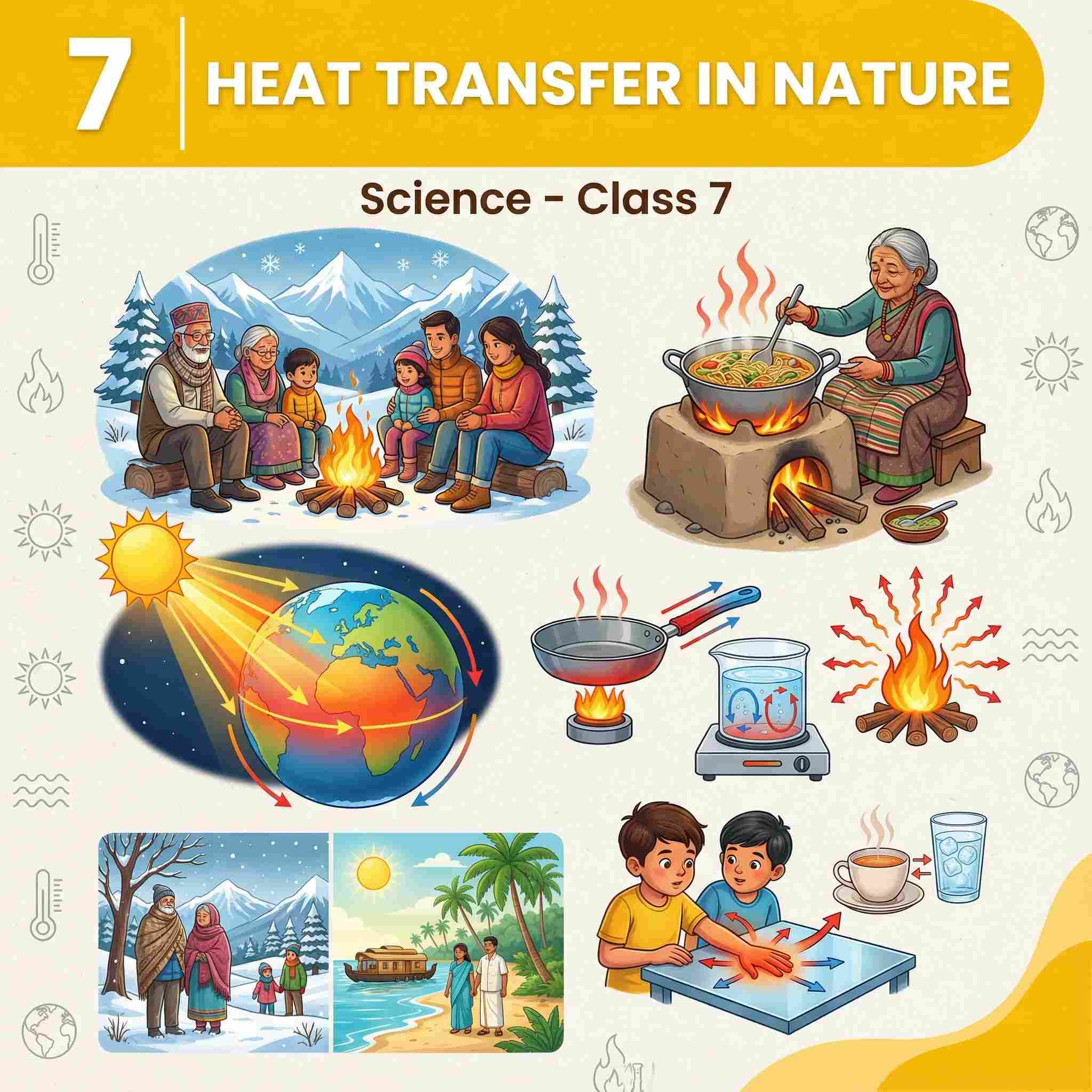
Heat transfer occurs in three main ways: conduction, convection, and radiation. These processes explain why some places are hot or cold and how heat moves in nature.
Conduction: Heat transfer through direct contact in solids, like in metals.
Convection: Heat transfer through movement of fluids (liquids/gases), e.g., land and sea breezes.
Radiation: Heat transfer without a medium, like Sun's heat reaching Earth.
Conduction of Heat
Heat moves from hotter to colder parts in solids without particle movement. Metals are good conductors; non-metals like wood are poor (insulators).
Good Conductors: Metals (steel, aluminum) used in utensils.
Poor Conductors: Wood, air, wool used for insulation.
Convection in Fluids
Hot fluids rise, cool ones sink, creating currents.
Land & Sea Breeze: Day: Sea breeze (cool air from sea to land); Night: Land breeze (cool air from land to sea).
Radiation
Heat transfer via electromagnetic waves. No medium needed. Dark colors absorb more heat; light colors reflect.
3 attempts on CBSE Class 7 Annual Assessment quizzes
HIMAKSHI GUPTA . scored 2/10 on Integers and Rational Numbers Naavya Agarwal scored 0/10 on Integers and Rational Numbers Anshika Yadav scored 0/10 on Integers and Rational Numbers HIMAKSHI GUPTA . scored 2/10 on Integers and Rational Numbers Naavya Agarwal scored 0/10 on Integers and Rational Numbers Anshika Yadav scored 0/10 on Integers and Rational Numbers
#1
Integers and Rational Numbers Fundamentals | CBSE Class 7 Annual Assessment
10 Qs · ~10 min
#2
Class 7 Social Science — Banks and the Magic of Finance (Practice Quiz)
10 Qs · ~10 min
#3
Class 7 Social Science — Infrastructure: Engine of India's Development (Practice Quiz)
10 Qs · ~10 min
#4
Class 7 Social Science — The State, the Government, and You (Practice Quiz)
10 Qs · ~10 min
#5
Class 7 Social Science — India, a Home to Many (Practice Quiz)
10 Qs · ~10 min
#6
Class 7 Social Science — Turning Tides: 11th and 12th Centuries (Practice Quiz)
10 Qs · ~10 min
#7
Class 7 Social Science — Empires and Kingdoms: 6th to 10th Centuries (Practice Quiz)
10 Qs · ~10 min
#8
Class 7 Social Science — India and Her Neighbours (Practice Quiz)
10 Qs · ~10 min
#9
Class 7 Social Science — The Story of Indian Farming (Practice Quiz)
10 Qs · ~10 min
#10
Class 7 Social Science — Understanding Markets (Practice Quiz)
10 Qs · ~10 min
#11
Class 7 Social Science — From Barter to Money (Practice Quiz)
10 Qs · ~10 min
#12
Class 7 Social Science — The Constitution of India — An Introduction (Practice Quiz)
10 Qs · ~10 min
#13
Class 7 Social Science — From the Rulers to the Ruled: Types of Governments (Practice Quiz)
10 Qs · ~10 min
#14
Class 7 Social Science — How the Land Becomes Sacred (Practice Quiz)
10 Qs · ~10 min
#15
Class 7 Social Science — The Gupta Era: An Age of Tireless Creativity (Practice Quiz)
10 Qs · ~10 min
#16
Class 7 Social Science — The Age of Reorganisation (Practice Quiz)
10 Qs · ~10 min
#17
Class 7 Social Science — The Rise of Empires (Practice Quiz)
10 Qs · ~10 min
#18
Class 7 Social Science — New Beginnings: Cities and States (Practice Quiz)
10 Qs · ~10 min
#19
Class 7 Social Science — Climates of India (Practice Quiz)
10 Qs · ~10 min
#20
Class 7 Social Science — Understanding the Weather (Practice Quiz)
10 Qs · ~10 min
#21
Class 7 Social Science — Geographical Diversity of India (Practice Quiz)
10 Qs · ~10 min
#22
Class 7 Sanskrit — परिशिष्टम् २ — धातुरूपाणि एवं सन्धि-परिचयः (Practice Quiz)
10 Qs · ~10 min
#23
Class 7 Sanskrit — परिशिष्टम् १ — शब्दरूपाणि (Practice Quiz)
10 Qs · ~10 min
#24
Class 7 Sanskrit — वर्णमात्रा-परिचयः (Practice Quiz)
10 Qs · ~10 min
#25
Class 7 Sanskrit — वीराङ्गना पन्नाधाया (Practice Quiz)
10 Qs · ~10 min
#26
Class 7 Sanskrit — द्वीपेषु रम्यः द्वीपोऽण्डमानः (Practice Quiz)
10 Qs · ~10 min
#27
Class 7 Sanskrit — दशमः कः? (Practice Quiz)
10 Qs · ~10 min
#28
Class 7 Sanskrit — अन्नाद् भवन्ति भूतानि (Practice Quiz)
10 Qs · ~10 min
#29
Class 7 Sanskrit — हितं मनोहारि च दुर्लभं वचः (Practice Quiz)
10 Qs · ~10 min
#30
Class 7 Sanskrit — ईशावास्यम् इदं सर्वम् (Practice Quiz)
10 Qs · ~10 min
#31
Class 7 Sanskrit — क्रीडाम वयं श्लोकान्त्याक्षरीम् (Practice Quiz)
10 Qs · ~10 min
#32
Class 7 Sanskrit — सेवा हि परमो धर्मः (Practice Quiz)
10 Qs · ~10 min
#33
Class 7 Sanskrit — न लभ्यते चेत् आम्लं द्राक्षाफलम् (Practice Quiz)
10 Qs · ~10 min
#34
Class 7 Sanskrit — मित्राय नमः (Practice Quiz)
10 Qs · ~10 min
#35
Class 7 Sanskrit — नित्यं पिबामः सुभाषितरसम् (Practice Quiz)
10 Qs · ~10 min
#36
Class 7 Sanskrit — वन्दे भारतमातरम् (Practice Quiz)
10 Qs · ~10 min
#37
Class 7 Hindi — मीरा के पद (Practice Quiz)
10 Qs · ~10 min
#38
Class 7 Hindi — चिड़िया (Practice Quiz)
10 Qs · ~10 min
#39
Class 7 Hindi — बिरजू महाराज से साक्षात्कार (Practice Quiz)
10 Qs · ~10 min
#40
Class 7 Hindi — वर्षा-बहार (Practice Quiz)
10 Qs · ~10 min
#41
Class 7 Hindi — गिरिधर कविराय की कुंडलियाँ (Practice Quiz)
10 Qs · ~10 min
#42
Class 7 Hindi — नहीं होना बीमार (Practice Quiz)
10 Qs · ~10 min
#43
Class 7 Hindi — पानी रे पानी (Practice Quiz)
10 Qs · ~10 min
#44
Class 7 Hindi — फूल और काँटा (Practice Quiz)
10 Qs · ~10 min
#45
Class 7 Hindi — तीन बुद्धिमान (Practice Quiz)
10 Qs · ~10 min
#46
Class 7 Hindi — माँ, कह एक कहानी (Practice Quiz)
10 Qs · ~10 min
#47
Class 7 English — Bravehearts (Practice Quiz)
10 Qs · ~10 min
#48
Class 7 English — Travel and Adventure (Practice Quiz)
10 Qs · ~10 min
#49
Class 7 English — Dreams and Discoveries (Practice Quiz)
10 Qs · ~10 min
#50
Class 7 English — Wit and Humour (Practice Quiz)
10 Qs · ~10 min
#51
Class 7 English — Learning Together (Practice Quiz)
10 Qs · ~10 min
#52
Class 7 Maths — Finding the Unknown (Practice Quiz)
10 Qs · ~10 min
#53
Class 7 Maths — Constructions and Tilings (Practice Quiz)
10 Qs · ~10 min
#54
Class 7 Maths — Connecting the Dots… (Practice Quiz)
10 Qs · ~10 min
#55
Class 7 Maths — Another Peek Beyond the Point (Practice Quiz)
10 Qs · ~10 min
#56
Class 7 Maths — Finding Common Ground (Practice Quiz)
10 Qs · ~10 min
#57
Class 7 Maths — Operations with Integers (Practice Quiz)
10 Qs · ~10 min
#58
Class 7 Maths — Geometric Twins (Practice Quiz)
10 Qs · ~10 min
#59
Class 7 Maths — Working with Fractions (Practice Quiz)
10 Qs · ~10 min
#60
Class 7 Maths — A Tale of Three Intersecting Lines (Practice Quiz)
10 Qs · ~10 min
#61
Class 7 Maths — Number Play (Practice Quiz)
10 Qs · ~10 min
#62
Class 7 Maths — Parallel and Intersecting Lines (Practice Quiz)
10 Qs · ~10 min
#63
Class 7 Maths — Expressions Using Letter-Numbers (Practice Quiz)
10 Qs · ~10 min
#64
Class 7 Maths — A Peek Beyond the Point (Practice Quiz)
10 Qs · ~10 min
#65
Class 7 Maths — Arithmetic Expressions (Practice Quiz)
10 Qs · ~10 min
#66
Class 7 Maths — Large Numbers Around Us (Practice Quiz)
10 Qs · ~10 min
#67
Class 7 Science — Earth, Moon, and the Sun (Practice Quiz)
10 Qs · ~10 min
#68
Class 7 Science — Light: Shadows and Reflections (Practice Quiz)
10 Qs · ~10 min
#69
Class 7 Science — Life Processes in Plants (Practice Quiz)
10 Qs · ~10 min
#70
Class 7 Science — Life Processes in Animals (Practice Quiz)
10 Qs · ~10 min
#71
Class 7 Science — Measurement of Time and Motion (Practice Quiz)
10 Qs · ~10 min
#72
Class 7 Science — Heat Transfer in Nature (Practice Quiz)
10 Qs · ~10 min
#73
Class 7 Science — Adolescence: A Stage of Growth and Change (Practice Quiz)
10 Qs · ~10 min
#74
Class 7 Science — Changes Around Us: Physical and Chemical (Practice Quiz)
10 Qs · ~10 min
#75
Class 7 Science — The World of Metals and Non-metals (Practice Quiz)
10 Qs · ~10 min
#76
Class 7 Science — Electricity: Circuits and their Components (Practice Quiz)
10 Qs · ~10 min
#77
Class 7 Science — Exploring Substances: Acidic, Basic, and Neutral (Practice Quiz)
10 Qs · ~10 min
#78
Class 7 Science — The Ever-Evolving World of Science (Practice Quiz)
10 Qs · ~10 min
#79
Simple Equations and Applications Practice Quiz | CBSE Class 7 Annual Assessment