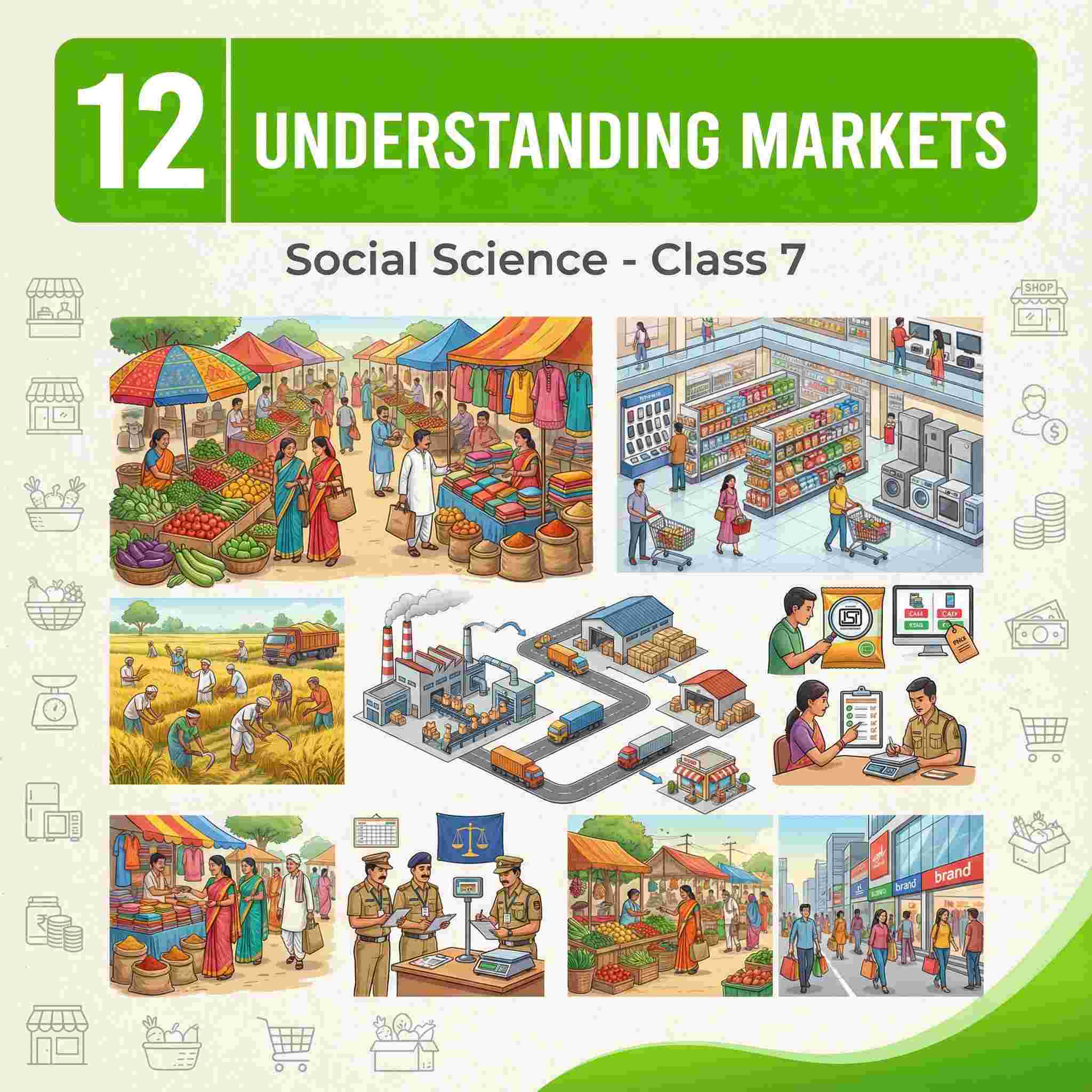
Class 7 Social Science Chapter 12: Understanding Markets | What Markets Are, How Prices Are Set, Types of Markets (Weekly, Malls, Online) & Role of Government
Complete Chapter 12 guide: meaning of markets and why people need them, Hampi Bazaar as a historic market example, key features of any market (buyers, sellers, negotiation and price), how demand and supply interact to fix a “just right” price, different kinds of markets around us (weekly haats, local shops, malls, online/e‑commerce), how goods move from producers to consumers, and the role of government rules and consumer awareness in keeping markets fair, with summary, Q&A, extra questions and quiz for CBSE Exam
Updated: 5 months ago
Categories: Class 7 Social Science, NCERT Notes 2025, Economic Life Around Us, Markets and Trade, Prices and Consumers, CBSE Exam Preparation, Q&A and Quizzes
Tags: class 7 social science chapter 12 notes, understanding markets class 7, what is a market definition, buyer and seller negotiation price, demand and supply determine price, weekly market haat bazaar examples, hampi bazaar vijayanagar empire trade, physical markets shops malls, online markets ecommerce apps websites, producers wholesalers retailers consumers chain, why vegetables cheaper at night, discounts at end of season example, government role in markets fair trade rules, consumer awareness quality and rights, economic life around us markets, cbse class 7 economics chapter 12
Class 7 Social Science Chapter 12: Understanding Markets – Complete NCERT Notes, Activities, Questions & Answers 2025
Understanding Markets
Class 7 Social Science Chapter 12 | Complete NCERT Guide | Types, Functions, Role, Government
Full Chapter Summary & Detailed Notes – Understanding Markets
Opening Idea – What are Markets?
Markets are places where buyers and sellers exchange goods and services at agreed prices, fulfilling needs and wants. Prosperity comes from markets for things we can't produce ourselves (Adam Smith).
Markets connect people, traditions, ideas; include physical/online, domestic/international, wholesale/retail.
The Four Big Questions of the Chapter (Most Important for Exams)
What are markets and how do they function?
What is the role of markets in people's lives?
What role does the government play in markets?
How can consumers assess the quality of goods and services they purchase?
What is a Market? – Key Elements
Element
Description
Examples
Buyers & Sellers
Essential parties who negotiate
Guava buyer bargaining with seller
Price
Agreed amount for transaction
Determined by demand/supply
Needs vs Wants
Essentials (food) vs desires (luxuries)
Food for survival, phones for convenience
Types
Physical/online, domestic/international
Hampi Bazaar (historical), online apps
How Markets Function – Price Determination
Negotiation: Buyers/sellers bargain to mutual price.
Scenarios: High price → fewer buyers; low price → quick sell-out; right price → balance.
Demand & Supply: Buyers' needs vs sellers' offers set prices over time.
All important terms with detailed explanation, examples, exam tips & golden lines – perfect for 2-mark, 3-mark & 5-mark answers.
Market
Definition: Place for buying/selling goods/services; physical/online.
Features: Buyers, sellers, price negotiation.
Example: Hampi Bazaar (historical trade).
Exam Golden Line: “Markets connect needs/wants through transactions.”
Price
Definition: Agreed amount for goods/services.
Features: Determined by demand/supply.
Example: Guava at ₹40/kg balanced.
Exam Tip: High price reduces buyers; low increases.
Demand
Definition: Quantity buyers want at a price.
Example: More guavas needed → higher production.
Exam Golden Line: “Demand drives supply and prices.”
Supply
Definition: Quantity sellers offer at a price.
Example: Low onion supply → high prices.
Exam Tip: Balances with demand for equilibrium.
Wholesaler
Definition: Buys bulk from producers, sells to retailers.
Example: Grain mandis, godowns.
Exam Golden Line: “Wholesalers store and distribute in bulk.”
Retailer
Definition: Sells small quantities to consumers.
Example: Grocery stores, salons.
Exam Tip: Final link in chain.
Distributor
Definition: Bridges wholesalers to distant retailers.
Example: Milk middlemen like AMUL.
Exam Golden Line: “Distributors overcome distance barriers.”
Aggregator
Definition: Online platform combining sellers.
Example: Shopping apps delivering goods.
Exam Tip: For online markets.
Export
Definition: Selling goods abroad.
Example: Indian textiles to world.
Exam Golden Line: “Exports cross national boundaries.”
Import
Definition: Buying from abroad.
Example: Vegetable oils to India.
Exam Tip: For international markets.
Exam Quick Tips & Mnemonics
Most Important Terms: Market, Price, Demand, Supply, Wholesaler
Mnemonic for Types: PODI WR (Physical/Online, Domestic/International, Wholesale/Retail)
Mnemonic for Chain: P W D R C (Producer, Wholesaler, Distributor, Retailer, Consumer)
Golden 5-Mark Line:
“Markets balance demand-supply via prices, with chain from producers to consumers, regulated by government for fairness.”
Activities & Questions and Answers – Understanding Markets
All Textbook Activities & "Think About It" Questions – Completely Solved
Imagine Hampi Bazaar at its peak
It would have been an extremely colourful, noisy and crowded place. Hundreds of shops lined both sides of the wide street, selling silk, jewels, spices, grains, horses, elephants, birds, perfumes and rare goods brought from foreign lands. Portuguese travellers described it as “the best-provided city in the world” with endless variety and abundance.
Old markets of your state vs today’s markets
Similarities: Bargaining, variety of goods, social meeting place. Differences: Earlier – mostly weekly haats, cash only, no cold storage. Today – malls, online apps, fixed prices, cold chains, 24×7 availability, plastic money, home delivery.
Skit – Buyer and Seller of guavas
Buyer: “Bhaiya ₹80/kg is too costly!” Seller: “Madam, fresh from Alphonso farm, very sweet.” Buyer: “Give at ₹55.” Seller: “Not possible, ₹70 final.” Buyer: “Okay ₹60, pack 3 kg.” Seller: “Deal!” → Shows negotiation to reach mutually acceptable price.
Think About It – Where negotiation is less common?
In branded shops, malls, supermarkets, petrol pumps, cinema tickets, online platforms (Amazon, Flipkart) – prices are fixed for uniformity and trust.
Think About It – Vegetables cheaper late night & woollens discounted end of winter
Both are perishable/seasonal goods. Sellers reduce price to clear stock and avoid loss because next day demand will be zero.
Think About It – Pros & cons of online vs physical shopping
Online
Physical
Buyer
Convenience, variety, compare prices, home delivery
Touch/feel, immediate take, no delivery wait
Seller
Reach whole country, low rent
Build trust, no return hassle
Cons
Cannot check quality, returns painful
Time, travel cost, limited choice
Think About It – Services that need physical markets
Hair cutting, doctor check-up, car/bike repair, tailoring, restaurant dining, gym, spa, cinema hall experience.
Let's Explore – Flow diagram (Fig. 12.11)
Producer/Manufacturer → Wholesaler (bulk purchase & storage) → (sometimes Distributor) → Retailer → Consumer. Wholesaler ensures bulk availability; Retailer makes goods reachable in every neighbourhood.
Let's Explore – Trace any product chain from retailer
Example – Milk packet in my shop: Farmers → AMUL cooperative → Milk chilling centre → Processing plant → Distributor → Retailer → Me.
Think About It – Life without markets?
Everyone would have to produce everything themselves. No specialisation, no variety, very low standard of living. Farmers couldn’t sell surplus, factories couldn’t buy raw material → economy would collapse.
Consumers demand → retailers tell wholesalers → wholesalers order from companies → companies manufacture more 5-star models → society saves electricity and environment improves.
Let's Explore – Onion price when supply falls
Price shoots up (e.g., 2023–24 onion reached ₹100–150/kg in many cities). Government releases buffer stock or imports to control prices.
Think About It – Kautilya’s ghee rule
Ancient consumer protection – extra 1/50th quantity given to compensate loss due to sticking, same idea as today’s accurate weighing laws.
End-of-Chapter Questions – Fully Solved (Perfect for Exams)
1. What are the main features of a market? Recall a recent visit.
Features: (i) Buyers & sellers (ii) Goods/services (iii) Price through negotiation (iv) Place (physical/online). Recent visit: Sunday haat – saw vegetable sellers bargaining, fruit carts, clothes stalls, people negotiating prices loudly – exactly how demand and supply decide price.
2. Relevance of Adam Smith’s quote
Markets create prosperity because they allow specialisation. One person grows tomatoes, another makes phones – both exchange and sell what they can’t produce. Without markets there is no exchange → no prosperity.
3. If seller is getting good price for guavas, what will farmer do next season?
Farmer will grow more guavas next season because demand and price are high → increase supply → earn more profit. This is how markets guide production.
4. Match the following (Table)
1. Physical market
→ Requires physical presence
2. Online market
→ Buyers/sellers meet virtually
3. Domestic market
→ Within nation boundaries
4. International market
→ Goods flow outside nation
5. Wholesale market
→ Deals in bulk quantities
6. Retail market
→ Serves final consumers
5. Products where price is high despite fewer buyers
Luxury items – iPhones, diamonds, designer clothes, sports cars. High price because of rarity, brand value, high production cost, status symbol.
6. Beans ₹30/kg at cart but family buys at ₹40/kg in super bazaar – Why?
Because super bazaar gives clean packing, fixed weight, air-conditioned comfort, guarantee of quality, card payment, parking – people pay extra for convenience and trust.
7. Why farmers throw tomatoes? Role of wholesaler & solutions?
Oversupply → price falls below cost → loss in selling. Wholesaler can buy at low price, store in cold storage, process into ketchup/puree, or export. Solutions: MSP, food processing units, better forecasting, farmer-producer organisations (FPOs).
Real 2024–25 example: Maharashtra & Madhya Pradesh farmers destroyed thousands of tonnes of tomatoes when price fell to ₹2–5/kg.
8. School carnival activities & negotiation
Food counters, games, handmade items. Students fix prices but give discounts on bulk (“Buy 5 coupons, get 1 free”), shout offers, attract customers – exactly like real markets.
9. Check certification marks on 5 products
Examples: 1. Atta packet → FSSAI 2. Pressure cooker → ISI 3. Pulses → AGMARK 4. Ceiling fan → BEE 5-star 5. Packaged milk → FSSAI Products without marks are usually local/unbranded – risk of poor quality.
10. Design label for your soap bar
Must include: Brand name, net weight, manufacturing & expiry date, full ingredients list, batch no., MRP, manufacturer address, FSSAI/ISI mark, vegetarian symbol, barcode.
Extra Exam Booster Questions with Answers
1. Define market in one sentence.
Place (physical or virtual) where buyers and sellers meet to exchange goods/services at mutually agreed price.
2. Difference between need and want with example.
Need – essential for survival (roti); Want – desirable but not essential (pizza).
3. Who called Hampi “best-provided city in the world”?
Portuguese traveller Domingos Paes.
4. What happens when price is fixed too high?
Goods remain unsold, seller suffers loss.
5. What is an aggregator?
Online platform (Amazon, Flipkart, Swiggy) that brings many sellers at one place for consumers.
Golden Answer for 5 Marks:
“Markets determine prices via demand-supply, with chain involving wholesalers/retailers, regulated by government for quality and fairness.”
Historical & Social Insights – Markets in India
Deep historical role + present-day impact – perfect for 5-mark and 8-mark answers.
Historical Insights – Ancient Markets
Hampi Bazaar: 16th century; grains, jewels, animals; prosperous Vijayanagara.
3 attempts on CBSE Class 7 Annual Assessment quizzes
HIMAKSHI GUPTA . scored 2/10 on Integers and Rational Numbers Naavya Agarwal scored 0/10 on Integers and Rational Numbers Anshika Yadav scored 0/10 on Integers and Rational Numbers HIMAKSHI GUPTA . scored 2/10 on Integers and Rational Numbers Naavya Agarwal scored 0/10 on Integers and Rational Numbers Anshika Yadav scored 0/10 on Integers and Rational Numbers
#1
Integers and Rational Numbers Fundamentals | CBSE Class 7 Annual Assessment
10 Qs · ~10 min
#2
Class 7 Social Science — Banks and the Magic of Finance (Practice Quiz)
10 Qs · ~10 min
#3
Class 7 Social Science — Infrastructure: Engine of India's Development (Practice Quiz)
10 Qs · ~10 min
#4
Class 7 Social Science — The State, the Government, and You (Practice Quiz)
10 Qs · ~10 min
#5
Class 7 Social Science — India, a Home to Many (Practice Quiz)
10 Qs · ~10 min
#6
Class 7 Social Science — Turning Tides: 11th and 12th Centuries (Practice Quiz)
10 Qs · ~10 min
#7
Class 7 Social Science — Empires and Kingdoms: 6th to 10th Centuries (Practice Quiz)
10 Qs · ~10 min
#8
Class 7 Social Science — India and Her Neighbours (Practice Quiz)
10 Qs · ~10 min
#9
Class 7 Social Science — The Story of Indian Farming (Practice Quiz)
10 Qs · ~10 min
#10
Class 7 Social Science — Understanding Markets (Practice Quiz)
10 Qs · ~10 min
#11
Class 7 Social Science — From Barter to Money (Practice Quiz)
10 Qs · ~10 min
#12
Class 7 Social Science — The Constitution of India — An Introduction (Practice Quiz)
10 Qs · ~10 min
#13
Class 7 Social Science — From the Rulers to the Ruled: Types of Governments (Practice Quiz)
10 Qs · ~10 min
#14
Class 7 Social Science — How the Land Becomes Sacred (Practice Quiz)
10 Qs · ~10 min
#15
Class 7 Social Science — The Gupta Era: An Age of Tireless Creativity (Practice Quiz)
10 Qs · ~10 min
#16
Class 7 Social Science — The Age of Reorganisation (Practice Quiz)
10 Qs · ~10 min
#17
Class 7 Social Science — The Rise of Empires (Practice Quiz)
10 Qs · ~10 min
#18
Class 7 Social Science — New Beginnings: Cities and States (Practice Quiz)
10 Qs · ~10 min
#19
Class 7 Social Science — Climates of India (Practice Quiz)
10 Qs · ~10 min
#20
Class 7 Social Science — Understanding the Weather (Practice Quiz)
10 Qs · ~10 min
#21
Class 7 Social Science — Geographical Diversity of India (Practice Quiz)
10 Qs · ~10 min
#22
Class 7 Sanskrit — परिशिष्टम् २ — धातुरूपाणि एवं सन्धि-परिचयः (Practice Quiz)
10 Qs · ~10 min
#23
Class 7 Sanskrit — परिशिष्टम् १ — शब्दरूपाणि (Practice Quiz)
10 Qs · ~10 min
#24
Class 7 Sanskrit — वर्णमात्रा-परिचयः (Practice Quiz)
10 Qs · ~10 min
#25
Class 7 Sanskrit — वीराङ्गना पन्नाधाया (Practice Quiz)
10 Qs · ~10 min
#26
Class 7 Sanskrit — द्वीपेषु रम्यः द्वीपोऽण्डमानः (Practice Quiz)
10 Qs · ~10 min
#27
Class 7 Sanskrit — दशमः कः? (Practice Quiz)
10 Qs · ~10 min
#28
Class 7 Sanskrit — अन्नाद् भवन्ति भूतानि (Practice Quiz)
10 Qs · ~10 min
#29
Class 7 Sanskrit — हितं मनोहारि च दुर्लभं वचः (Practice Quiz)
10 Qs · ~10 min
#30
Class 7 Sanskrit — ईशावास्यम् इदं सर्वम् (Practice Quiz)
10 Qs · ~10 min
#31
Class 7 Sanskrit — क्रीडाम वयं श्लोकान्त्याक्षरीम् (Practice Quiz)
10 Qs · ~10 min
#32
Class 7 Sanskrit — सेवा हि परमो धर्मः (Practice Quiz)
10 Qs · ~10 min
#33
Class 7 Sanskrit — न लभ्यते चेत् आम्लं द्राक्षाफलम् (Practice Quiz)
10 Qs · ~10 min
#34
Class 7 Sanskrit — मित्राय नमः (Practice Quiz)
10 Qs · ~10 min
#35
Class 7 Sanskrit — नित्यं पिबामः सुभाषितरसम् (Practice Quiz)
10 Qs · ~10 min
#36
Class 7 Sanskrit — वन्दे भारतमातरम् (Practice Quiz)
10 Qs · ~10 min
#37
Class 7 Hindi — मीरा के पद (Practice Quiz)
10 Qs · ~10 min
#38
Class 7 Hindi — चिड़िया (Practice Quiz)
10 Qs · ~10 min
#39
Class 7 Hindi — बिरजू महाराज से साक्षात्कार (Practice Quiz)
10 Qs · ~10 min
#40
Class 7 Hindi — वर्षा-बहार (Practice Quiz)
10 Qs · ~10 min
#41
Class 7 Hindi — गिरिधर कविराय की कुंडलियाँ (Practice Quiz)
10 Qs · ~10 min
#42
Class 7 Hindi — नहीं होना बीमार (Practice Quiz)
10 Qs · ~10 min
#43
Class 7 Hindi — पानी रे पानी (Practice Quiz)
10 Qs · ~10 min
#44
Class 7 Hindi — फूल और काँटा (Practice Quiz)
10 Qs · ~10 min
#45
Class 7 Hindi — तीन बुद्धिमान (Practice Quiz)
10 Qs · ~10 min
#46
Class 7 Hindi — माँ, कह एक कहानी (Practice Quiz)
10 Qs · ~10 min
#47
Class 7 English — Bravehearts (Practice Quiz)
10 Qs · ~10 min
#48
Class 7 English — Travel and Adventure (Practice Quiz)
10 Qs · ~10 min
#49
Class 7 English — Dreams and Discoveries (Practice Quiz)
10 Qs · ~10 min
#50
Class 7 English — Wit and Humour (Practice Quiz)
10 Qs · ~10 min
#51
Class 7 English — Learning Together (Practice Quiz)
10 Qs · ~10 min
#52
Class 7 Maths — Finding the Unknown (Practice Quiz)
10 Qs · ~10 min
#53
Class 7 Maths — Constructions and Tilings (Practice Quiz)
10 Qs · ~10 min
#54
Class 7 Maths — Connecting the Dots… (Practice Quiz)
10 Qs · ~10 min
#55
Class 7 Maths — Another Peek Beyond the Point (Practice Quiz)
10 Qs · ~10 min
#56
Class 7 Maths — Finding Common Ground (Practice Quiz)
10 Qs · ~10 min
#57
Class 7 Maths — Operations with Integers (Practice Quiz)
10 Qs · ~10 min
#58
Class 7 Maths — Geometric Twins (Practice Quiz)
10 Qs · ~10 min
#59
Class 7 Maths — Working with Fractions (Practice Quiz)
10 Qs · ~10 min
#60
Class 7 Maths — A Tale of Three Intersecting Lines (Practice Quiz)
10 Qs · ~10 min
#61
Class 7 Maths — Number Play (Practice Quiz)
10 Qs · ~10 min
#62
Class 7 Maths — Parallel and Intersecting Lines (Practice Quiz)
10 Qs · ~10 min
#63
Class 7 Maths — Expressions Using Letter-Numbers (Practice Quiz)
10 Qs · ~10 min
#64
Class 7 Maths — A Peek Beyond the Point (Practice Quiz)
10 Qs · ~10 min
#65
Class 7 Maths — Arithmetic Expressions (Practice Quiz)
10 Qs · ~10 min
#66
Class 7 Maths — Large Numbers Around Us (Practice Quiz)
10 Qs · ~10 min
#67
Class 7 Science — Earth, Moon, and the Sun (Practice Quiz)
10 Qs · ~10 min
#68
Class 7 Science — Light: Shadows and Reflections (Practice Quiz)
10 Qs · ~10 min
#69
Class 7 Science — Life Processes in Plants (Practice Quiz)
10 Qs · ~10 min
#70
Class 7 Science — Life Processes in Animals (Practice Quiz)
10 Qs · ~10 min
#71
Class 7 Science — Measurement of Time and Motion (Practice Quiz)
10 Qs · ~10 min
#72
Class 7 Science — Heat Transfer in Nature (Practice Quiz)
10 Qs · ~10 min
#73
Class 7 Science — Adolescence: A Stage of Growth and Change (Practice Quiz)
10 Qs · ~10 min
#74
Class 7 Science — Changes Around Us: Physical and Chemical (Practice Quiz)
10 Qs · ~10 min
#75
Class 7 Science — The World of Metals and Non-metals (Practice Quiz)
10 Qs · ~10 min
#76
Class 7 Science — Electricity: Circuits and their Components (Practice Quiz)
10 Qs · ~10 min
#77
Class 7 Science — Exploring Substances: Acidic, Basic, and Neutral (Practice Quiz)
10 Qs · ~10 min
#78
Class 7 Science — The Ever-Evolving World of Science (Practice Quiz)
10 Qs · ~10 min
#79
Simple Equations and Applications Practice Quiz | CBSE Class 7 Annual Assessment