Class 7 Social Science Chapter 4: New Beginnings – Cities and States | Second Urbanisation, Janapadas & 16 Mahajanapadas, Early Republics & Fortified Capitals
Complete Chapter 4 guide: India’s Second Urbanisation after the Harappan cities, rise of janapadas and 16 mahajanapadas in the Ganga plains, reasons for their growth (fertile land, iron, trade networks), fortified capitals with moats and narrow gateways, Kautilya’s ideal kingdom features, early democratic traditions in sabhā and samiti, gana‑sangha states like Vajji and Malla as early republics, plus exam-focused summary, maps, Q&A and quiz for CBSE Exam
Updated: 6 months ago
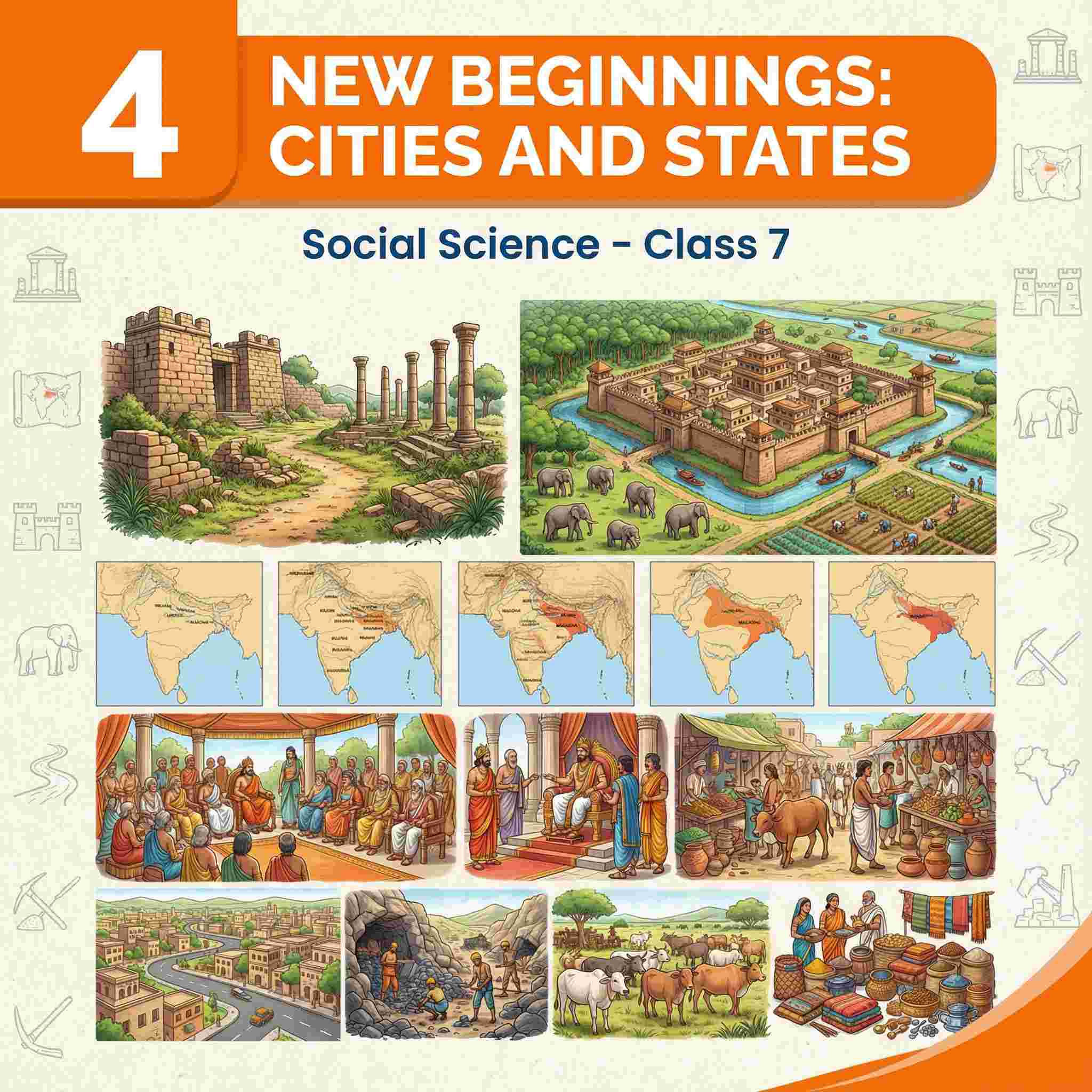
New Beginnings: Cities and States
Class 7 Social Science Chapter 4 | Complete NCERT Guide | Second Urbanisation, Janapadas Mahajanapadas, Governance
Full Chapter Summary & Detailed Notes – New Beginnings: Cities and States
Opening Quote – Kautilya (Arthashāstra)
“The kingdom shall be protected by fortifying the capital and the towns at the frontiers… It should be beautiful, being endowed with cultivable land, mines, timber forests, elephant forests, and good pastures rich in cattle… It should have good roads and waterways. It should have a productive economy, with a wide variety of commodities…”
This quote shows the idea of an ideal kingdom in ancient India – strong, rich, and self-sufficient.
Fig. 4.1 – Ruins at Rajagriha (Rajgir, Bihar)
Ancient capital of Magadha mahājanapada – one of the most powerful states.
The Big Questions (3 Questions – Very Important)
- What is meant by ‘Second Urbanisation of India’?
- Why were the janapadas and mahājanapadas an important development in India’s early history?
- What kind of system of governance did they evolve?
Second Urbanisation of India (~600 BCE)
After the decline of the Indus Valley Civilisation (First Urbanisation), cities disappeared). Around 600 BCE, cities re-emerged in the Ganga-Yamuna valley – called Second Urbanisation.
Reasons:
- Use of iron tools → better farming → surplus food
- Surplus food → population growth → trade → towns and cities
- New materials: baked bricks, iron weapons, coins
- Cities: Pataliputra, Ujjain, Taxila, Vaishali, Rajagriha
Janapadas → Mahājanapadas
| Stage | Meaning | Features |
|---|---|---|
| Janapada | “Jana” (people) + “pada” (foot) = land where people settled | Small territories, tribal chiefs, villages |
| Mahājanapada | “Great janapada” | 16 large, powerful states around 600 BCE |
Most Powerful Mahājanapadas: Magadha, Kosala, Vatsa, Avanti
Why Were Mahājanapadas Important?
- First real states in India
- Fixed boundaries, capital cities, standing armies
- Tax collection started
- Trade and craft grew
- Beginning of cities and urban life
Two Types of Government
| Type | Ruled By | Examples |
|---|---|---|
| Monarchy (Rajya) | King (Raja) – hereditary | Magadha (Bimbisara, Ajatashatru), Kosala |
| Gana or Sangha (Republic) | Assembly of people (no single king) | Vajji (Lichchhavis), Shakya (Buddha’s clan) |
Features of Mahājanapadas
- Fortified capital cities (e.g., Rajagriha had huge walls)
- Standing armies (soldiers paid salary)
- Tax system: farmers paid 1/6th of produce (Bhaga)
- Craftsmen, traders, merchants became important
- Use of coins (punch-marked coins) started
Magadha – The Most Powerful Mahājanapada
Reasons for Rise:
- Fertile land (Ganga plain)
- Iron mines nearby
- Elephants for army
- Good location for trade
- Strong rulers: Bimbisara, Ajatashatru
Key Takeaways for Exams
- Second Urbanisation = cities re-emerged after Indus Valley (~600 BCE)
- 16 Mahājanapadas – Magadha most powerful
- Two governments: Monarchy (king) & Gana (assembly)
- Kautilya’s Arthashāstra = book on ideal kingdom
One-Page Revision Map
Second Urbanisation → ~600 BCE, iron tools, surplus food → cities
Janapada → small → Mahājanapada → 16 large states
Government: Monarchy (raja) or Gana (assembly)
Magadha: Most powerful – fertile land, iron, elephants
Kautilya: Ideal kingdom – forts, fertile land, good roads


As an Amazon Associate, ProSyllabus earns from qualifying purchases. Prices shown are subject to change.
Test your CBSE Class 7 Annual Assessment prep
Quizzes
10 questions · ~10 minutes · instant rank & AI diagnosis
Integers and Rational Numbers Fundamentals | CBSE Class 7 Annual Assessment
Class 7 Social Science — Banks and the Magic of Finance (Practice Quiz)
Class 7 Social Science — Infrastructure: Engine of India's Development (Practice Quiz)
Class 7 Social Science — The State, the Government, and You (Practice Quiz)
Class 7 Social Science — India, a Home to Many (Practice Quiz)
Class 7 Social Science — Turning Tides: 11th and 12th Centuries (Practice Quiz)
Class 7 Social Science — Empires and Kingdoms: 6th to 10th Centuries (Practice Quiz)
Class 7 Social Science — India and Her Neighbours (Practice Quiz)
Class 7 Social Science — The Story of Indian Farming (Practice Quiz)
Class 7 Social Science — Understanding Markets (Practice Quiz)
Class 7 Social Science — From Barter to Money (Practice Quiz)
Class 7 Social Science — The Constitution of India — An Introduction (Practice Quiz)
Class 7 Social Science — From the Rulers to the Ruled: Types of Governments (Practice Quiz)
Class 7 Social Science — How the Land Becomes Sacred (Practice Quiz)
Class 7 Social Science — The Gupta Era: An Age of Tireless Creativity (Practice Quiz)
Class 7 Social Science — The Age of Reorganisation (Practice Quiz)
Class 7 Social Science — The Rise of Empires (Practice Quiz)
Class 7 Social Science — New Beginnings: Cities and States (Practice Quiz)
Class 7 Social Science — Climates of India (Practice Quiz)
Class 7 Social Science — Understanding the Weather (Practice Quiz)
Class 7 Social Science — Geographical Diversity of India (Practice Quiz)
Class 7 Sanskrit — परिशिष्टम् २ — धातुरूपाणि एवं सन्धि-परिचयः (Practice Quiz)
Class 7 Sanskrit — परिशिष्टम् १ — शब्दरूपाणि (Practice Quiz)
Class 7 Sanskrit — वर्णमात्रा-परिचयः (Practice Quiz)
Class 7 Sanskrit — वीराङ्गना पन्नाधाया (Practice Quiz)
Class 7 Sanskrit — द्वीपेषु रम्यः द्वीपोऽण्डमानः (Practice Quiz)
Class 7 Sanskrit — दशमः कः? (Practice Quiz)
Class 7 Sanskrit — अन्नाद् भवन्ति भूतानि (Practice Quiz)
Class 7 Sanskrit — हितं मनोहारि च दुर्लभं वचः (Practice Quiz)
Class 7 Sanskrit — ईशावास्यम् इदं सर्वम् (Practice Quiz)
Class 7 Sanskrit — क्रीडाम वयं श्लोकान्त्याक्षरीम् (Practice Quiz)
Class 7 Sanskrit — सेवा हि परमो धर्मः (Practice Quiz)
Class 7 Sanskrit — न लभ्यते चेत् आम्लं द्राक्षाफलम् (Practice Quiz)
Class 7 Sanskrit — मित्राय नमः (Practice Quiz)
Class 7 Sanskrit — नित्यं पिबामः सुभाषितरसम् (Practice Quiz)
Class 7 Sanskrit — वन्दे भारतमातरम् (Practice Quiz)
Class 7 Hindi — मीरा के पद (Practice Quiz)
Class 7 Hindi — चिड़िया (Practice Quiz)
Class 7 Hindi — बिरजू महाराज से साक्षात्कार (Practice Quiz)
Class 7 Hindi — वर्षा-बहार (Practice Quiz)
Class 7 Hindi — गिरिधर कविराय की कुंडलियाँ (Practice Quiz)
Class 7 Hindi — नहीं होना बीमार (Practice Quiz)
Class 7 Hindi — पानी रे पानी (Practice Quiz)
Class 7 Hindi — फूल और काँटा (Practice Quiz)
Class 7 Hindi — तीन बुद्धिमान (Practice Quiz)
Class 7 Hindi — माँ, कह एक कहानी (Practice Quiz)
Class 7 English — Bravehearts (Practice Quiz)
Class 7 English — Travel and Adventure (Practice Quiz)
Class 7 English — Dreams and Discoveries (Practice Quiz)
Class 7 English — Wit and Humour (Practice Quiz)
Class 7 English — Learning Together (Practice Quiz)
Class 7 Maths — Finding the Unknown (Practice Quiz)
Class 7 Maths — Constructions and Tilings (Practice Quiz)
Class 7 Maths — Connecting the Dots… (Practice Quiz)
Class 7 Maths — Another Peek Beyond the Point (Practice Quiz)
Class 7 Maths — Finding Common Ground (Practice Quiz)
Class 7 Maths — Operations with Integers (Practice Quiz)
Class 7 Maths — Geometric Twins (Practice Quiz)
Class 7 Maths — Working with Fractions (Practice Quiz)
Class 7 Maths — A Tale of Three Intersecting Lines (Practice Quiz)
Class 7 Maths — Number Play (Practice Quiz)
Class 7 Maths — Parallel and Intersecting Lines (Practice Quiz)
Class 7 Maths — Expressions Using Letter-Numbers (Practice Quiz)
Class 7 Maths — A Peek Beyond the Point (Practice Quiz)
Class 7 Maths — Arithmetic Expressions (Practice Quiz)
Class 7 Maths — Large Numbers Around Us (Practice Quiz)
Class 7 Science — Earth, Moon, and the Sun (Practice Quiz)
Class 7 Science — Light: Shadows and Reflections (Practice Quiz)
Class 7 Science — Life Processes in Plants (Practice Quiz)
Class 7 Science — Life Processes in Animals (Practice Quiz)
Class 7 Science — Measurement of Time and Motion (Practice Quiz)
Class 7 Science — Heat Transfer in Nature (Practice Quiz)
Class 7 Science — Adolescence: A Stage of Growth and Change (Practice Quiz)
Class 7 Science — Changes Around Us: Physical and Chemical (Practice Quiz)
Class 7 Science — The World of Metals and Non-metals (Practice Quiz)
Class 7 Science — Electricity: Circuits and their Components (Practice Quiz)
Class 7 Science — Exploring Substances: Acidic, Basic, and Neutral (Practice Quiz)
Class 7 Science — The Ever-Evolving World of Science (Practice Quiz)
Simple Equations and Applications Practice Quiz | CBSE Class 7 Annual Assessment
Visualising Solid Shapes Advanced Challenge | CBSE Class 7 Annual Assessment
Tracing Changes Through Time Fundamentals | CBSE Class 7 Annual Assessment
Nutrition in Plants Fundamentals | CBSE Class 7 Annual Assessment

Group Discussions
No forum posts available.


