Class 7 Social Science Chapter 5: The Rise of Empires | Meaning of Empire, Features, Pataliputra Story, Tribute, Army, Administration, Trade & Culture
Complete Chapter 5 guide: definition of an empire (imperium, samrāj, rājādhirāja), time‑travel story tour of Pataliputra with forts, moats, caves and markets, how large empires grew from smaller kingdoms using war, resources and trade routes, key features of an empire (central authority, tributary kings, army, administration, taxes, roads and navigation, promotion of art and learning), and how empires reshaped political, economic, social and cultural life, with exam-focused summary, Q&A, extra questions and quiz for CBSE Exam
Updated: 6 months ago
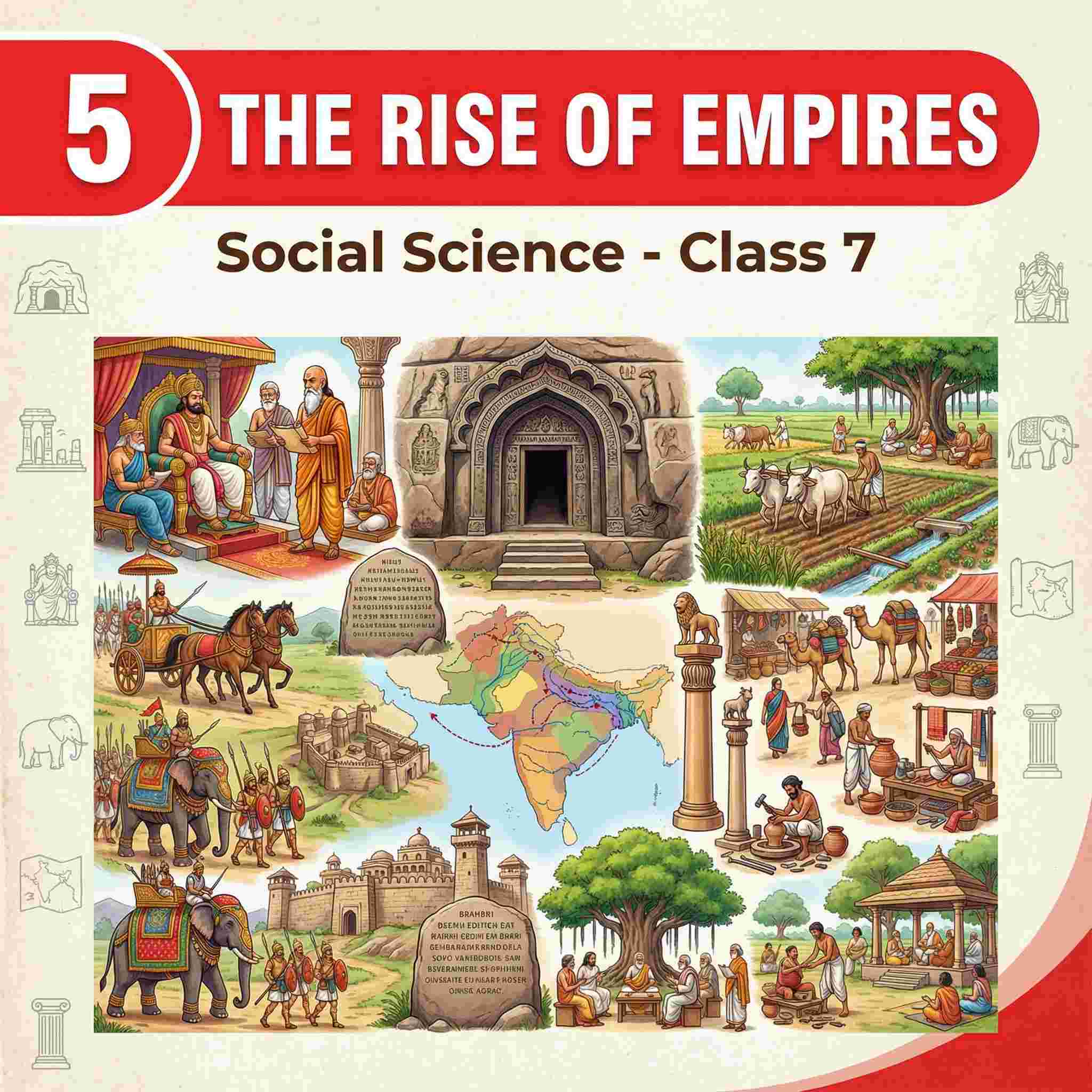
The Rise of Empires
Class 7 Social Science Chapter 5 | Complete NCERT Guide | Mauryan Empire, Ashoka, Kautilya, Alexander
Full Chapter Summary & Detailed Notes – The Rise of Empires
Opening Quote – Kautilya (Arthashāstra)
"There cannot be a country without people and there is no kingdom without a country."
This quote shows the essential connection between people, land, and governance in ancient India.
Fig. 5.1 – Rock-cut cave in Barabar Hills, Bihar
Ancient cave carved for monks, showing royal patronage of religion.
The Big Questions (4 Questions – Very Important)
- What is an empire?
- How did empires rise and shape Indian civilisation?
- What factors facilitated the transition from kingdoms to empires?
- What was life like from the 6th to the 2nd century BCE?
Story Introduction: Visit to Pāṭaliputra
Bhavisha and Dhruv time-travel to ancient Pāṭaliputra (modern Patna), meet Ira (daughter of ironsmith), see soldiers marching to battle, drawbridge, moat, market with traders from China, south India, acrobats performing.
What is an Empire?
From Latin imperium = supreme power. Large territory of smaller kingdoms under one ruler (emperor). Smaller rulers become tributaries – pay tribute (gold, elephants, grain) as sign of loyalty.
Sanskrit Terms: Samrāj (lord of all), Adhirāja (overlord), Rājādhirāja (king of kings).
Features of an Empire
| Feature | Description |
|---|---|
| 01. Army | Maintains control, expands, protects from aggression |
| 02. Administration | Officials manage territories, collect taxes, maintain law |
| 03. Laws & Economy | Makes laws, issues coins, weights, measures, regulates trade |
| 04. Resource Control | Controls mines, forests, agricultural produce, manpower |
| 05. Culture | Encourages art, literature, religions, centres of learning |
| 06. Infrastructure | Maintains roads, river/sea navigation for trade & welfare |
Why Expand to Empire?
- Ambition: Rule the entire world, be remembered for posterity
- Resources: Control large areas for economic & military strength
- Wealth: Great wealth for emperor and empire
In return, emperors allowed local rulers to continue governing their areas.
Methods of Expansion
- War: Against neighbouring territories
- Fortifications: Strategic settlements at borders
- Trade Control: Rivers and trade networks for resources & tax
- Military Superiority: Stronger army + surplus resources win
- Other: Alliances, marriages, diplomacy
Trade, Trade Routes & Guilds
Trade Goods: Textiles, spices, agricultural produce, gems, handicrafts, animals
Routes: Uttarapatha (north), Dakshinapatha (south), sea routes to other countries
Guilds (Shreni): Associations of traders/craftsmen with elected heads, self-governing, promoted collaboration over competition
The Rise of Magadha
Period: 6th–4th century BCE
Advantages:
- Fertile Ganga plains
- Iron mines nearby
- Elephant forests for army
- Ganga & Son rivers for trade/transport
- Strong rulers: Ajātaśatru, Mahāpadma Nanda
Nanda Dynasty
- Mahāpadma Nanda unified many kingdoms
- Issued punch-marked coins
- Large army (Greek accounts)
- Unpopular due to oppression → overthrown
Alexander's Arrival (327–325 BCE)
Conquered Persian Empire, reached India, defeated Porus in Punjab, faced resistance, soldiers mutinied, retreated. Left satraps in northwest.
The Mighty Mauryas (321–185 BCE)
Founder: Chandragupta Maurya with mentor Kautilya (Chanakya)
Capital: Pāṭaliputra
Greatest King: Ashoka (268–232 BCE)
Kautilya's Arthashāstra
Saptānga Theory: 7 elements of state (king, minister, territory, fort, treasury, army, ally)
Welfare State: "In the happiness of his subjects lies the king's happiness"
Ashoka: The King Who Chose Peace
- Expanded empire to almost entire subcontinent
- Kalinga War (261 BCE) → 100,000+ deaths → gave up violence
- Embraced Buddhism, sent missionaries abroad
- Edicts: In Prakrit (Brahmi script) on rocks/pillars promoting dhamma
- Title: Devanampiya Piyadasi (Beloved of Gods, Kind-hearted)
Life in Mauryan Period
- Bustling cities, planned streets, granaries
- Strong trade, guilds, punch-marked coins
- Beautiful art: Sarnath Lion Capital (national emblem)
- Dharmachakra on national flag
One-Page Revision Map
Empire → Many kingdoms under emperor, tributaries pay tribute
Magadha Rise → Fertile land + iron + elephants → Nanda → Maurya
Chandragupta + Kautilya → Founded Mauryan Empire, Arthashāstra
Ashoka → Kalinga war → Dhamma → Edicts → Spread Buddhism
Legacy → Sarnath Lion Capital (Emblem), Dharmachakra (Flag)


As an Amazon Associate, ProSyllabus earns from qualifying purchases. Prices shown are subject to change.
Test your CBSE Class 7 Annual Assessment prep
Quizzes
10 questions · ~10 minutes · instant rank & AI diagnosis
Integers and Rational Numbers Fundamentals | CBSE Class 7 Annual Assessment
Class 7 Social Science — Banks and the Magic of Finance (Practice Quiz)
Class 7 Social Science — Infrastructure: Engine of India's Development (Practice Quiz)
Class 7 Social Science — The State, the Government, and You (Practice Quiz)
Class 7 Social Science — India, a Home to Many (Practice Quiz)
Class 7 Social Science — Turning Tides: 11th and 12th Centuries (Practice Quiz)
Class 7 Social Science — Empires and Kingdoms: 6th to 10th Centuries (Practice Quiz)
Class 7 Social Science — India and Her Neighbours (Practice Quiz)
Class 7 Social Science — The Story of Indian Farming (Practice Quiz)
Class 7 Social Science — Understanding Markets (Practice Quiz)
Class 7 Social Science — From Barter to Money (Practice Quiz)
Class 7 Social Science — The Constitution of India — An Introduction (Practice Quiz)
Class 7 Social Science — From the Rulers to the Ruled: Types of Governments (Practice Quiz)
Class 7 Social Science — How the Land Becomes Sacred (Practice Quiz)
Class 7 Social Science — The Gupta Era: An Age of Tireless Creativity (Practice Quiz)
Class 7 Social Science — The Age of Reorganisation (Practice Quiz)
Class 7 Social Science — The Rise of Empires (Practice Quiz)
Class 7 Social Science — New Beginnings: Cities and States (Practice Quiz)
Class 7 Social Science — Climates of India (Practice Quiz)
Class 7 Social Science — Understanding the Weather (Practice Quiz)
Class 7 Social Science — Geographical Diversity of India (Practice Quiz)
Class 7 Sanskrit — परिशिष्टम् २ — धातुरूपाणि एवं सन्धि-परिचयः (Practice Quiz)
Class 7 Sanskrit — परिशिष्टम् १ — शब्दरूपाणि (Practice Quiz)
Class 7 Sanskrit — वर्णमात्रा-परिचयः (Practice Quiz)
Class 7 Sanskrit — वीराङ्गना पन्नाधाया (Practice Quiz)
Class 7 Sanskrit — द्वीपेषु रम्यः द्वीपोऽण्डमानः (Practice Quiz)
Class 7 Sanskrit — दशमः कः? (Practice Quiz)
Class 7 Sanskrit — अन्नाद् भवन्ति भूतानि (Practice Quiz)
Class 7 Sanskrit — हितं मनोहारि च दुर्लभं वचः (Practice Quiz)
Class 7 Sanskrit — ईशावास्यम् इदं सर्वम् (Practice Quiz)
Class 7 Sanskrit — क्रीडाम वयं श्लोकान्त्याक्षरीम् (Practice Quiz)
Class 7 Sanskrit — सेवा हि परमो धर्मः (Practice Quiz)
Class 7 Sanskrit — न लभ्यते चेत् आम्लं द्राक्षाफलम् (Practice Quiz)
Class 7 Sanskrit — मित्राय नमः (Practice Quiz)
Class 7 Sanskrit — नित्यं पिबामः सुभाषितरसम् (Practice Quiz)
Class 7 Sanskrit — वन्दे भारतमातरम् (Practice Quiz)
Class 7 Hindi — मीरा के पद (Practice Quiz)
Class 7 Hindi — चिड़िया (Practice Quiz)
Class 7 Hindi — बिरजू महाराज से साक्षात्कार (Practice Quiz)
Class 7 Hindi — वर्षा-बहार (Practice Quiz)
Class 7 Hindi — गिरिधर कविराय की कुंडलियाँ (Practice Quiz)
Class 7 Hindi — नहीं होना बीमार (Practice Quiz)
Class 7 Hindi — पानी रे पानी (Practice Quiz)
Class 7 Hindi — फूल और काँटा (Practice Quiz)
Class 7 Hindi — तीन बुद्धिमान (Practice Quiz)
Class 7 Hindi — माँ, कह एक कहानी (Practice Quiz)
Class 7 English — Bravehearts (Practice Quiz)
Class 7 English — Travel and Adventure (Practice Quiz)
Class 7 English — Dreams and Discoveries (Practice Quiz)
Class 7 English — Wit and Humour (Practice Quiz)
Class 7 English — Learning Together (Practice Quiz)
Class 7 Maths — Finding the Unknown (Practice Quiz)
Class 7 Maths — Constructions and Tilings (Practice Quiz)
Class 7 Maths — Connecting the Dots… (Practice Quiz)
Class 7 Maths — Another Peek Beyond the Point (Practice Quiz)
Class 7 Maths — Finding Common Ground (Practice Quiz)
Class 7 Maths — Operations with Integers (Practice Quiz)
Class 7 Maths — Geometric Twins (Practice Quiz)
Class 7 Maths — Working with Fractions (Practice Quiz)
Class 7 Maths — A Tale of Three Intersecting Lines (Practice Quiz)
Class 7 Maths — Number Play (Practice Quiz)
Class 7 Maths — Parallel and Intersecting Lines (Practice Quiz)
Class 7 Maths — Expressions Using Letter-Numbers (Practice Quiz)
Class 7 Maths — A Peek Beyond the Point (Practice Quiz)
Class 7 Maths — Arithmetic Expressions (Practice Quiz)
Class 7 Maths — Large Numbers Around Us (Practice Quiz)
Class 7 Science — Earth, Moon, and the Sun (Practice Quiz)
Class 7 Science — Light: Shadows and Reflections (Practice Quiz)
Class 7 Science — Life Processes in Plants (Practice Quiz)
Class 7 Science — Life Processes in Animals (Practice Quiz)
Class 7 Science — Measurement of Time and Motion (Practice Quiz)
Class 7 Science — Heat Transfer in Nature (Practice Quiz)
Class 7 Science — Adolescence: A Stage of Growth and Change (Practice Quiz)
Class 7 Science — Changes Around Us: Physical and Chemical (Practice Quiz)
Class 7 Science — The World of Metals and Non-metals (Practice Quiz)
Class 7 Science — Electricity: Circuits and their Components (Practice Quiz)
Class 7 Science — Exploring Substances: Acidic, Basic, and Neutral (Practice Quiz)
Class 7 Science — The Ever-Evolving World of Science (Practice Quiz)
Simple Equations and Applications Practice Quiz | CBSE Class 7 Annual Assessment
Visualising Solid Shapes Advanced Challenge | CBSE Class 7 Annual Assessment
Tracing Changes Through Time Fundamentals | CBSE Class 7 Annual Assessment
Nutrition in Plants Fundamentals | CBSE Class 7 Annual Assessment

Group Discussions
No forum posts available.


