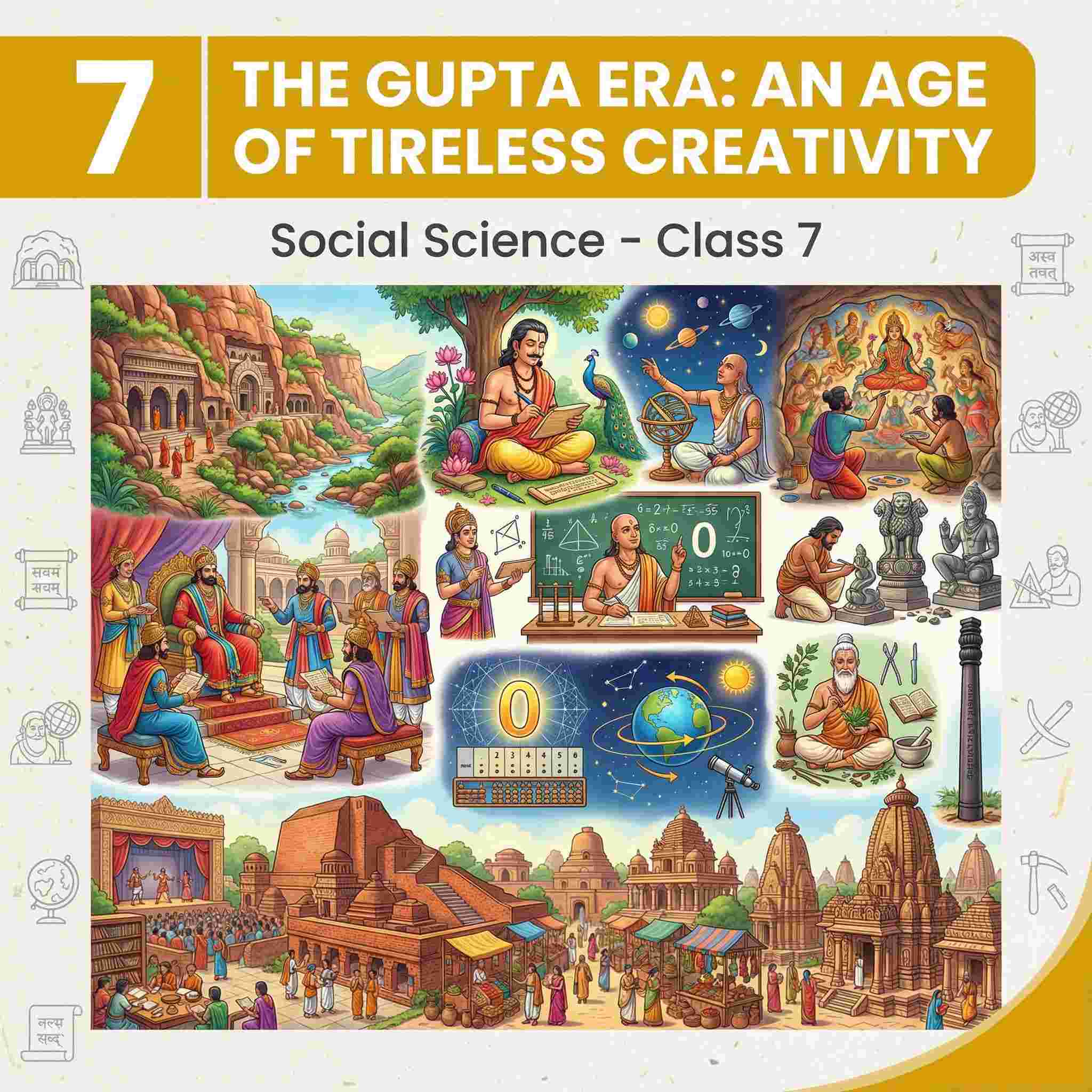
Class 7 Social Science Chapter 7: The Gupta Era – An Age of Tireless Creativity | Gupta Empire, Chandragupta I & II, Samudragupta, Iron Pillar, Golden Age in Art, Science & Literature
Complete Chapter 7 guide: rise of the Gupta dynasty after the Kushanas, expansion under Chandragupta I and the warrior‑king Samudragupta (Prayaga prashasti, veena coin, aśvamedha), Chandragupta II Vikramaditya and the Iron Pillar inscription, contemporary kingdoms Vakataka, Pallava and Kamarupa, flourishing of art, architecture, metallurgy, astronomy, mathematics and classical Sanskrit literature (Kalidasa), with timeline, maps, summary, NCERT-style Q&A, extra questions and quiz for CBSE Exam
Updated: 6 months ago
Categories: Class 7 Social Science, NCERT Notes, Ancient Indian History, Gupta Empire & Classical Age, Art Science and Literature, CBSE Exam Preparation, Q&A and Quizzes
Tags: class 7 social science chapter 7 notes, gupta era age of tireless creativity, gupta empire map class 7, chandragupta I coins alliance, samudragupta prayaga prashasti inscription, samudragupta veena coin, ashvamedha yajna gupta, chandragupta II vikramaditya iron pillar delhi, iron pillar rust proof metallurgy, vakataka kingdom nandivardhana, pallava kingdom kanchipuram, kamarupa early assam kingdom, gupta golden age art science literature, kalidasa raghuvansham classical sanskrit, ajanta caves gupta period, cbse class 7 history chapter 7, ncert gupta era solutions, summary questions answers quiz
Class 7 Social Science Chapter 7: The Gupta Era: An Age of Tireless Creativity | Complete NCERT Notes, Activities, Questions & Answers 2025
The Gupta Era: An Age of Tireless Creativity
Class 7 Social Science Chapter 7 | Complete NCERT Guide | Gupta Empire, Classical Age
Full Chapter Summary & Detailed Notes – The Gupta Era: An Age of Tireless Creativity
Opening Quote – Kālidāsa in Raghuvamśham
“Neither force nor mere diplomacy can eliminate evil; nor is righteousness upheld by flattery alone. It is wisdom and knowledge that truly strengthen a kingdom—not indulgence in luxuries.”
This quote highlights the importance of wisdom in governance.
Fig. 7.1 – Landscape of Ajanta Caves
Dating from 2nd century BCE to 480 CE, a symbol of ancient creativity.
The Big Questions (3 Questions – Very Important)
Who were the Guptas? Why is the Gupta period called the ‘classical age’?
What was happening in the rest of the subcontinent?
Who were great figures, and why do their stories matter today?
Introduction & Period Overview
Gupta period (3rd-6th century CE): Emerged after Kushana decline. From Uttar Pradesh, expanded to north, west, parts of central/east India. Known for art, literature, science; called 'classical age'.
Why 'Classical Age'? Peace, stability led to cultural/intellectual growth.
Golden Line for 5 Marks:
“Gupta era (3rd-6th CE) is 'classical' for peace enabling art (Ajanta), science (Aryabhata), literature (Kalidasa). Rulers like Chandragupta II patronised talent, leaving lasting legacy.”
Activities & 25+ Questions and Answers - The Gupta Era
All "Let's Explore", "Think About It", "Don't Miss Out" & "Let's Remember" – Key Insights
Dynasty in south (TN, Karnataka, etc.); patrons of art, Kanchipuram capital.
7. Exploration trip report
(Describe visit to site like Ajanta: History, architecture, artefacts, learning reflection.)
Extra Practice 25+ Questions (Exam Booster)
1. Gupta period called?
Classical age.
2. Iron Pillar ruler?
Chandragupta II.
3. Samudragupta inscription?
Prayaga Prashasti.
4. Vikramaditya?
Chandragupta II.
5. Regent example?
Prabhāvati Gupta.
6. Faxian visited?
5th CE.
7. Ayurveda texts?
Charaka/Sushruta Samhita.
8. Aryabhata contribution?
Earth spins.
9. Kalidasa work?
Meghadūtam.
10. Ajanta caves?
Paintings, sculptures.
11. Decline cause?
Huna invasions.
12. Pallavas capital?
Kanchipuram.
13. Kamarupa region?
Assam, Bengal.
14. Trade island?
Socotra.
15. Nalanda?
University.
16. Udayagiri?
Caves, Vishnu.
17. Outcastes?
Chandalas.
18. Land grants?
Copper plates.
19. Vishnu vahana?
Garuda.
20. Varahamihira work?
Brihat Samhita.
21. Gupta art centers?
Sarnath, Ajanta.
22. Pallavas patrons?
Art, temples.
23. Ghatikas?
Learning centers.
24. Prashasti by?
Harisena.
25. Gupta origin?
Uttar Pradesh.
Key Concepts - In-Depth Exploration (Chapter 7)
Core ideas explained with examples, common confusions, and exam connections for "The Gupta Era".
Classical Age
Concept: Peak of cultural/intellectual growth. Example: Aryabhata's math, Kalidasa's poetry. Exam Note: Due to stability. Confusion: Not just golden, but 'classical' for consolidation.
Matrimonial Alliances
Concept: Marriages for political stability. Example: Prabhāvati with Vakatakas. Exam Trick: Women's regency roles.
Exam Master Tips:
Mnemonics: "Guptas: Chandra-Samudra-Chandra"
Contributions: Art-Science-Lit
Most Asked: Why classical? Legacy today.
Historical & Social Insights – How Gupta Era Shaped India
Trade Networks: Indian Ocean, Socotra – cultural exchanges.
Religious Tolerance: Vishnu devotees supported Buddhism (Nalanda).
Art Evolution: Gupta style influenced later temples.
Decline & Transition: Hunas led to regional powers.
Other Regions: Pallavas (south temples), Kamarupa (northeast learning).
Social Insights
Prosperous Society: Faxian: No harsh laws, charity for poor.
Women's Roles: Prabhāvati as regent, temple builder.
Outcastes: Chandalas faced discrimination.
Learning & Patronage: Courts with scholars, ghatikas.
Economy: Land grants, trade taxes.
Holistic Health: Ayurveda emphasis on mind-body.
Inclusivity: Supported multiple faiths.
Modern Connections – You Can Still See Today!
Iron Pillar → Delhi, rust-resistant tech
Ajanta Caves → UNESCO site, paintings
Ayurveda → Global wellness practices
Nalanda → Revived as university
Kanchipuram → Temple city
Math/Astronomy → Aryabhata's ideas in science
Important Archaeological Sites
Ajanta (MH) → Caves, paintings
Udayagiri (MP) → Vishnu carvings
Sarnath (UP) → Buddha sculptures
Nalanda (Bihar) → University ruins
Impact on Indian History
Golden/Classical benchmark
Cultural legacy in art/science
Tolerance model
Bridge to medieval eras
Exam Quick Tips & Golden Lines
Best Historical Example: “Samudragupta's prashasti shows unification ambition.”
Best Social Example: “Faxian described prosperous, kind society.”
Golden Line for Long Answer:
“Gupta era marked 'classical age' with advances in art (Ajanta), science (Aryabhata), governance via alliances. Legacy inspires modern India’s creativity and tolerance.”
3 attempts on CBSE Class 7 Annual Assessment quizzes
HIMAKSHI GUPTA . scored 2/10 on Integers and Rational Numbers Naavya Agarwal scored 0/10 on Integers and Rational Numbers Anshika Yadav scored 0/10 on Integers and Rational Numbers HIMAKSHI GUPTA . scored 2/10 on Integers and Rational Numbers Naavya Agarwal scored 0/10 on Integers and Rational Numbers Anshika Yadav scored 0/10 on Integers and Rational Numbers
#1
Integers and Rational Numbers Fundamentals | CBSE Class 7 Annual Assessment
10 Qs · ~10 min
#2
Class 7 Social Science — Banks and the Magic of Finance (Practice Quiz)
10 Qs · ~10 min
#3
Class 7 Social Science — Infrastructure: Engine of India's Development (Practice Quiz)
10 Qs · ~10 min
#4
Class 7 Social Science — The State, the Government, and You (Practice Quiz)
10 Qs · ~10 min
#5
Class 7 Social Science — India, a Home to Many (Practice Quiz)
10 Qs · ~10 min
#6
Class 7 Social Science — Turning Tides: 11th and 12th Centuries (Practice Quiz)
10 Qs · ~10 min
#7
Class 7 Social Science — Empires and Kingdoms: 6th to 10th Centuries (Practice Quiz)
10 Qs · ~10 min
#8
Class 7 Social Science — India and Her Neighbours (Practice Quiz)
10 Qs · ~10 min
#9
Class 7 Social Science — The Story of Indian Farming (Practice Quiz)
10 Qs · ~10 min
#10
Class 7 Social Science — Understanding Markets (Practice Quiz)
10 Qs · ~10 min
#11
Class 7 Social Science — From Barter to Money (Practice Quiz)
10 Qs · ~10 min
#12
Class 7 Social Science — The Constitution of India — An Introduction (Practice Quiz)
10 Qs · ~10 min
#13
Class 7 Social Science — From the Rulers to the Ruled: Types of Governments (Practice Quiz)
10 Qs · ~10 min
#14
Class 7 Social Science — How the Land Becomes Sacred (Practice Quiz)
10 Qs · ~10 min
#15
Class 7 Social Science — The Gupta Era: An Age of Tireless Creativity (Practice Quiz)
10 Qs · ~10 min
#16
Class 7 Social Science — The Age of Reorganisation (Practice Quiz)
10 Qs · ~10 min
#17
Class 7 Social Science — The Rise of Empires (Practice Quiz)
10 Qs · ~10 min
#18
Class 7 Social Science — New Beginnings: Cities and States (Practice Quiz)
10 Qs · ~10 min
#19
Class 7 Social Science — Climates of India (Practice Quiz)
10 Qs · ~10 min
#20
Class 7 Social Science — Understanding the Weather (Practice Quiz)
10 Qs · ~10 min
#21
Class 7 Social Science — Geographical Diversity of India (Practice Quiz)
10 Qs · ~10 min
#22
Class 7 Sanskrit — परिशिष्टम् २ — धातुरूपाणि एवं सन्धि-परिचयः (Practice Quiz)
10 Qs · ~10 min
#23
Class 7 Sanskrit — परिशिष्टम् १ — शब्दरूपाणि (Practice Quiz)
10 Qs · ~10 min
#24
Class 7 Sanskrit — वर्णमात्रा-परिचयः (Practice Quiz)
10 Qs · ~10 min
#25
Class 7 Sanskrit — वीराङ्गना पन्नाधाया (Practice Quiz)
10 Qs · ~10 min
#26
Class 7 Sanskrit — द्वीपेषु रम्यः द्वीपोऽण्डमानः (Practice Quiz)
10 Qs · ~10 min
#27
Class 7 Sanskrit — दशमः कः? (Practice Quiz)
10 Qs · ~10 min
#28
Class 7 Sanskrit — अन्नाद् भवन्ति भूतानि (Practice Quiz)
10 Qs · ~10 min
#29
Class 7 Sanskrit — हितं मनोहारि च दुर्लभं वचः (Practice Quiz)
10 Qs · ~10 min
#30
Class 7 Sanskrit — ईशावास्यम् इदं सर्वम् (Practice Quiz)
10 Qs · ~10 min
#31
Class 7 Sanskrit — क्रीडाम वयं श्लोकान्त्याक्षरीम् (Practice Quiz)
10 Qs · ~10 min
#32
Class 7 Sanskrit — सेवा हि परमो धर्मः (Practice Quiz)
10 Qs · ~10 min
#33
Class 7 Sanskrit — न लभ्यते चेत् आम्लं द्राक्षाफलम् (Practice Quiz)
10 Qs · ~10 min
#34
Class 7 Sanskrit — मित्राय नमः (Practice Quiz)
10 Qs · ~10 min
#35
Class 7 Sanskrit — नित्यं पिबामः सुभाषितरसम् (Practice Quiz)
10 Qs · ~10 min
#36
Class 7 Sanskrit — वन्दे भारतमातरम् (Practice Quiz)
10 Qs · ~10 min
#37
Class 7 Hindi — मीरा के पद (Practice Quiz)
10 Qs · ~10 min
#38
Class 7 Hindi — चिड़िया (Practice Quiz)
10 Qs · ~10 min
#39
Class 7 Hindi — बिरजू महाराज से साक्षात्कार (Practice Quiz)
10 Qs · ~10 min
#40
Class 7 Hindi — वर्षा-बहार (Practice Quiz)
10 Qs · ~10 min
#41
Class 7 Hindi — गिरिधर कविराय की कुंडलियाँ (Practice Quiz)
10 Qs · ~10 min
#42
Class 7 Hindi — नहीं होना बीमार (Practice Quiz)
10 Qs · ~10 min
#43
Class 7 Hindi — पानी रे पानी (Practice Quiz)
10 Qs · ~10 min
#44
Class 7 Hindi — फूल और काँटा (Practice Quiz)
10 Qs · ~10 min
#45
Class 7 Hindi — तीन बुद्धिमान (Practice Quiz)
10 Qs · ~10 min
#46
Class 7 Hindi — माँ, कह एक कहानी (Practice Quiz)
10 Qs · ~10 min
#47
Class 7 English — Bravehearts (Practice Quiz)
10 Qs · ~10 min
#48
Class 7 English — Travel and Adventure (Practice Quiz)
10 Qs · ~10 min
#49
Class 7 English — Dreams and Discoveries (Practice Quiz)
10 Qs · ~10 min
#50
Class 7 English — Wit and Humour (Practice Quiz)
10 Qs · ~10 min
#51
Class 7 English — Learning Together (Practice Quiz)
10 Qs · ~10 min
#52
Class 7 Maths — Finding the Unknown (Practice Quiz)
10 Qs · ~10 min
#53
Class 7 Maths — Constructions and Tilings (Practice Quiz)
10 Qs · ~10 min
#54
Class 7 Maths — Connecting the Dots… (Practice Quiz)
10 Qs · ~10 min
#55
Class 7 Maths — Another Peek Beyond the Point (Practice Quiz)
10 Qs · ~10 min
#56
Class 7 Maths — Finding Common Ground (Practice Quiz)
10 Qs · ~10 min
#57
Class 7 Maths — Operations with Integers (Practice Quiz)
10 Qs · ~10 min
#58
Class 7 Maths — Geometric Twins (Practice Quiz)
10 Qs · ~10 min
#59
Class 7 Maths — Working with Fractions (Practice Quiz)
10 Qs · ~10 min
#60
Class 7 Maths — A Tale of Three Intersecting Lines (Practice Quiz)
10 Qs · ~10 min
#61
Class 7 Maths — Number Play (Practice Quiz)
10 Qs · ~10 min
#62
Class 7 Maths — Parallel and Intersecting Lines (Practice Quiz)
10 Qs · ~10 min
#63
Class 7 Maths — Expressions Using Letter-Numbers (Practice Quiz)
10 Qs · ~10 min
#64
Class 7 Maths — A Peek Beyond the Point (Practice Quiz)
10 Qs · ~10 min
#65
Class 7 Maths — Arithmetic Expressions (Practice Quiz)
10 Qs · ~10 min
#66
Class 7 Maths — Large Numbers Around Us (Practice Quiz)
10 Qs · ~10 min
#67
Class 7 Science — Earth, Moon, and the Sun (Practice Quiz)
10 Qs · ~10 min
#68
Class 7 Science — Light: Shadows and Reflections (Practice Quiz)
10 Qs · ~10 min
#69
Class 7 Science — Life Processes in Plants (Practice Quiz)
10 Qs · ~10 min
#70
Class 7 Science — Life Processes in Animals (Practice Quiz)
10 Qs · ~10 min
#71
Class 7 Science — Measurement of Time and Motion (Practice Quiz)
10 Qs · ~10 min
#72
Class 7 Science — Heat Transfer in Nature (Practice Quiz)
10 Qs · ~10 min
#73
Class 7 Science — Adolescence: A Stage of Growth and Change (Practice Quiz)
10 Qs · ~10 min
#74
Class 7 Science — Changes Around Us: Physical and Chemical (Practice Quiz)
10 Qs · ~10 min
#75
Class 7 Science — The World of Metals and Non-metals (Practice Quiz)
10 Qs · ~10 min
#76
Class 7 Science — Electricity: Circuits and their Components (Practice Quiz)
10 Qs · ~10 min
#77
Class 7 Science — Exploring Substances: Acidic, Basic, and Neutral (Practice Quiz)
10 Qs · ~10 min
#78
Class 7 Science — The Ever-Evolving World of Science (Practice Quiz)
10 Qs · ~10 min
#79
Simple Equations and Applications Practice Quiz | CBSE Class 7 Annual Assessment