Class 7 Social Science Chapter 9: From the Rulers to the Ruled – Types of Governments | Democracy, Monarchy, Theocracy, Dictatorship, Fundamental Rights & Participation
Complete Chapter 9 guide: what government is and what it does, detailed meaning of democracy as “rule of the people” with school committee example, three functions of government (legislative, executive, judiciary), key differences between systems (who gives power, how govt is formed, parts of govt, aims), core democratic principles (equality, freedoms, representation, universal adult franchise, independent judiciary, rights), and overview of forms like direct democracy, representative democracy, monarchy and theocracy, with exam-focused summary, Q&A, extra questions and quiz for CBSE Exam
Updated: 6 months ago
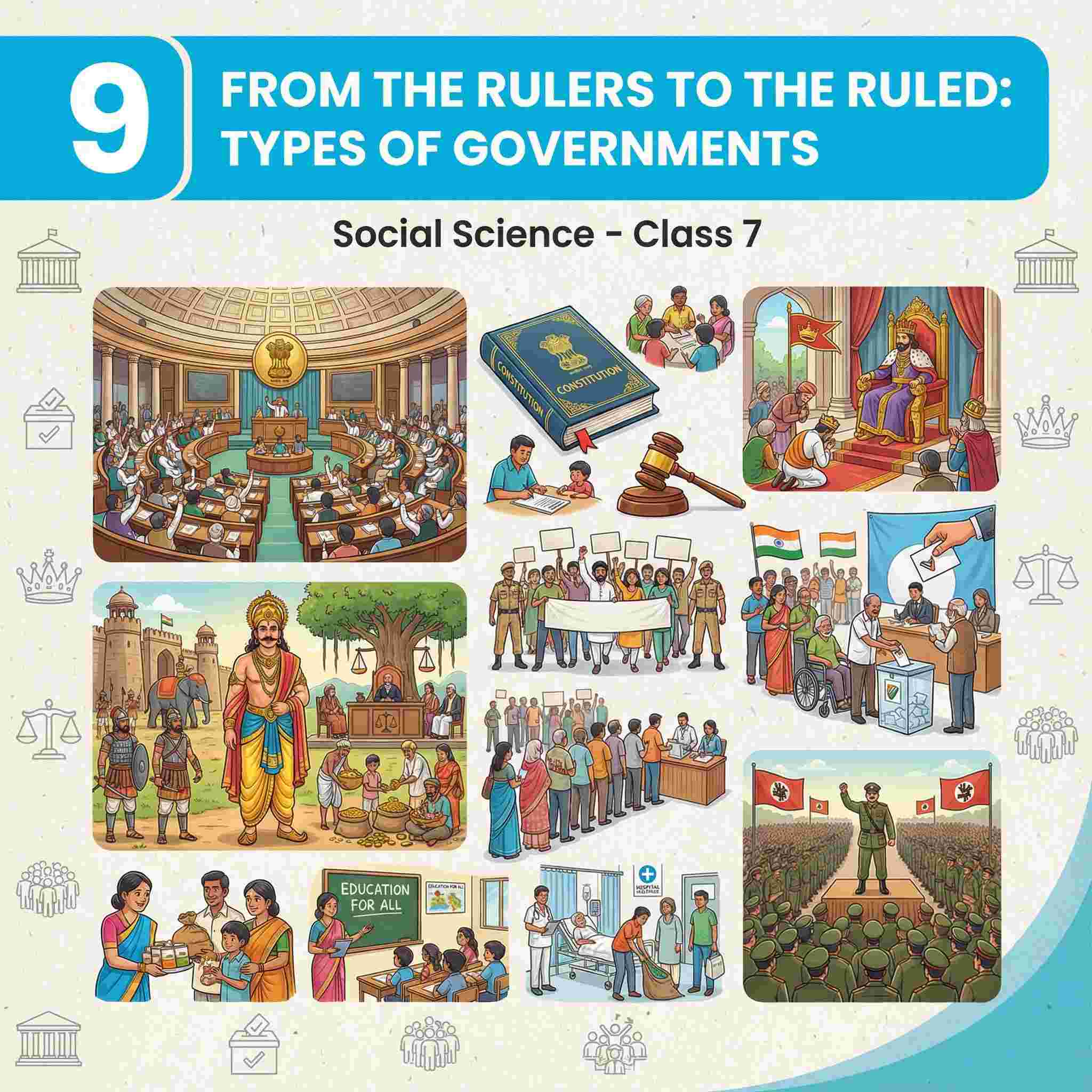
From the Rulers to the Ruled: Types of Governments
Class 7 Social Science Chapter 9 | Complete NCERT Guide | Democracy, Monarchy, Dictatorship 2025
Full Chapter Summary & Detailed Notes – From the Rulers to the Ruled: Types of Governments
Opening Idea – What is Government?
Government is the system that runs a country. As per Kautilya's Arthashastra, a ruler's duties are three-fold: raksha (protection from external aggression), palana (maintenance of law and order), and yogakshema (safeguarding people's welfare).
Functions include maintaining law/order, peace, foreign relations, defense, essential services (education, health, infrastructure), managing economy, and improving lives.
The Big Questions of the Chapter (Most Important for Exams)
- What are the different types of government?
- Where do governments get their power from?
- How does a country's government interact with the people?
- Why does democracy matter?
What is Democracy? – Explained with School Example
| Option | Description | Why Democratic? |
|---|---|---|
| Everyone in committee | Hard to decide/manage | Impractical for large groups |
| Head Teacher chooses | No voice for students | Not representative |
| Students elect representatives | One per grade, voices heard | Democratic way |
Functions of Government – 3 Branches
Legislative
Creation of rules/laws (framework for country)
Executive
Implementation and administration
Judicial
Ensuring rules are followed
Key Differences Between Governments
| Aspect | Description | Examples |
|---|---|---|
| Who decides 'this is the government'? | Source of authority | Democracy: People; Theocracy: Religion |
| How is government formed? | Elections, inheritance, etc. | Democracy: Elections; Monarchy: Family |
| Parts and roles | Legislative, Executive, Judicial | Independent or combined |
| Goals | Equality, prosperity, etc. | India: For all; Some: For elite groups |
Democratic Governments – Fundamental Principles
- Equality: Equal treatment, access, before law
- Freedom: Choices, opinions
- Representative Participation: Elect representatives via universal adult franchise
- Fundamental Rights: Protected (equality, freedom, against exploitation)
- Independent Judiciary: Protects rights, ensures laws followed
Note: Evolved over time (e.g., India 1950 universal franchise; Switzerland women vote 1971).
Forms of Democratic Governments
Direct Democracy
All citizens decide directly (e.g., Switzerland) – Hard in large countries
Representative Democracy
Elect representatives; accountable; elections every 4–5 years
Parliamentary
Executive part of legislature (India: PM + ministers in Parliament)
Presidential
Executive independent (USA: President elected separately)
Table 9.1: Different Forms of Democratic Government
| Institution | Executive | Legislature | Judiciary |
|---|---|---|---|
| India | PM + Council of Ministers | Lok Sabha > Rajya Sabha | Independent |
| USA | President | Senate = House of Representatives | Independent |
| South Korea | President | National Assembly (single) | Independent |
| Australia | PM + Council of Ministers | Senate = House of Representatives | Independent |
Peek into History – Early Republics
- Ancient India: Vajji/Lichchhavi (collective decisions, merit-based leaders), Uttaramerur inscriptions (Chola period elections)
- World: Greece/Rome (limited voting – free men only, no women/slaves)
Other Forms of Government
Monarchy
Ruled by king/queen; Absolute (Saudi Arabia) or Constitutional (UK)
Theocracy
Based on religion (Iran: Supreme Leader + elected parts)
Dictatorship
Absolute power to one (Hitler Germany, Idi Amin Uganda)
Oligarchy
Small elite group rules (ancient Greece aristocrats)
Why Democracy Matters – Table 9.2 Comparison
| Characteristics | Democracy | Dictatorship | Absolute Monarchy | Oligarchy |
|---|---|---|---|---|
| Universal Adult Franchise | Yes | No | No | No |
| Equality amongst citizens | Yes | No | No | No |
| Freedom of speech | Yes | No | No | No |
| Separation of powers | Yes | No | No | No |
| Wellbeing and Prosperity of all citizens | Yes | No | No | No |
Key Takeaways & Golden Lines for Exams
One-Page Revision Map
Government Functions → Legislative + Executive + Judicial
Democracy: Rule of people • Principles: Equality, Freedom, Franchise
Forms: Direct/Representative • Parliamentary/Presidential
Others: Monarchy, Theocracy, Dictatorship, Oligarchy
↓
Democracy Matters → Accountability, Rights, Elections
Result: Better for people's wellbeing
5-Mark Golden Answer Lines
- “Democracy is 'rule of the people' where authority comes from citizens via elections, unlike monarchy where it's hereditary.”
- “In parliamentary democracy like India, executive is part of legislature and accountable to it; in presidential like USA, they are separate.”
- “Early Indian republics like Lichchhavi showed collective decision-making based on merit, not birth.”
- “Democracy ensures equality, freedom, and rights – absent in dictatorship or absolute monarchy.”


As an Amazon Associate, ProSyllabus earns from qualifying purchases. Prices shown are subject to change.
Test your CBSE Class 7 Annual Assessment prep
Quizzes
10 questions · ~10 minutes · instant rank & AI diagnosis
Integers and Rational Numbers Fundamentals | CBSE Class 7 Annual Assessment
Class 7 Social Science — Banks and the Magic of Finance (Practice Quiz)
Class 7 Social Science — Infrastructure: Engine of India's Development (Practice Quiz)
Class 7 Social Science — The State, the Government, and You (Practice Quiz)
Class 7 Social Science — India, a Home to Many (Practice Quiz)
Class 7 Social Science — Turning Tides: 11th and 12th Centuries (Practice Quiz)
Class 7 Social Science — Empires and Kingdoms: 6th to 10th Centuries (Practice Quiz)
Class 7 Social Science — India and Her Neighbours (Practice Quiz)
Class 7 Social Science — The Story of Indian Farming (Practice Quiz)
Class 7 Social Science — Understanding Markets (Practice Quiz)
Class 7 Social Science — From Barter to Money (Practice Quiz)
Class 7 Social Science — The Constitution of India — An Introduction (Practice Quiz)
Class 7 Social Science — From the Rulers to the Ruled: Types of Governments (Practice Quiz)
Class 7 Social Science — How the Land Becomes Sacred (Practice Quiz)
Class 7 Social Science — The Gupta Era: An Age of Tireless Creativity (Practice Quiz)
Class 7 Social Science — The Age of Reorganisation (Practice Quiz)
Class 7 Social Science — The Rise of Empires (Practice Quiz)
Class 7 Social Science — New Beginnings: Cities and States (Practice Quiz)
Class 7 Social Science — Climates of India (Practice Quiz)
Class 7 Social Science — Understanding the Weather (Practice Quiz)
Class 7 Social Science — Geographical Diversity of India (Practice Quiz)
Class 7 Sanskrit — परिशिष्टम् २ — धातुरूपाणि एवं सन्धि-परिचयः (Practice Quiz)
Class 7 Sanskrit — परिशिष्टम् १ — शब्दरूपाणि (Practice Quiz)
Class 7 Sanskrit — वर्णमात्रा-परिचयः (Practice Quiz)
Class 7 Sanskrit — वीराङ्गना पन्नाधाया (Practice Quiz)
Class 7 Sanskrit — द्वीपेषु रम्यः द्वीपोऽण्डमानः (Practice Quiz)
Class 7 Sanskrit — दशमः कः? (Practice Quiz)
Class 7 Sanskrit — अन्नाद् भवन्ति भूतानि (Practice Quiz)
Class 7 Sanskrit — हितं मनोहारि च दुर्लभं वचः (Practice Quiz)
Class 7 Sanskrit — ईशावास्यम् इदं सर्वम् (Practice Quiz)
Class 7 Sanskrit — क्रीडाम वयं श्लोकान्त्याक्षरीम् (Practice Quiz)
Class 7 Sanskrit — सेवा हि परमो धर्मः (Practice Quiz)
Class 7 Sanskrit — न लभ्यते चेत् आम्लं द्राक्षाफलम् (Practice Quiz)
Class 7 Sanskrit — मित्राय नमः (Practice Quiz)
Class 7 Sanskrit — नित्यं पिबामः सुभाषितरसम् (Practice Quiz)
Class 7 Sanskrit — वन्दे भारतमातरम् (Practice Quiz)
Class 7 Hindi — मीरा के पद (Practice Quiz)
Class 7 Hindi — चिड़िया (Practice Quiz)
Class 7 Hindi — बिरजू महाराज से साक्षात्कार (Practice Quiz)
Class 7 Hindi — वर्षा-बहार (Practice Quiz)
Class 7 Hindi — गिरिधर कविराय की कुंडलियाँ (Practice Quiz)
Class 7 Hindi — नहीं होना बीमार (Practice Quiz)
Class 7 Hindi — पानी रे पानी (Practice Quiz)
Class 7 Hindi — फूल और काँटा (Practice Quiz)
Class 7 Hindi — तीन बुद्धिमान (Practice Quiz)
Class 7 Hindi — माँ, कह एक कहानी (Practice Quiz)
Class 7 English — Bravehearts (Practice Quiz)
Class 7 English — Travel and Adventure (Practice Quiz)
Class 7 English — Dreams and Discoveries (Practice Quiz)
Class 7 English — Wit and Humour (Practice Quiz)
Class 7 English — Learning Together (Practice Quiz)
Class 7 Maths — Finding the Unknown (Practice Quiz)
Class 7 Maths — Constructions and Tilings (Practice Quiz)
Class 7 Maths — Connecting the Dots… (Practice Quiz)
Class 7 Maths — Another Peek Beyond the Point (Practice Quiz)
Class 7 Maths — Finding Common Ground (Practice Quiz)
Class 7 Maths — Operations with Integers (Practice Quiz)
Class 7 Maths — Geometric Twins (Practice Quiz)
Class 7 Maths — Working with Fractions (Practice Quiz)
Class 7 Maths — A Tale of Three Intersecting Lines (Practice Quiz)
Class 7 Maths — Number Play (Practice Quiz)
Class 7 Maths — Parallel and Intersecting Lines (Practice Quiz)
Class 7 Maths — Expressions Using Letter-Numbers (Practice Quiz)
Class 7 Maths — A Peek Beyond the Point (Practice Quiz)
Class 7 Maths — Arithmetic Expressions (Practice Quiz)
Class 7 Maths — Large Numbers Around Us (Practice Quiz)
Class 7 Science — Earth, Moon, and the Sun (Practice Quiz)
Class 7 Science — Light: Shadows and Reflections (Practice Quiz)
Class 7 Science — Life Processes in Plants (Practice Quiz)
Class 7 Science — Life Processes in Animals (Practice Quiz)
Class 7 Science — Measurement of Time and Motion (Practice Quiz)
Class 7 Science — Heat Transfer in Nature (Practice Quiz)
Class 7 Science — Adolescence: A Stage of Growth and Change (Practice Quiz)
Class 7 Science — Changes Around Us: Physical and Chemical (Practice Quiz)
Class 7 Science — The World of Metals and Non-metals (Practice Quiz)
Class 7 Science — Electricity: Circuits and their Components (Practice Quiz)
Class 7 Science — Exploring Substances: Acidic, Basic, and Neutral (Practice Quiz)
Class 7 Science — The Ever-Evolving World of Science (Practice Quiz)
Simple Equations and Applications Practice Quiz | CBSE Class 7 Annual Assessment
Visualising Solid Shapes Advanced Challenge | CBSE Class 7 Annual Assessment
Tracing Changes Through Time Fundamentals | CBSE Class 7 Annual Assessment
Nutrition in Plants Fundamentals | CBSE Class 7 Annual Assessment
Group Discussions
No forum posts available.


