Complete Solutions and Summary of Empires – NCERT Class 11, History, Chapter 2 – Summary, Questions, Answers, Extra Questions
An in-depth look at empire-building from the ancient Near East to Rome, the rise and fall of the Roman Empire, administrative systems, social hierarchy, economy, urbanisation, military power, the spread of religions like Christianity and Islam, and the transformation of Mediterranean and West Asian societies.
Updated: 10 months ago
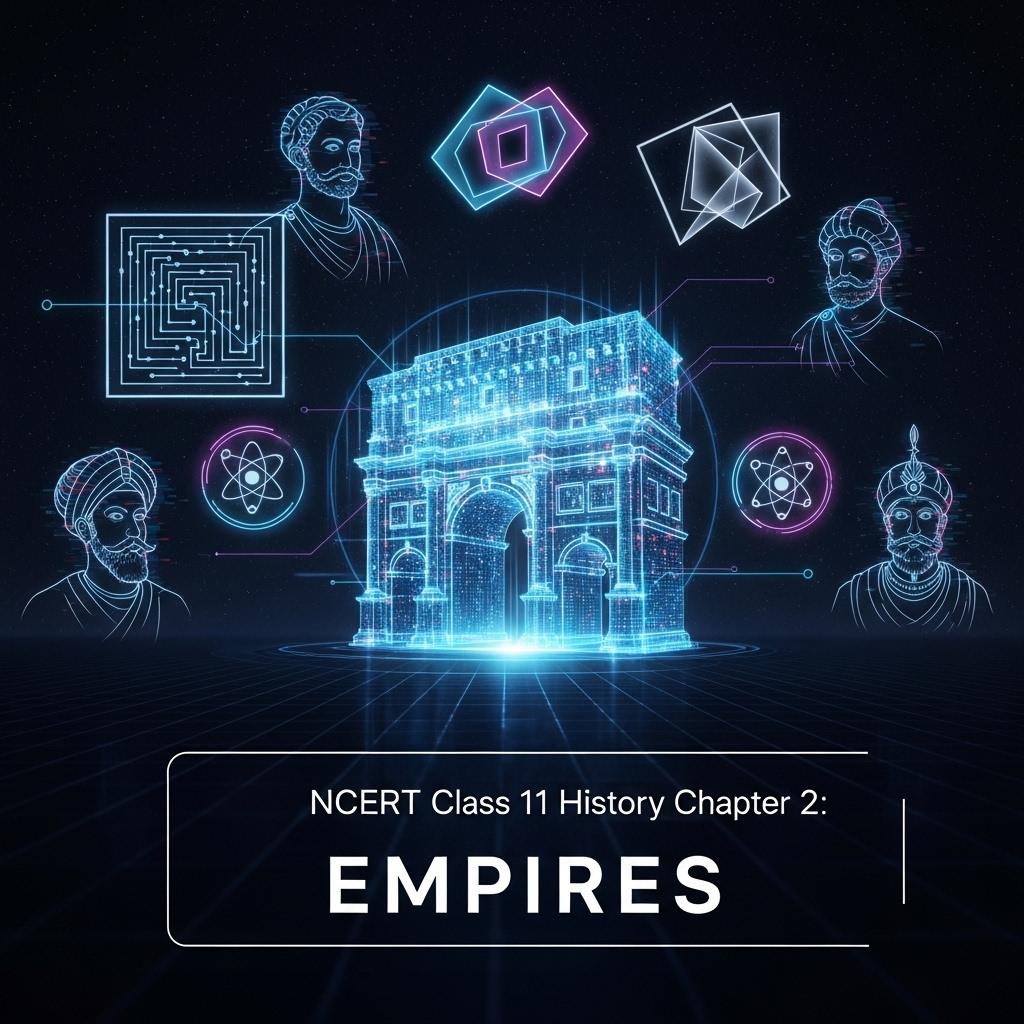
Empires
Theme 2: History - Ultimate Study Guide | NCERT Class 11 Notes, Questions, Examples & Quiz 2025
Full Theme Summary & Detailed Notes - Empires Class 11 NCERT
Overview & Key Concepts
- Theme Goal: Explores empires across continents from 100 BCE to 1300 CE; Roman Empire, Persian, Ottoman, nomadic empires, administration, military, society, timelines. Exam Focus: Structure of empires, army, slavery, cultural exchanges. 2025 Updates: Recent archaeological finds; Indian context with Kushanas. Fun Fact: Roman Empire spanned three continents. Core Idea: Control over diverse populations through military and administration. Real-World: Modern governance origins. Ties: Links to Theme 1 Early Societies.
- Wider Scope: Imperialism; cultural diffusion.
Introduction to Empires
Over two millennia that followed the establishment of empires in Mesopotamia, various attempts at empire-building took place across the region and in the area to the west and east of it. By the sixth century BCE, Iranians had established control over major parts of the Assyrian empire. Networks of trade developed overland, as well as along the coasts of the Mediterranean Sea. In the eastern Mediterranean, Greek cities and their colonies benefited from improvements in trade that were the result of these changes. They also benefited from close trade with nomadic people to the north of the Black Sea. In Greece, city-states were established in many regions. Athens and Sparta were the foci of civic life. From among the Greek states, in the late fourth century BCE, the ruler of the kingdom of Macedon, Alexander, undertook a series of military campaigns and conquered parts of North Africa, West Asia and Iran, reaching up to the Beas. Here, his soldiers refused to proceed further east. Alexander’s troops retreated, though many Greeks stayed behind. Depth: Sources archaeology written. Real-Life: Museums artifacts. Exam Tip: Empires vs kingdoms. Extended: Hellenistic culture. Graphs: Timeline. Historical: Alexander conquests. NCERT: Two millennia empires.
- Examples: Persian Empire control Assyrian.
- Point: Trade networks Mediterranean.
Extended Discussion: Empire building. Errors: All empires same? No diverse. Scope: Eurasian. Principles: Expansion. Real: Conservation sites. Additional: Hellenism. Depth: Conquests Alexander. Interlinks: Timelines. Advanced: Numismatics. Symbols: BCE CE.
How to Read Timelines
Timeline II focuses on kingdoms and empires. Some of these such as the Roman Empire were very large, spreading across three continents. This was also the time when some of the major religious and cultural traditions developed. It was a time when institutions of intellectual activity emerged. Books were written and ideas travelled across continents. Some things that are now part of our everyday lives were used for the first time during this period. Depth: Dates BCE CE. Real-Life: Calendar history. Exam Tip: Read vertical. Extended: Processes gradual. Graphs: Table timeline. Pitfalls: Exact dates? Approx. Applications: Understand change. Interlinks: Developments. Advanced: Radiocarbon. Historical: Constantine 330 CE. NCERT: Kingdoms empires.
- Examples: Constantine establishes Constantinople 330 CE.
- Point: Interconnected processes.
Extended: Revising dates evidence. Errors: Linear progress? No. Scope: Global. Principles: Chronology. Real: Archaeology digs. Additional: CE common era. Depth: Intellectual activity. Interlinks: Regions. Advanced: Stratigraphy. Symbols: BCE before common era.
Timeline II (100 BCE to 1300 CE)
Focuses on kingdoms empires religious cultural traditions intellectual activity books ideas. Roman Empire large three continents. Depth: Africa bananas introduced. Real-Life: Viking raids 900-950. Exam Tip: Key dates memorize. Extended: Regions diff. Graphs: Table dates events. Pitfalls: All simultaneous? No. Applications: Compare regions. Interlinks: Societies. Advanced: Carbon dating. Historical: Bede writes 700-750. NCERT: Major religious traditions.
- Examples: Jesus Christ 1-50 CE.
- Point: Cultural exchanges.
Extended: Ideas travel. Errors: Dates fixed? Revised. Scope: History religion. Principles: Progression. Real: Museums artifacts. Additional: Sweet potato 1050-1100. Depth: Institutions. Interlinks: Empires. Advanced: Paleography. Symbols: CE.
An Empire Across Three Continents
Roman Empire covered vast stretch territory three continents. Army conscripted, administration, society slavery. Depth: Principate Augustus. Real-Life: Modern armies. Exam Tip: Early vs late empire. Extended: Trajan conquests. Graphs: Map empire. Pitfalls: Uniform? Regional. Applications: Governance. Interlinks: Persian. Advanced: Epigraphy. Historical: Augustus 27 BCE. NCERT: Three continents.
- Examples: Euphrates Rhine boundaries.
- Point: Diverse populations.
Extended: Urban traditions. Errors: Stable? Crises. Scope: Mediterranean. Principles: Centralization. Real: Ruins Rome. Additional: Senate. Depth: Military. Interlinks: Nomadic. Advanced: Archaeology. Symbols: CE.
Nomadic Empires
Settlement conflicts increasing scale coincided internal dissensions empire leading collapse empire west fifth century CE. Tribes established own kingdoms within former empire. Holy Roman Empire formed some these kingdoms ninth century CE. This claimed some continuity with Roman Empire. Between seventh century fifteenth century almost all lands eastern Roman Empire centred on Constantinople created by the followers the Prophet Muhammad. Depth: Mongols Genghis Khan. Real-Life: Steppe nomads. Exam Tip: Nomadic vs settled. Extended: Ottoman Turks. Graphs: Timeline. Pitfalls: Barbarians? Complex. Applications: Mobility. Interlinks: Trade. Advanced: Ethnography. Historical: Genghis 1206. NCERT: Tribes increasing.
- Examples: Mongols control China.
- Point: Military organization.
Extended: Cultural impact. Errors: Unstable? Long-lasting. Scope: Eurasian steppes. Principles: Adaptation. Real: Modern nomads. Additional: Khanates. Depth: Pastoralists. Interlinks: Roman. Advanced: Linguistics. Symbols: CE.
Summary
- Empires Roman Persian Ottoman nomadic administration military society timelines crises.
Why This Guide Stands Out
Complete: All subtopics (5+), examples (10+), Q&A, quiz. History-focused with timelines/maps. Free 2025.
Key Themes & Tips
- Expansion: Military conquests.
- Sources: Archaeology written.
- Tip: Timelines memorize key dates; compare empires; sources evidence.
Exam Case Studies
Roman administration; nomadic conquests; timelines read.
Project & Group Ideas
- Model Roman army.
- Debate empire stability.


As an Amazon Associate, ProSyllabus earns from qualifying purchases. Prices shown are subject to change.
Test your CBSE Class 11 Annual Assessment prep
Dual AI-verified questions Real exam pattern 2 quizzes free, then 10 credits per quiz
Constitution: Why and How?
What is Psychology?
India – Location
Nomadic Empires
Animal Kingdom
The Living World
Mother's Day
A Photograph
Methods of Enquiry in Psychology
Election and Representation
Political Theory: An Introduction
An Empire Across Three Continents
Plant Kingdom
Biological Classification
Motion in a Straight Line
Accountancy (Class 11) Practice Quiz | CBSE Class 11 Annual Assessment
Sets and Venn Operations Fundamentals — Free CBSE Class 11 Annual Assessment Quiz
The Summer of the Beautiful White Horse
The Laburnum Top
Discovering Tut: the Saga Continues
We're Not Afraid to Die... if We Can All Be Together
The Portrait of a Lady
Learning
Federalism
Rights in the Indian Constitution
Social Justice
Freedom
Water in the Atmosphere
Changing Cultural Traditions
Writing and City Life
Indian Economy 1950-1990
Introduction
Private, Public and Global Enterprises
Introduction to Accounting
Cell: The Unit of Life
Anatomy of Flowering Plants
Organic Chemistry – Some Basic Principles and Techniques
Redox Reactions
Motion in a Plane
Units and Measurement
The Tale of Melon City
Birth
The Address
Father to Son
Silk Road
The Adventure
Childhood
The Ailing Planet: the Green Movement's Role
The Voice of the Rain
Motivation and Emotion
Thinking
Human Memory
Sensory, Attentional and Perceptual Processes
Human Development
Indian Sociologists
Introducing Western Sociologists
Environment and Society
Social Change and Social Order in Rural and Urban Society
Social Structure, Stratification and Social Processes in Society
Doing Sociology: Research Methods
Culture and Socialisation
Understanding Social Institutions
Terms, Concepts and Their Use in Sociology
Sociology and Society
The Philosophy of the Constitution
Constitution as a Living Document
Local Governments
Judiciary
Legislature
Executive
Secularism
Nationalism
Citizenship
Rights
Equality
Natural Hazards and Disasters
Natural Vegetation
Climate
Drainage System
Structure and Physiography
Biodiversity and Conservation
Movements of Ocean Water
Water (Oceans)
World Climate and Climate Change
Atmospheric Circulation and Weather Systems
Solar Radiation, Heat Balance and Temperature
Composition and Structure of Atmosphere
Landforms and their Evolution
Geomorphic Processes
Distribution of Oceans and Continents
Interior of the Earth
The Origin and Evolution of the Earth
Geography as a Discipline
Paths to Modernisation
Displacing Indigenous Peoples
The Three Orders
Comparative Development Experiences of India and its Neighbours
Environment and Sustainable Development
Employment: Growth, Informalisation and Other Issues
Rural Development
Human Capital Formation in India
Liberalisation, Privatisation and Globalisation: An Appraisal
Indian Economy on the Eve of Independence
Use of Statistical Tools
Index Numbers
Correlation
Measures of Central Tendency
Presentation of Data
Organisation of Data
Collection of Data
International Business
Internal Trade
MSME and Business Entrepreneurship
Sources of Business Finance
Formation of a Company
Social Responsibilities of Business and Business Ethics
Emerging Modes of Business
Business Services
Forms of Business Organisation
Business, Trade and Commerce
Financial Statements - II
Financial Statements - I
Depreciation, Provisions and Reserves
Trial Balance and Rectification of Errors
Bank Reconciliation Statement
Recording of Transactions - II
Recording of Transactions - I
Theory Base of Accounting
Probability
Statistics
Limits and Derivatives
Introduction to Three Dimensional Geometry
Conic Sections
Straight Lines
Sequences and Series
Binomial Theorem
Permutations and Combinations
Linear Inequalities
Complex Numbers and Quadratic Equations
Relations and Functions
Sets
Chemical Coordination and Integration
Neural Control and Coordination
Locomotion and Movement
Excretory Products and their Elimination
Body Fluids and Circulation
Breathing and Exchange of Gases
Plant Growth and Development
Respiration in Plants
Photosynthesis in Higher Plants
Cell Cycle and Cell Division
Biomolecules
Structural Organisation in Animals
Morphology of Flowering Plants
Hydrocarbons
Equilibrium
Chemical Bonding and Molecular Structure
Classification of Elements and Periodicity in Properties
Some Basic Concepts of Chemistry
Waves
Oscillations
Kinetic Theory
Thermodynamics
Thermal Properties of Matter
Mechanical Properties of Fluids
Mechanical Properties of Solids
Gravitation
Systems of Particles and Rotational Motion
Work, Energy and Power
Trigonometric Functions
Structure of Atom
Laws of Motion
Business Studies (Class 11) Practice Quiz | CBSE Class 11 Annual Assessment
Economics (Class 11) Practice Quiz | CBSE Class 11 Annual Assessment
Humanities Subjects Practice Quiz | CBSE Class 11 Annual Assessment
Motion in a Straight Line Practice Quiz | CBSE Class 11 Annual Assessment
Thermodynamic Processes and Laws Advanced Challenge | CBSE Class 11 Annual Assessment

Group Discussions
No forum posts available.


