Complete Summary and Explanation of Exploring Substances: Acidic, Basic, and Neutral – NCERT Class 7 Science Chapter 2 – Full Chapter Notes, Key Concepts, Activities, Natural Indicators, Litmus Test, Science Fair Invisible Ink, and Textbook Solutions
A comprehensive, easy-to-understand explanation of NCERT Class 7 Science Chapter 2 – Exploring Substances: Acidic, Basic, and Neutral. Covers National Science Day science fair story, litmus as natural indicator, how to identify acids, bases & neutral substances, preparation of lime water, turmeric & red cabbage as indicators, invisible ink magic, colour changes with red rose extract, plus all textbook activities (Activity 2.1), tables, Let Us Enhance Our Learning (Page 14–16) questions with answers, and exam-ready notes in simple language.
Updated: 6 months ago
Categories: NCERT, Class 7, Science, Chapter 2, Acids Bases and Neutral, Natural Indicators, Litmus Test, Turmeric Indicator, Red Cabbage Indicator, Lime Water, Science Fair, Invisible Ink, National Science Day, Curiosity Textbook, Education, School Notes, Summary, Explanation
Tags: Class 7 Science Chapter 2, Exploring Substances Acidic Basic Neutral, NCERT Class 7 Science, Acids and Bases Class 7, Litmus Paper Test, Natural Indicators Class 7, Turmeric as Indicator, Red Rose Extract Indicator, Invisible Ink Science Project, National Science Day Activity, Lime Water Preparation, Let Us Enhance Our Learning Answers, Textbook Solutions Class 7, Science Notes in Hindi English, Activity 2.1 Solutions, Table 2.1 Table 2.2, Curiosity Science Book
Exploring Substances: Acidic, Basic, and Neutral - Class 7 Science Chapter 2 Ultimate Study Guide 2025
Exploring Substances: Acidic, Basic, and Neutral
Chapter 2: Curiosity Textbook of Science - Grade 7 | Ultimate Study Guide | NCERT Class 7 Notes, Activity, Examples & Quiz 2025
Full Chapter Summary & Detailed Notes - Exploring Substances: Acidic, Basic, and Neutral Class 7 NCERT
Overview & Key Concepts
Chapter Goal: Understand acidic, basic, and neutral substances through experiments like litmus test. Exam Focus: Indicators, color changes, nature of common substances. 2025 Updates: Link to real-life applications like cleaning stains. Fun Core: Invisible ink at science fair. Core Idea: Substances change color with indicators, classifying them as acid/base/neutral.
Wider Scope: From daily items (lemon, soap) to natural indicators (litmus from lichens). Expanded: Role in pH, safety.
Expanded Content: Point-wise for recall; add 2025 relevance like eco-friendly indicators.
Introduction to Acid-Base Exploration
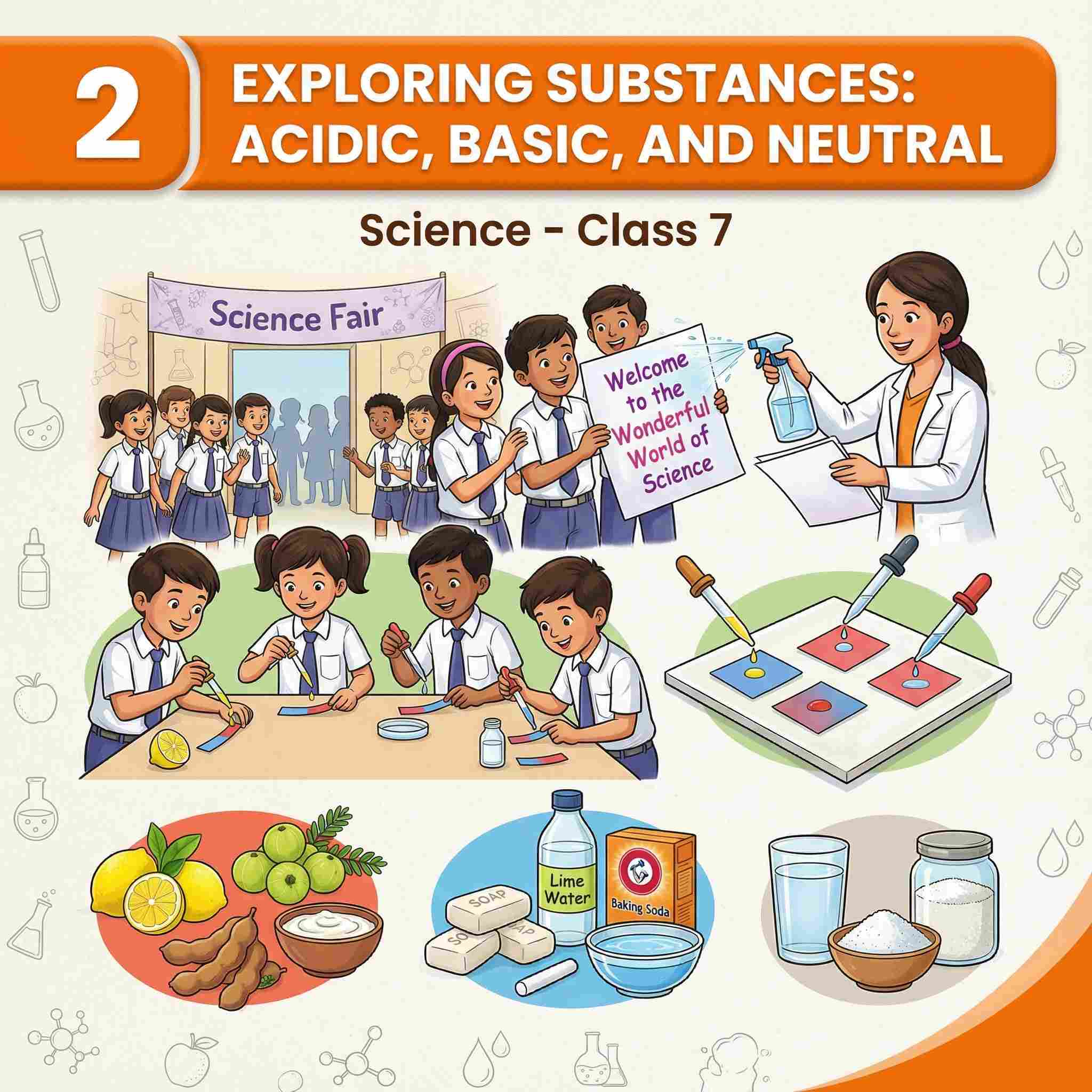
Story: Science fair on National Science Day; white paper turns to message with spray (invisible ink).
Purpose: Explore color changes when mixing substances.
Example: 'Welcome to the Wonderful World of Science' appears on paper.
Expanded: Curiosity from stall 'Colourful World of Substances'.
Fig. 2.1: Science Fair Scene
Siblings get paper sprayed, message appears.
Why This Guide Stands Out
Comprehensive: All experiments point-wise, 2025 with practical tips; analyzed for lab skills.
Nature as Science Laboratory
Litmus Indicator: From lichens; blue/red papers test acid/base.
Activity 2.1: Test samples (lemon, soap, etc.) with litmus.
Expanded: Group A (acidic: blue to red), B (basic: red to blue), C (neutral: no change).
Exam Activities
Fill Table 2.1/2.2; discuss lichens.
Classification of Substances
Acidic: Lemon, amla, tamarind, vinegar (blue litmus to red).
Basic: Soap, baking soda, lime water (red litmus to blue).
Neutral: Tap water, sugar, salt (no change).
Expanded: Synthetic indicators in higher grades; natural like turmeric.
Fig. 2.2(a/b): Litmus Test
Dropper on litmus pieces; color change.
Indicators and Lichens
Litmus: Natural from lichens (fungus+alga).
Holistic Lens: Lichens in clean air, rainfall areas.
Expanded: Blue litmus red in acid; red litmus blue in base.
Summary Key Points
Indicators like litmus classify substances as acidic (sour), basic (bitter/slippery), neutral.
Impact: Understand household chemicals; challenges: Safety in experiments.
Project & Group Ideas
Group: Home substance test; individual: Indicator poster.
Debate: Natural vs synthetic indicators.
Role-play: Acid-base reaction demo.
Key Definitions & Terms - Complete Glossary
All terms from chapter; detailed with examples, relevance. Expanded: 20+ terms grouped.
Acidic Substance
Turns blue litmus red. Ex: Lemon juice. Relevance: Sour taste.
Basic Substance
Turns red litmus blue. Ex: Soap. Relevance: Slippery feel.
Neutral Substance
No change in litmus. Ex: Tap water. Relevance: Neither acid nor base.
Litmus
Natural indicator from lichens. Ex: Blue/red papers. Relevance: Tests pH.
Indicator
Shows color change in acid/base. Ex: Litmus. Relevance: Classify substances.
Lichens
Fungus + alga symbiosis. Ex: On trees. Relevance: Source of litmus.
Lime Water
Calcium hydroxide solution. Ex: Basic. Relevance: Turns red litmus blue.
Vinegar
Acetic acid. Ex: Acidic. Relevance: Blue litmus red.
Baking Soda
Sodium bicarbonate. Ex: Basic. Relevance: Red litmus blue.
Tamarind
Tartaric acid. Ex: Acidic. Relevance: Sour taste.
Amla
Vitamin C (ascorbic acid). Ex: Acidic. Relevance: Blue litmus red.
Basic. Ex: Turns red litmus blue. Relevance: Cleaning agent.
Sugar Solution
Neutral. Ex: No change. Relevance: Sweet, no pH effect.
Salt Solution
Neutral. Ex: No change. Relevance: Common neutral.
Tip: Group by type; examples for recall. Depth: Lab safety. Errors: Confuse acid/base. Interlinks: To pH in higher grades. Advanced: pH scale. Real-Life: Cooking, cleaning. Coherent: Test → Classify.
Text Book Activity, Questions & Answers - NCERT Exercises
Direct from chapter (Activity 2.1) and added chapter-related Q&A. Answers based on content, point-wise for exams.
Blue litmus: Acidic → red (lemon, amla, tamarind, vinegar).
Red litmus: Basic → blue (soap, baking soda, lime water, washing powder).
Neutral: No change (tap water, sugar, salt).
Tip: Practice classification; full marks: Examples + tables.
Chapter-Related Questions & Answers (15+ for Extra Practice)
1. What happened at the science fair entry gate?
Answer:
White paper given; sprayed liquid revealed 'Welcome to the Wonderful World of Science'.
2. What is litmus?
Answer:
Natural substance from lichens; blue/red papers or solution.
3. How to prepare lime water?
Answer:
Mix lime (calcium oxide) in water, let stand 1 hour, filter.
4. What are acidic substances? Give examples.
Answer:
Turn blue litmus red; ex: lemon juice, vinegar.
5. What are basic substances? Give examples.
Answer:
Turn red litmus blue; ex: soap, baking soda.
6. What are neutral substances? Give examples.
Answer:
No change in litmus; ex: sugar, salt.
7. What is an indicator?
Answer:
Changes color in acid/base; ex: litmus.
8. What are lichens?
Answer:
Fungus + alga; grow in clean, rainy areas.
9. Why do some substances turn blue litmus red?
Answer:
They are acidic.
10. Fill Table 2.1 for vinegar on blue/red litmus.
Answer:
Blue: Red; Red: No change.
11. Group soap in Table 2.2.
Answer:
Group B (basic).
12. What are synthetic indicators?
Answer:
Lab-made; learn in higher grades.
13. Do lichens grow in your area?
Answer:
Yes, if clean air and rainfall.
14. Why is litmus purple in solution?
Answer:
Turns red in acid, blue in base.
15. Predict salt solution nature.
Answer:
Neutral; no color change.
16. What is National Science Day?
Answer:
28 February; celebrate science.
17. How does invisible ink work?
Answer:
Acid-base reaction reveals message.
Tip: Practice classification; full marks: Examples + tables.
Let Us Enhance Our Learning (Page 14-16)
1. A solution turns the red litmus paper to blue. Excess addition of which of the following solution would reverse the change?
Answer:
(iii) Vinegar (It is acidic, so adds acid to base, reverses to red).
2. You are provided with three unknown solutions labelled A, B, and C... Based on the observations, which is the correct sequence for the nature of solutions A, B, and C?
Answer:
(iii) Basic, basic, and acidic (A: red litmus blue = basic; B: turmeric red = basic; C: red rose green = acidic).
3. Observe and analyse Figs. 2.13, 2.14, and 2.15, in which red rose extract paper strips are used. Label the nature of solutions present in each of the containers.
4. A liquid sample from the laboratory was tested using various indicators... Based on the tests, identify the acidic or basic nature of the liquid and justify your answer.
Answer:
Acidic (No change in red litmus, turns blue litmus red, no change in turmeric).
5. Manya is blindfolded. She is given two unknown solutions to test and determine whether they are acidic or basic. Which indicator should Manya use to test the solutions and why?
Answer:
Turmeric or red cabbage (natural, safe to touch/smell; litmus needs sight for color).
6. Could you suggest various materials which can be used for writing the message on the white sheet of paper (given at the beginning of the chapter) and what could be in the spray bottle? Make a table of various possible combinations and the colour of the writing obtained.
Answer:
Message: Baking soda (base); Spray: Phenolphthalein (pink).
Message: Lemon juice (acid); Spray: Turmeric (red).
Table: Material (Base/Acid) | Spray (Indicator) | Color (Pink/Red).
7. Grape juice was mixed with red rose extract; the mixture got a tint of red colour. What will happen if baking soda is added to this mixture? Justify your answer.
Answer:
Turns green (Grape juice acid + red rose red; baking soda base reverses to green).
8. Keerthi wrote a secret message to her grandmother on her birthday using orange juice. Can you assist her grandmother in revealing the message? Which indicator would you use to make it visible?
Answer:
Heat paper or spray baking soda; use purple cabbage juice (turns green).
9. How can natural indicators be prepared? Explain by giving an example.
Answer:
Boil red cabbage leaves, filter juice (turns red in acid, green in base).
10. Three liquids are given to you. One is vinegar, another is a baking soda solution, and the third is a sugar solution. Can you identify them only using turmeric paper? Explain.
Answer:
Yes; vinegar (acid) no change; baking soda (base) red; sugar (neutral) no change. Distinguish by color.
11. The extract of red rose turns the liquid X to green. What will the nature of liquid X be? What will happen when excess of amla juice is added to liquid X?
Answer:
Acid (green in acid); amla (acid) keeps green or no change.
12. Observe and analyse the information given in the following flowchart. Complete the missing information.
Answer:
Indicator: Litmus. Acidic treated with lime; basic with compost. Acidic, basic.
Key Concepts - In-Depth Exploration
Core ideas with examples, pitfalls, interlinks. Expanded: All concepts with steps/examples/pitfalls.
3 attempts on CBSE Class 7 Annual Assessment quizzes
HIMAKSHI GUPTA . scored 2/10 on Integers and Rational Numbers Naavya Agarwal scored 0/10 on Integers and Rational Numbers Anshika Yadav scored 0/10 on Integers and Rational Numbers HIMAKSHI GUPTA . scored 2/10 on Integers and Rational Numbers Naavya Agarwal scored 0/10 on Integers and Rational Numbers Anshika Yadav scored 0/10 on Integers and Rational Numbers
#1
Integers and Rational Numbers Fundamentals | CBSE Class 7 Annual Assessment
10 Qs · ~10 min
#2
Class 7 Social Science — Banks and the Magic of Finance (Practice Quiz)
10 Qs · ~10 min
#3
Class 7 Social Science — Infrastructure: Engine of India's Development (Practice Quiz)
10 Qs · ~10 min
#4
Class 7 Social Science — The State, the Government, and You (Practice Quiz)
10 Qs · ~10 min
#5
Class 7 Social Science — India, a Home to Many (Practice Quiz)
10 Qs · ~10 min
#6
Class 7 Social Science — Turning Tides: 11th and 12th Centuries (Practice Quiz)
10 Qs · ~10 min
#7
Class 7 Social Science — Empires and Kingdoms: 6th to 10th Centuries (Practice Quiz)
10 Qs · ~10 min
#8
Class 7 Social Science — India and Her Neighbours (Practice Quiz)
10 Qs · ~10 min
#9
Class 7 Social Science — The Story of Indian Farming (Practice Quiz)
10 Qs · ~10 min
#10
Class 7 Social Science — Understanding Markets (Practice Quiz)
10 Qs · ~10 min
#11
Class 7 Social Science — From Barter to Money (Practice Quiz)
10 Qs · ~10 min
#12
Class 7 Social Science — The Constitution of India — An Introduction (Practice Quiz)
10 Qs · ~10 min
#13
Class 7 Social Science — From the Rulers to the Ruled: Types of Governments (Practice Quiz)
10 Qs · ~10 min
#14
Class 7 Social Science — How the Land Becomes Sacred (Practice Quiz)
10 Qs · ~10 min
#15
Class 7 Social Science — The Gupta Era: An Age of Tireless Creativity (Practice Quiz)
10 Qs · ~10 min
#16
Class 7 Social Science — The Age of Reorganisation (Practice Quiz)
10 Qs · ~10 min
#17
Class 7 Social Science — The Rise of Empires (Practice Quiz)
10 Qs · ~10 min
#18
Class 7 Social Science — New Beginnings: Cities and States (Practice Quiz)
10 Qs · ~10 min
#19
Class 7 Social Science — Climates of India (Practice Quiz)
10 Qs · ~10 min
#20
Class 7 Social Science — Understanding the Weather (Practice Quiz)
10 Qs · ~10 min
#21
Class 7 Social Science — Geographical Diversity of India (Practice Quiz)
10 Qs · ~10 min
#22
Class 7 Sanskrit — परिशिष्टम् २ — धातुरूपाणि एवं सन्धि-परिचयः (Practice Quiz)
10 Qs · ~10 min
#23
Class 7 Sanskrit — परिशिष्टम् १ — शब्दरूपाणि (Practice Quiz)
10 Qs · ~10 min
#24
Class 7 Sanskrit — वर्णमात्रा-परिचयः (Practice Quiz)
10 Qs · ~10 min
#25
Class 7 Sanskrit — वीराङ्गना पन्नाधाया (Practice Quiz)
10 Qs · ~10 min
#26
Class 7 Sanskrit — द्वीपेषु रम्यः द्वीपोऽण्डमानः (Practice Quiz)
10 Qs · ~10 min
#27
Class 7 Sanskrit — दशमः कः? (Practice Quiz)
10 Qs · ~10 min
#28
Class 7 Sanskrit — अन्नाद् भवन्ति भूतानि (Practice Quiz)
10 Qs · ~10 min
#29
Class 7 Sanskrit — हितं मनोहारि च दुर्लभं वचः (Practice Quiz)
10 Qs · ~10 min
#30
Class 7 Sanskrit — ईशावास्यम् इदं सर्वम् (Practice Quiz)
10 Qs · ~10 min
#31
Class 7 Sanskrit — क्रीडाम वयं श्लोकान्त्याक्षरीम् (Practice Quiz)
10 Qs · ~10 min
#32
Class 7 Sanskrit — सेवा हि परमो धर्मः (Practice Quiz)
10 Qs · ~10 min
#33
Class 7 Sanskrit — न लभ्यते चेत् आम्लं द्राक्षाफलम् (Practice Quiz)
10 Qs · ~10 min
#34
Class 7 Sanskrit — मित्राय नमः (Practice Quiz)
10 Qs · ~10 min
#35
Class 7 Sanskrit — नित्यं पिबामः सुभाषितरसम् (Practice Quiz)
10 Qs · ~10 min
#36
Class 7 Sanskrit — वन्दे भारतमातरम् (Practice Quiz)
10 Qs · ~10 min
#37
Class 7 Hindi — मीरा के पद (Practice Quiz)
10 Qs · ~10 min
#38
Class 7 Hindi — चिड़िया (Practice Quiz)
10 Qs · ~10 min
#39
Class 7 Hindi — बिरजू महाराज से साक्षात्कार (Practice Quiz)
10 Qs · ~10 min
#40
Class 7 Hindi — वर्षा-बहार (Practice Quiz)
10 Qs · ~10 min
#41
Class 7 Hindi — गिरिधर कविराय की कुंडलियाँ (Practice Quiz)
10 Qs · ~10 min
#42
Class 7 Hindi — नहीं होना बीमार (Practice Quiz)
10 Qs · ~10 min
#43
Class 7 Hindi — पानी रे पानी (Practice Quiz)
10 Qs · ~10 min
#44
Class 7 Hindi — फूल और काँटा (Practice Quiz)
10 Qs · ~10 min
#45
Class 7 Hindi — तीन बुद्धिमान (Practice Quiz)
10 Qs · ~10 min
#46
Class 7 Hindi — माँ, कह एक कहानी (Practice Quiz)
10 Qs · ~10 min
#47
Class 7 English — Bravehearts (Practice Quiz)
10 Qs · ~10 min
#48
Class 7 English — Travel and Adventure (Practice Quiz)
10 Qs · ~10 min
#49
Class 7 English — Dreams and Discoveries (Practice Quiz)
10 Qs · ~10 min
#50
Class 7 English — Wit and Humour (Practice Quiz)
10 Qs · ~10 min
#51
Class 7 English — Learning Together (Practice Quiz)
10 Qs · ~10 min
#52
Class 7 Maths — Finding the Unknown (Practice Quiz)
10 Qs · ~10 min
#53
Class 7 Maths — Constructions and Tilings (Practice Quiz)
10 Qs · ~10 min
#54
Class 7 Maths — Connecting the Dots… (Practice Quiz)
10 Qs · ~10 min
#55
Class 7 Maths — Another Peek Beyond the Point (Practice Quiz)
10 Qs · ~10 min
#56
Class 7 Maths — Finding Common Ground (Practice Quiz)
10 Qs · ~10 min
#57
Class 7 Maths — Operations with Integers (Practice Quiz)
10 Qs · ~10 min
#58
Class 7 Maths — Geometric Twins (Practice Quiz)
10 Qs · ~10 min
#59
Class 7 Maths — Working with Fractions (Practice Quiz)
10 Qs · ~10 min
#60
Class 7 Maths — A Tale of Three Intersecting Lines (Practice Quiz)
10 Qs · ~10 min
#61
Class 7 Maths — Number Play (Practice Quiz)
10 Qs · ~10 min
#62
Class 7 Maths — Parallel and Intersecting Lines (Practice Quiz)
10 Qs · ~10 min
#63
Class 7 Maths — Expressions Using Letter-Numbers (Practice Quiz)
10 Qs · ~10 min
#64
Class 7 Maths — A Peek Beyond the Point (Practice Quiz)
10 Qs · ~10 min
#65
Class 7 Maths — Arithmetic Expressions (Practice Quiz)
10 Qs · ~10 min
#66
Class 7 Maths — Large Numbers Around Us (Practice Quiz)
10 Qs · ~10 min
#67
Class 7 Science — Earth, Moon, and the Sun (Practice Quiz)
10 Qs · ~10 min
#68
Class 7 Science — Light: Shadows and Reflections (Practice Quiz)
10 Qs · ~10 min
#69
Class 7 Science — Life Processes in Plants (Practice Quiz)
10 Qs · ~10 min
#70
Class 7 Science — Life Processes in Animals (Practice Quiz)
10 Qs · ~10 min
#71
Class 7 Science — Measurement of Time and Motion (Practice Quiz)
10 Qs · ~10 min
#72
Class 7 Science — Heat Transfer in Nature (Practice Quiz)
10 Qs · ~10 min
#73
Class 7 Science — Adolescence: A Stage of Growth and Change (Practice Quiz)
10 Qs · ~10 min
#74
Class 7 Science — Changes Around Us: Physical and Chemical (Practice Quiz)
10 Qs · ~10 min
#75
Class 7 Science — The World of Metals and Non-metals (Practice Quiz)
10 Qs · ~10 min
#76
Class 7 Science — Electricity: Circuits and their Components (Practice Quiz)
10 Qs · ~10 min
#77
Class 7 Science — Exploring Substances: Acidic, Basic, and Neutral (Practice Quiz)
10 Qs · ~10 min
#78
Class 7 Science — The Ever-Evolving World of Science (Practice Quiz)
10 Qs · ~10 min
#79
Simple Equations and Applications Practice Quiz | CBSE Class 7 Annual Assessment