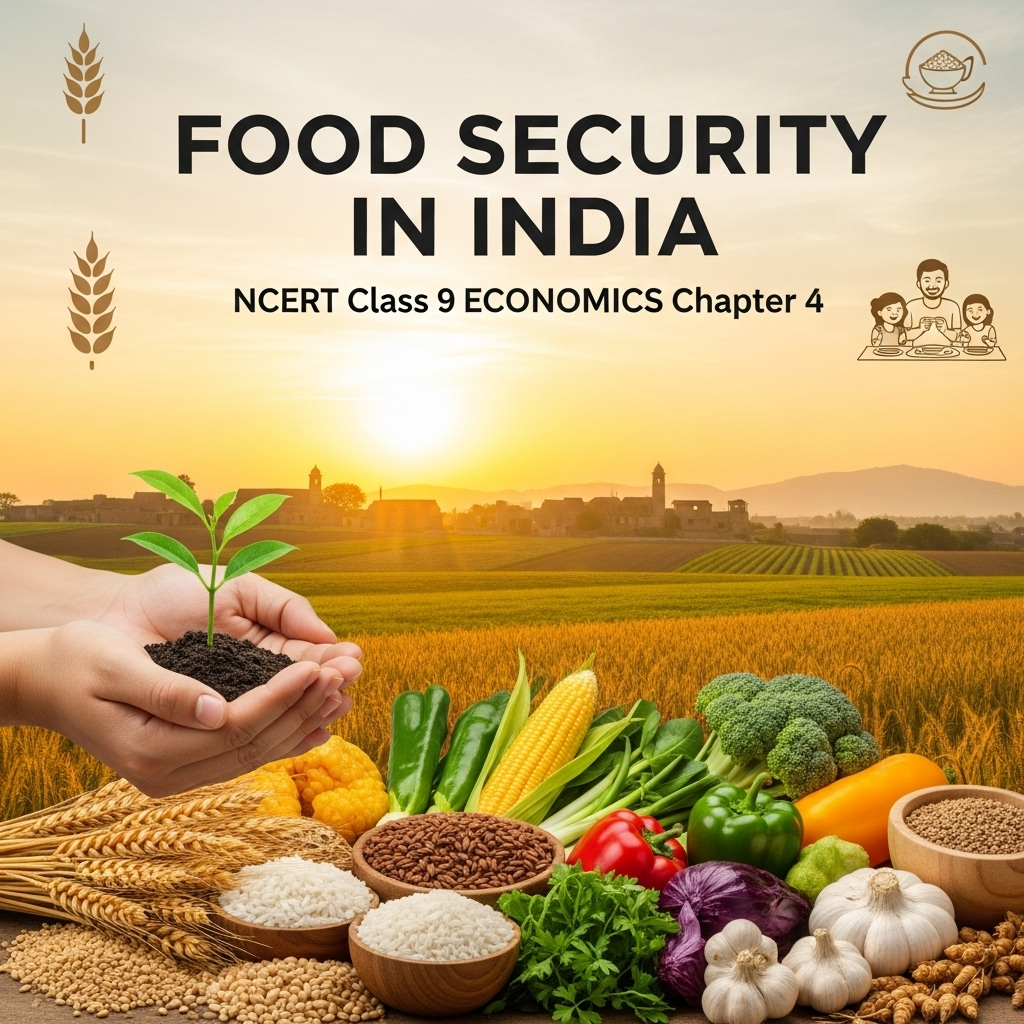
Questions & Answers - CBSE Class 9 (60 from NCERT PDF)
20 Short (2M), 20 Medium (4M), 20 Long (8M) based on PDF exercises/content.
Short Questions (2 Marks Each) - 20 Total
1. What are food security dimensions? (PDF p.42)
Answer: Availability (production/imports/stock), accessibility, affordability.
2. Why food security during calamities? (PDF p.42)
Answer: Reduces production/prices rise; starvation/famine.
3. Bengal Famine year/deaths? (PDF p.43)
Answer: 1943; 30 lakh.
4. Most affected in Bengal Famine? (PDF p.43)
Answer: Laborers/fishermen/transport workers.
5. 1970s food security definition? (PDF p.42)
Answer: Adequate basic foodstuffs supply (UN).
6. Amartya Sen contribution? (PDF p.42)
Answer: Access via entitlements.
7. 1995 Summit declaration? (PDF p.42)
Answer: Physical/economic access to safe/nutritious food.
8. Food insecure groups? (PDF p.44)
Answer: Landless/artisans/self-employed/destitutes.
9. States with most insecure? (PDF p.45)
Answer: UP/Bihar/Jharkhand/Orissa/WB/Chhattisgarh/MP/Maharashtra.
10. Chronic hunger? (PDF p.46)
Answer: Persistent inadequate diets.
11. Seasonal hunger? (PDF p.46)
Answer: Cycles of growing/harvesting.
12. Green Revolution focus? (PDF p.46)
Answer: Wheat/rice production.
13. 2020-21 production? (PDF p.46)
Answer: 310MT foodgrains.
14. Buffer stock purpose? (PDF p.47)
Answer: Distribute in deficits/poor at issue price.
15. PDS items? (PDF p.48)
Answer: Foodgrains/sugar/kerosene.
16. NFSA 2013 coverage? (PDF p.49)
Answer: 75% rural/50% urban.
17. AAY launch? (PDF p.50)
Answer: 2000; poorest BPL.
18. MSP meaning? (PDF p.51)
Answer: Minimum support price for farmers.
19. Amul role? (PDF p.52)
Answer: White Revolution in milk.
20. ADS focus? (PDF p.52)
Answer: Grain Banks in Maharashtra.
Medium Questions (4 Marks Each) - 20 Total
1. Food security during calamity? (PDF p.42)
Answer: During a calamity like drought, earthquake, flood, or tsunami, total production of foodgrains decreases, leading to a shortage in affected areas. This shortage causes prices to rise sharply, making food unaffordable for many people. If the calamity is widespread or prolonged, it can result in starvation and even famine, characterized by widespread deaths due to starvation and epidemics from contaminated water or decaying food.
2. Bengal Famine causes? (PDF p.43)
Answer: The Bengal Famine of 1943 was not primarily due to a shortage of rice production, as shown in Table 4.1, where availability remained relatively stable. Instead, it was caused by dramatically increasing rice prices, which affected agricultural laborers, fishermen, transport workers, and casual laborers the most. This led to starvation and epidemics, killing thirty lakh people in Bengal.
3. Evolution of concept? (PDF p.42)
Answer: In the 1970s, food security was defined as the availability of adequate basic foodstuffs (UN). Amartya Sen added the dimension of access through entitlements, combining production, market exchange, and state supplies. The 1995 World Food Summit expanded it to include physical and economic access to sufficient, safe, nutritious food for an active life, emphasizing poverty eradication.
4. COVID-19 impact? (PDF p.44)
Answer: The COVID-19 pandemic adversely impacted food security by restricting movement of people, goods, and services, which disrupted economic activities. This led to food shortages in many areas, exacerbating famine-like conditions and causing starvation deaths in vulnerable populations.
5. Insecure social groups? (PDF p.44)
Answer: Social composition plays a role in food insecurity. Scheduled Castes (SCs), Scheduled Tribes (STs), and some sections of Other Backward Classes (OBCs) with poor land bases or low productivity are prone to insecurity. Natural disaster migrants, pregnant and nursing mothers, and children under 5 (about 11 crore per NHFS 1998-99) are also highly vulnerable.
6. Ramu story key? (PDF p.44)
Answer: Ramu is a casual agricultural laborer in Raipur village, unemployed for 4 months during plant consolidation. His family supplements income through his wife Sunhari's part-time work and son Somu's cattle herding. During unemployment, they face difficulties, sometimes sleeping without food, making Ramu food insecure seasonally.
7. Ahmad story role PDS? (PDF p.45)
Answer: Ahmad, a rickshaw puller in Bangalore, has fluctuating earnings. His yellow PDS card for below poverty line allows him to buy wheat, rice, sugar, and kerosene at half market price monthly, helping sustain his large family despite insufficient daily income.
8. Hunger types difference? (PDF p.46)
Answer: Chronic hunger results from persistently inadequate diets due to low income and inability to buy food for survival. Seasonal hunger is linked to cycles of food growing and harvesting in rural areas or casual labor in urban areas, like less work for construction laborers during rains.
9. Green Revolution success? (PDF p.46)
Answer: The Green Revolution led to self-sufficiency in foodgrains, especially wheat and rice. Uttar Pradesh and Madhya Pradesh achieved highest growth with 58 and 33 million tonnes in 2020-21. Total production reached 310 million tonnes in 2020-21, avoiding famines even in adverse conditions.
10. Buffer stock creation? (PDF p.47)
Answer: Buffer stock is foodgrains (wheat/rice) procured by the Food Corporation of India (FCI) from surplus states at Minimum Support Price (MSP). It is stored in granaries to distribute in deficit areas or to poorer sections at issue price during shortages or calamities.
11. PDS function? (PDF p.47)
Answer: The Public Distribution System (PDS) distributes FCI-procured foodgrains through regulated ration shops to poorer sections at prices lower than market (issue price). It includes about 5.5 lakh shops stocking foodgrains, sugar, and kerosene, ensuring affordable access.
12. ICDS/FFW intro? (PDF p.48)
Answer: Integrated Child Development Services (ICDS) was introduced in 1975 on an experimental basis for child nutrition. Food-for-Work (FFW) was launched in 1977-78 to provide employment and food security through wage programs.
13. NFSA 2013 aim? (PDF p.49)
Answer: The National Food Security Act, 2013, aims to provide food and nutritional security at affordable prices, enabling people to live with dignity. It categorizes 75% rural and 50% urban populations as eligible for 5 kg per person per month at subsidized rates.
14. PDS benefits? (PDF p.50)
Answer: PDS stabilizes prices, averts hunger and famine by supplying food from surplus to deficit regions. It increases foodgrain production through MSP and provides income security to farmers, with revisions favoring poor households.
15. Overflow issues? (PDF p.50)
Answer: FCI godowns overflow with grains, leading to wastage, deterioration, and high carrying costs. In 2022, stocks were 159 LMT wheat and 104 LMT rice, exceeding buffer norms, which is undesirable and wasteful.
16. MSP pressure? (PDF p.51)
Answer: Increased MSP is pressured by surplus states like Punjab, Haryana, and Andhra Pradesh. This diverts land from coarse grains to wheat/rice, causing environmental degradation and falling water levels.
17. Consumption decline? (PDF p.52)
Answer: Per NSSO, rice consumption declined from 6.38 kg rural (2004-05) to 5.98 kg (2011-12), and wheat doubled via PDS. Similar trends in urban areas show PDS increasing but overall consumption dropping.
18. Malpractices in PDS? (PDF p.52)
Answer: Dealers divert grains to open market for better margins, sell poor quality grains, and open shops irregularly. This leads to unsold poor-quality stocks piling up with FCI.
19. Mother Dairy role? (PDF p.52)
Answer: Mother Dairy provides milk and vegetables at controlled rates decided by the Delhi Government, ensuring affordable access to consumers through cooperative shops.
20. ADS Grain Banks? (PDF p.52)
Answer: Academy of Development Science (ADS) facilitates NGO networks for Grain Banks in Maharashtra, organizing training, capacity building, and influencing government policy on food security.
Long Questions (8 Marks Each) - 20 Total
1. How is food security ensured in India? (PDF p.53, NCERT Q1)
Answer: Food security in India is ensured through a multi-pronged approach. Firstly, availability is maintained by domestic production, imports, and buffer stocks of foodgrains like wheat and rice procured by the Food Corporation of India (FCI). The Green Revolution has boosted self-sufficiency, with production reaching 310 million tonnes in 2020-21. Accessibility is facilitated by the Public Distribution System (PDS), which distributes subsidized food through 5.5 lakh fair price shops to poorer sections. Affordability is achieved via Minimum Support Price (MSP) for farmers and issue prices lower than market rates for consumers. Government schemes like Antyodaya Anna Yojana (AAY) target the poorest, providing 35 kg of grains at highly subsidized rates. The National Food Security Act (NFSA) 2013 covers 75% rural and 50% urban populations. Cooperatives like Amul and ADS Grain Banks also play a role. During calamities, buffer stocks resolve shortages. However, issues like wastage and malpractices need addressing for complete security.
2. Food insecure people? (PDF p.53, NCERT Q2)
Answer: The most food-insecure people in India include landless households with little or no land, traditional artisans, providers of traditional services, petty self-employed workers, and destitutes like beggars in rural areas. In urban areas, they are families with members in ill-paid occupations or casual labor markets, often engaged in seasonal activities with low wages barely ensuring survival. Social groups like Scheduled Castes (SCs), Scheduled Tribes (STs), and some Other Backward Classes (OBCs) with poor land bases or low productivity are prone to insecurity. Natural disaster victims who migrate for work, pregnant and nursing mothers, and children under 5 years (about 11 crore per NHFS 1998-99) form a significant vulnerable segment. Stories like Ramu (seasonal agricultural laborer) and Ahmad (rickshaw puller) illustrate how low, fluctuating incomes lead to chronic or seasonal hunger. These groups are disproportionately large in economically backward states with high poverty, tribal, and remote areas.
3. Food insecure states? (PDF p.53, NCERT Q3)
Answer: The states with the largest number of food-insecure people are Uttar Pradesh (eastern and south-eastern parts), Bihar, Jharkhand, Orissa, West Bengal, Chhattisgarh, parts of Madhya Pradesh, and Maharashtra. These are economically backward regions with high poverty incidence, tribal and remote areas prone to natural disasters like floods and droughts. They account for a disproportionate share of insecure populations due to low land productivity, poor infrastructure, and limited access to PDS. For instance, SCs, STs, and OBCs in these areas face chronic hunger from inadequate diets. Calamities exacerbate shortages, raising prices and causing starvation. Government interventions like NFSA aim to cover 75% rural populations here, but challenges like malpractices in ration shops persist. Data from NHFS and NSSO highlight malnutrition among women and children, emphasizing the need for targeted programs.
4. Green Revolution self-sufficiency? (PDF p.53, NCERT Q4)
Answer: Yes, the Green Revolution has made India self-sufficient in foodgrains. Post-Independence, India adopted a new agricultural strategy focusing on high-yielding varieties of wheat and rice, leading to impressive production increases. Indira Gandhi released the 'Wheat Revolution' stamp in 1968 to mark this. Production rose from 80 million tonnes in 1960-61 to 310 million tonnes in 2020-21 and 315 million tonnes in 2021-22. Uttar Pradesh and Madhya Pradesh led in wheat (36 and 18 million tonnes in 2020-21), while West Bengal and UP excelled in rice (17 and 16 million tonnes). This avoided famines even during adverse weather, with a variety of crops ensuring national availability. Buffer stocks and PDS distribute surplus, stabilizing prices. However, it shifted land from coarse grains, affecting the poor's staple, and caused environmental issues like water degradation in Punjab and Haryana.
5. Section without food? (PDF p.53, NCERT Q5)
Answer: Despite self-sufficiency, a section of people in India remains without food due to persistent poverty and unequal distribution. The poorest, like landless laborers and casual urban workers, lack purchasing power amid rising prices. Calamities exacerbate shortages, affecting even those above poverty line. Famine-like conditions persist in remote areas, with starvation deaths reported. Vulnerable groups—SCs, STs, OBCs, migrants, women, and children (11 crore malnourished)—face chronic hunger from low incomes. PDS malpractices, such as diversion and poor quality grains, fail to reach them. Overflowing FCI stocks indicate inefficiency, with wastage instead of distribution. Schemes like NFSA cover 75% rural but implementation gaps leave gaps. Economic backwardness in states like Bihar and Jharkhand worsens this, highlighting the need for better targeting and poverty alleviation.
6. Disaster supply impact? (PDF p.53, NCERT Q6)
Answer: During a disaster or calamity like drought, flood, earthquake, or tsunami, the supply of food is severely impacted. Total production of foodgrains decreases, creating shortages in affected areas. This leads to a sharp rise in prices, making food unaffordable for many, especially the poor. If the calamity is widespread or prolonged, it causes starvation, as people cannot access sufficient nutrition. A famine may ensue, characterized by widespread deaths from starvation, epidemics due to contaminated water, decaying food, and weakened body resistance. For example, the Bengal Famine of 1943 killed 30 lakh due to price hikes, not production shortages. Pandemics like COVID-19 restrict movement and economic activities, further disrupting supply chains. Government buffer stocks and PDS help mitigate, but vigilance is crucial to prevent massive starvation.
7. Seasonal/chronic hunger? (PDF p.53, NCERT Q7)
Answer: Seasonal hunger is related to cycles of food growing and harvesting, prevalent in rural areas due to seasonal agricultural activities and in urban areas among casual laborers, like less work during rainy seasons. It affects people unable to find work year-round, leading to temporary food shortages. Chronic hunger, however, is a persistent consequence of inadequate diets in quantity or quality, stemming from very low incomes preventing even basic survival food purchases. Poor people suffer chronic hunger continuously. As per Table 4.2, seasonal hunger declined from 16.2% to 2.6% in rural areas (1983-2000), while chronic from 2.3% to 0.7%. Both indicate poverty but differ in duration—seasonal is cyclical, chronic ongoing. Eliminating hunger involves reducing future risks through employment and income security.
8. Government schemes for poor? (PDF p.53, NCERT Q8)
Answer: The government has launched several schemes to provide food security to the poor. Two key ones are Antyodaya Anna Yojana (AAY) and National Food Security Act (NFSA). AAY, launched in 2000, targets the poorest BPL families (2 crore by 2004), providing 35 kg of foodgrains monthly at Rs 2/kg wheat and Rs 3/kg rice. It identifies the poorest through BPL surveys and has been expanded multiple times. NFSA 2013 ensures affordable nutritious food for dignity, covering 75% rural and 50% urban as priority households with 5 kg/person/month at Rs 2/kg wheat, Rs 3/kg rice, and Rs 1/kg coarse grains. These schemes use PDS networks, stabilize prices, and avert hunger. Other programs like Mid-Day Meals and ICDS also enhance security by targeting children and mothers.
9. Buffer stock creation? (PDF p.53, NCERT Q9)
Answer: Buffer stock is created by the government through the Food Corporation of India (FCI) to ensure food availability during shortages. FCI procures surplus wheat and rice from farmers in states like Punjab and Haryana at pre-announced Minimum Support Price (MSP), incentivizing production. These grains are stored in granaries as buffer stock. It is distributed in deficit areas or among poorer strata at issue prices lower than market rates via PDS. This resolves food shortages during calamities, adverse weather, or pandemics like COVID-19. In 2022, stocks exceeded norms (159 LMT wheat, 104 LMT rice), but help stabilize prices and avert famine. However, overflows lead to wastage and high costs, suggesting MSP freezes.
10. Notes: MSP/buffer/issue/FPS. (PDF p.53, NCERT Q10)
Answer: (a) Minimum Support Price (MSP): Pre-announced price by government for procuring crops from farmers before sowing, incentivizing production and ensuring income security. Rising MSP has increased procurement costs. (b) Buffer Stock: Stock of wheat/rice procured by FCI at MSP and stored in granaries for distribution during shortages or to poor at issue price, preventing famines. (c) Issue Price: Subsidized price lower than market at which foodgrains are sold to poorer sections via PDS, resolving shortages in calamities. (d) Fair Price Shops (FPS): Government-regulated ration shops (5.5 lakh) stocking foodgrains, sugar, kerosene sold at issue price to ration card holders, ensuring accessibility for the poor.
11. Ration shops problems? (PDF p.53, NCERT Q11)
Answer: Ration shops face several functioning issues. Dealers resort to malpractices like diverting grains to open markets for better margins, selling poor-quality grains, and irregular openings, leading to unsold stocks piling with FCI. Poor quality causes consumer dissatisfaction. With TPDS introducing three card types (AAY, BPL, APL), APL families get little discount, as prices are near market rates, reducing incentive to buy from shops. This declines PDS usage among non-poor. Earlier universal PDS ensured wider access, but targeting has led to exclusion errors. Inefficiencies contribute to overflowing granaries and wastage, despite high poverty. Better monitoring and digitalization could address these.
12. Cooperatives role? (PDF p.53, NCERT Q12)
Answer: Cooperatives play a vital role in food security, especially in southern and western India. They set up shops selling low-priced goods to the poor. In Tamil Nadu, 94% fair price shops are cooperative-run. Mother Dairy in Delhi provides milk and vegetables at government-controlled rates. Amul from Gujarat has brought the White Revolution, ensuring milk and products availability. These cooperatives ensure affordable access for different sections. In Maharashtra, Academy of Development Science (ADS) facilitates NGO networks for Grain Banks, organizing training and capacity building on food security. ADS influences government policy, making Grain Banks a successful intervention replicated across regions.
13. Famine characteristics. (PDF p.43)
Answer: A famine is characterized by widespread deaths due to starvation and epidemics caused by forced use of contaminated water, decaying food, and loss of body resistance from weakening. The Bengal Famine of 1943 exemplifies this, killing 30 lakh in Bengal province. It resulted from price rises making rice unaffordable for laborers, fishermen, and transport workers, despite no drastic production decline (Table 4.1). Calamities like drought reduce output, escalating prices and shortages. Nothing like it has recurred, but famine-like conditions persist in parts, worsened by pandemics like COVID-19 disrupting supplies. Government vigilance through PDS and buffer stocks prevents escalation.
14. PDS evolution. (PDF p.48-49)
Answer: PDS evolved from universal coverage in the 1940s (post-Bengal Famine) to targeted systems. Revived in 1960s amid shortages, it was strengthened in mid-1970s with high poverty. RPDS (1992) targeted backward blocks. TPDS (1997) adopted differential prices for poor (BPL) and non-poor (APL). AAY (2000) for poorest poor and APS (2000) for indigent seniors linked to PDS. NFSA (2013) mandates affordable food for 75% rural/50% urban. Table 4.3 shows features like 35 kg/month under TPDS/AAY at subsidized rates. This shift improved efficiency but introduced issues like APL disincentive.
15. Overflow reasons. (PDF p.50)
Answer: FCI godowns overflow due to increased procurement at enhanced MSP, pressured by surplus states like Punjab, Haryana, and Andhra Pradesh. Stocks in 2022 were 159 LMT wheat and 104 LMT rice, far above buffer norms (Graph 4.2). This is wasteful, causing high carrying costs, wastage, and deterioration. Concentrated procurement of wheat/rice diverts land from coarse grains. Schemes distribute some, but high levels persist. Freezing MSP could help, as overflows indicate inefficiency despite food insecurity in remote areas.
16. Water degradation. (PDF p.51)
Answer: Intensive water use in rice cultivation, encouraged by rising MSP and procurement in states like Punjab and Haryana, has led to environmental degradation and falling water tables. This threatens agricultural sustainability. Shift from coarse grains to rice/wheat exacerbates the issue, as rice requires more water. Over-exploitation depletes groundwater, risking future shortages. Balanced cropping and efficient irrigation are needed to mitigate this while maintaining production.
17. PDS malpractices. (PDF p.52)
Answer: PDS dealers often divert grains to open markets for higher profits, sell poor-quality grains at shops, and open irregularly, leading to unsold stocks and FCI pile-ups. This reduces effectiveness for the poor. With TPDS, APL prices near market rates discourage usage, declining overall PDS role. Universal PDS earlier ensured wider access; targeting caused exclusion. Digital monitoring could curb these, ensuring better distribution.
18. AAY details. (PDF p.50)
Answer: Antyodaya Anna Yojana (AAY), launched December 2000, targets the poorest among BPL families (initially 1 crore, expanded to 2 crore by 2004). Identified via state BPL surveys, it provides 35 kg foodgrains/month (from 25 kg in 2002) at Rs 2/kg wheat and Rs 3/kg rice. Expanded by 50 lakh families in June 2003 and August 2004, it links to PDS for subsidized access, averting hunger among the most vulnerable like destitute and elderly.
19. Amul success. (PDF p.52)
Answer: Amul, a cooperative from Gujarat, has revolutionized milk and dairy products, bringing the White Revolution. It ensures affordable, quality milk supply through farmer cooperatives, boosting production and income. Amul's success demonstrates cooperatives' role in food security by providing low-priced goods, similar to Mother Dairy in Delhi for milk and vegetables.
20. ADS programme. (PDF p.52)
Answer: The Academy of Development Science (ADS) in Maharashtra facilitates NGO networks for setting up Grain Banks. It organizes training and capacity building on food security, enabling replication and influencing government policy. This innovative intervention pays dividends by ensuring local grain storage and access during shortages, addressing rural insecurity effectively.
Practice Tip: 2M: 2min; 4M: 5min; 8M: 12min; use PDF stories/tables.