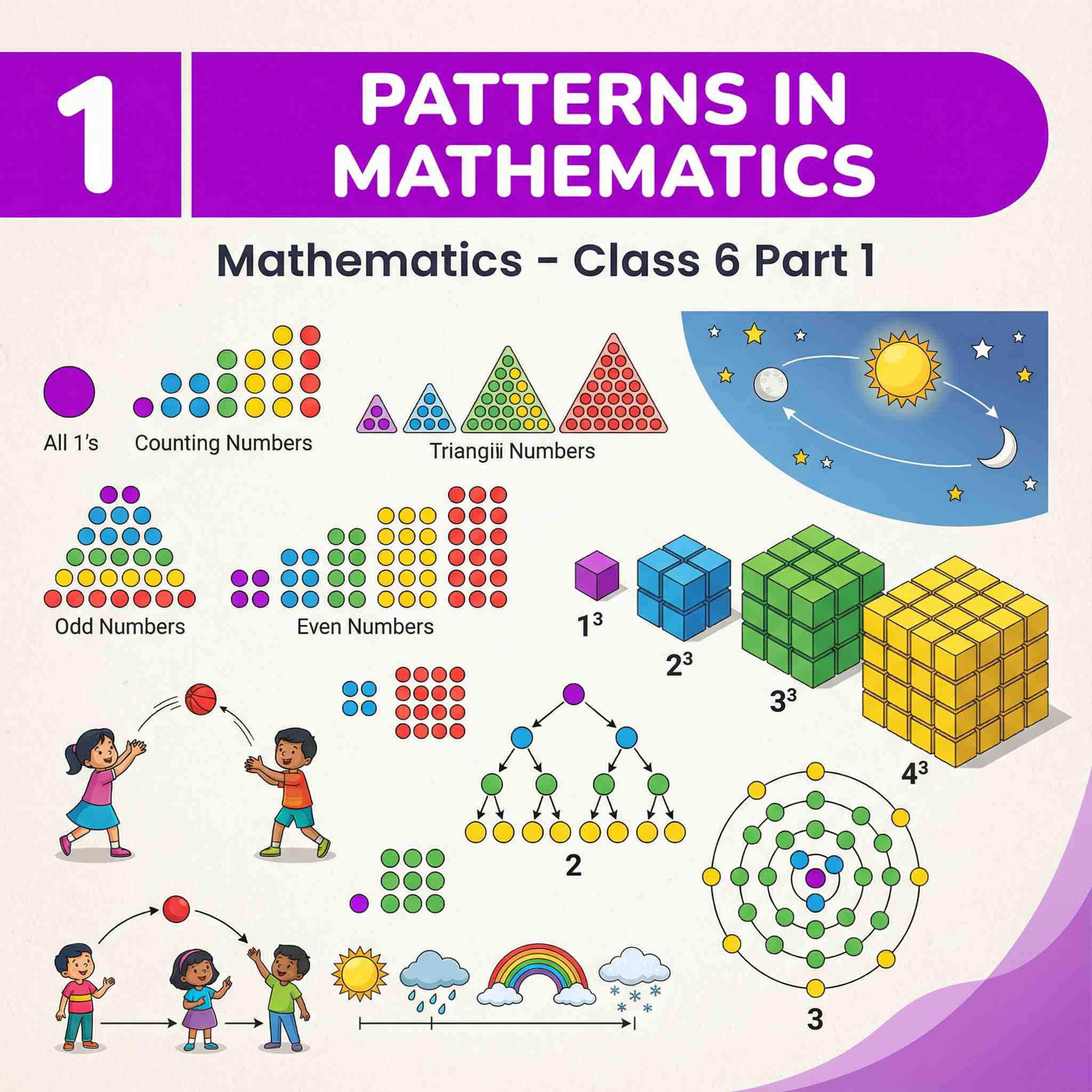
Complete Summary, Explanations, and Solutions for Patterns in Mathematics – Ganita Prakash Class VI, Chapter 1 – Number Sequences, Shape Patterns, Questions, Answers
Detailed summary and explanation of Chapter 1 'Patterns in Mathematics' from the Ganita Prakash Mathematics textbook for Class VI, covering number sequences (triangular, square, cube numbers), shape patterns, pictorial representations, and relations among sequences—along with all NCERT questions, answers, and exercises with step-by-step solutions.
Updated: just now

Patterns in Mathematics
NCERT Class 6 Mathematics Chapter 1 | Complete Guide | Patterns 2025
Chapter at a Glance – Patterns in Mathematics
This chapter introduces mathematics as the search for patterns and their explanations, focusing on number and shape patterns with visualizations and relations.
Main Topics Covered
- What is mathematics: Patterns and explanations
- Everyday applications of math
- Number patterns: Sequences like counting, odd/even, triangular, squares, cubes, Virahanka, powers
- Visualizing sequences with pictures
- Relations among sequences (e.g., sum of odds = squares)
- Shape patterns: Polygons, graphs, stacked shapes, Koch snowflake
- Relations between shapes and numbers
Key Takeaways for Exams
Number Sequences
Identify patterns, extend sequences.
Visualizations
Use dots/grids for triangular, squares, cubes.
Relations
Sum odds = squares; up-down counting = squares.
Shape Sequences
Polygons sides = counting from 3.
Hexagonal Numbers
1,7,19,37,... sum to cubes.
Koch Snowflake
Line segments: 3 × powers of 4.
Key Rules & Properties – Patterns
Important rules for number and shape sequences.
Number Sequence Rules
Patterns for generation and relations.
| Sequence | Rule | Example |
|---|---|---|
| Triangular | n(n+1)/2 | 1,3,6,10,15 |
| Squares | n² | 1,4,9,16,25 |
| Cubes | n³ | 1,8,27,64,125 |
| Virahanka | Previous two sum | 1,2,3,5,8,13 |
| Powers of 2 | 2^n | 1,2,4,8,16 |
Relations
| Relation | Formula | Example |
|---|---|---|
| Sum odds | = n² | 1+3+5+7=16 |
| Up-down counting | = n² | 1+2+1=4 |
| Sum triangular | = squares (pairs) | 1+3=4,3+6=9 |
| Sum powers 2 +1 | = next power 2 | 1+2+4=7+1=8 |
| 6×triangular+1 | = hexagonal | 6×1+1=7 |
Properties
- Visual Explanation: Pictures prove relations.
- Shape Sides: Polygons: 3+n.
- Complete Graphs Lines: Triangular numbers.
- Koch Segments: 3×4^n.
Concept Cards – Quick Explanations
Mathematics Definition
Search for patterns and why they exist.
Number Sequences
Patterns in whole numbers.
Triangular Numbers
1,3,6,10,... dots in triangles.
Square Numbers
1,4,9,16,... dots in squares.
Virahanka Numbers
1,2,3,5,8,... sum of previous two.
Relations
Sum odds = squares.
Shape Sequences
Polygons, graphs, stacked shapes.
Polygons Sides
3,4,5,... counting from 3.
Koch Snowflake
Iterations add bumps, segments ×4.
Hexagonal Numbers
1,7,19,37,... sum to cubes.
Examples + Solutions
Example 1: Sum of First 6 Odd Numbers
Solution: 1+3+5+7+9+11=36, which is 6².
Example 2: Up-Down Counting to 6
Solution: 1+2+3+4+5+6+5+4+3+2+1=36, 6².
Example 3: Sum of Powers of 2 +1
Solution: 1+2+4=7, +1=8=2^3.
Example 4: 6×Triangular +1
Solution: 6×3+1=19, hexagonal.
Example 5: Sum Hexagonal Numbers
Solution: 1+7+19=27=3³.
Example 6: Polygon Sides
Solution: Triangle=3, Square=4, etc.
Example 7: Complete Graph Lines
Solution: K3=3, K4=6, triangular.
Figure it Out Solutions (All Solved)
Section 1.1: What is Mathematics?
1. Other examples where math helps everyday?
Ans. Paying for fruits, vegetables, groceries etc. Calculation of speed of vehicles, designs in buildings.
2. How math propels humanity forward?
Ans. Scientific experiments, economy, bridges, TVs, phones, computers, vehicles, calendars.
Section 1.2: Patterns in Numbers
1. Recognize pattern in Table 1 sequences?
Ans. Yes, patterns as listed.
2. Rewrite sequences with next three and rule.
Ans. All 1's: 1,1,1,... next 1,1,1. Rule: Constant 1.
Counting: 1,2,3,... next 8,9,10. Rule: Add 1.
Odd: 1,3,5,... next 15,17,19. Rule: Add 2, odd.
Even: 2,4,6,... next 16,18,20. Rule: Add 2, even.
Triangular: 1,3,6,... next 36,45,55. Rule: n(n+1)/2.
Squares: 1,4,9,... next 64,81,100. Rule: n².
Cubes: 1,8,27,... next 216,343,512. Rule: n³.
Virahanka: 1,2,3,... next 34,55,89. Rule: Sum previous two.
Powers 2: 1,2,4,... next 128,256,512. Rule: ×2.
Powers 3: 1,3,9,... next 2187,6561,19683. Rule: ×3.
Section 1.3: Visualising Number Sequences
1. Copy pictures and draw next.
Ans. Refer Table 2, draw next for each.
2. Why called triangular, squares, cubes?
Ans. Dots form triangles, squares, cubes.
3. 36 as triangular and square.
Ans. Draw 8th triangular (rows 1-8), 6x6 square.
4. Sequence 1,7,19,37... name and next.
Ans. Hexagonal numbers, next 61.
5. Pictorial for powers 2,3.
Ans. Powers 2: Binary trees or doubling dots. Powers 3: Tripling branches.
Section 1.4: Relations among Number Sequences
Sum first 10 odds?
Ans. 100.
Sum first 100 odds?
Ans. 10000.
1. Pictorial for up-down counting = squares.
Ans. Pair opposites around center.
2. Value of 1+...+100+...+1?
Ans. 10000.
3. Sum All 1's up; up-down.
Ans. Up: Counting. Up-down: Squares of odds or similar.
4. Sum counting up.
Ans. Triangular. Pictorial: Stacked rows.
5. Pairs consecutive triangular.
Ans. Squares. Pictorial: Combine triangles to square.
6. Sum powers 2; +1.
Ans. 1,3,7,15,...; +1= next power 2. Why: Binary complete.
7. 6×triangular +1.
Ans. Hexagonal. Pictorial: Surround triangle with layers.
8. Sum hexagonal.
Ans. Cubes. Pictorial: Cube layers.
9. Own patterns.
Ans. Open, e.g., differences in squares = odds.
Section 1.5: Patterns in Shapes
1. Recognize pattern in Table 3.
Ans. Yes, increasing complexity.
2. Redraw, next shape, rule.
Ans. Polygons: Add side. Graphs: Add vertex+lines. Stacked: Add layer. Koch: Add bumps.
Section 1.6: Relation to Number Sequences
1. Polygon sides/corners.
Ans. Counting from 3. Same, as vertices=sides.
2. Complete graphs lines.
Ans. Triangular. n(n-1)/2 connections.
3. Stacked squares little squares.
Ans. Squares. n² total.
4. Stacked triangles little triangles.
Ans. Squares. Up-down rows sum.
5. Koch line segments.
Ans. 3,12,48,... 3×4^n.
Extra Practice Questions (Exam-Ready) – Chapter 1
25+ Questions • Categorized by Marks • With Detailed Solutions • Difficulty Tags
1-Mark Questions (Very Short Answer)
1. Next triangular number after 15.
2. Sum first 4 odds.
3. 5th square number.
4. Virahanka after 8,13.
5. Hexagonal after 37.
2-Mark Questions (Short Answer)
6. Rule for cubes.
7. Sum powers 2 up to 16 +1.
8. Polygon sides sequence.
9. Koch segments 3rd iteration.
10. 6×10+1.
3-Mark Questions (Reasoning)
11. Why sum odds = squares?
12. Up-down counting = squares why?
13. Sum hexagonal = cubes.
14. Complete graphs lines sequence.
15. 36 triangular and square.
4–5 Mark Questions (Application)
16. Sum first 10 odds.
17. Next 3 Virahanka after 21.
18. Sum up-down to 100.
19. Stacked triangles little triangles.
20. Koch 4th iteration segments.
Challenge Questions (6+ Marks)
21. Explain sum powers 2 +1 = next.
22. Own relation: Differences squares = odds.
23. Sum first 4 hexagonal.
24. Pictorial for 6×triangular+1=hexagonal.
25. Regular polygons names for 9,10 sides.
Common Mistakes & How to Avoid
Mistake 1: Wrong Sequence Extension
Misidentifying pattern rule.
Avoid: Check first few terms match rule.
Mistake 2: Ignoring Visual Proofs
Not drawing pictures for relations.
Avoid: Always sketch to verify.
Mistake 3: Confusing Sequences
Mixing triangular with squares.
Avoid: Name by shape visualization.
Mistake 4: Wrong Sum Calculations
Arithmetic errors in additions.
Avoid: Use formulas like n(n+1)/2.
Mistake 5: Missing Relations
Not spotting sum odds = squares.
Avoid: Compute small cases.
Mistake 6: Shape Count Errors
Miscounting sides/lines.
Avoid: Label and count systematically.
History & Fun Facts
Ancient Origins
Number patterns studied in ancient India (Virahanka/Fibonacci sequence in poetry meters, 200 BC).
Pythagoreans (Greece) discovered triangular/square numbers ~500 BC.
Real-Life Applications
- Nature: Fibonacci in plants, shells.
- Art: Patterns in designs, fractals like Koch.
- Science: Gravity from planetary patterns.
- Tech: Algorithms use sequences.
Fun Facts
- Fibonacci numbers appear in pinecones, sunflowers.
- 36 is both triangular and square (rare).
- Koch snowflake has infinite perimeter, finite area.
- Powers of 2 in binary computing.
- Hexagonal packing most efficient (honeycombs).
Did You Know?
Euler studied graph theory from complete graphs.
Quick Revision One-Pager
Sequences and Relations
| Sequence | Relation |
|---|---|
| Odds sum | Squares |
| Up-down counting | Squares |
| Triangular pairs | Squares |
| Hexagonal sum | Cubes |
| 6×triangular+1 | Hexagonal |
Quick Rules
- ✓ Patterns: Search and explain why.
- ✓ Sequences: Extend by rule.
- ✓ Visual: Dots for numbers.
- ✓ Shapes: Sides, lines relate to numbers.
- ✓ Polygons: Regular, equal sides/angles.
- ✓ Koch: ×4 segments per iteration.
Mind Map
Central: Patterns
- Numbers: Sequences, visuals, relations
- Shapes:
- Polygons, graphs
- Stacked, fractals
- Applications: Daily, science
Exam Tips
Before Solving
Identify pattern type
During Solving
Draw if needed
After Solving
Verify with small n
Time-Savers
Use known formulas
Interactive Quiz – 15 Questions

Group Discussions
No forum posts available.
Easily Share with Your Tribe