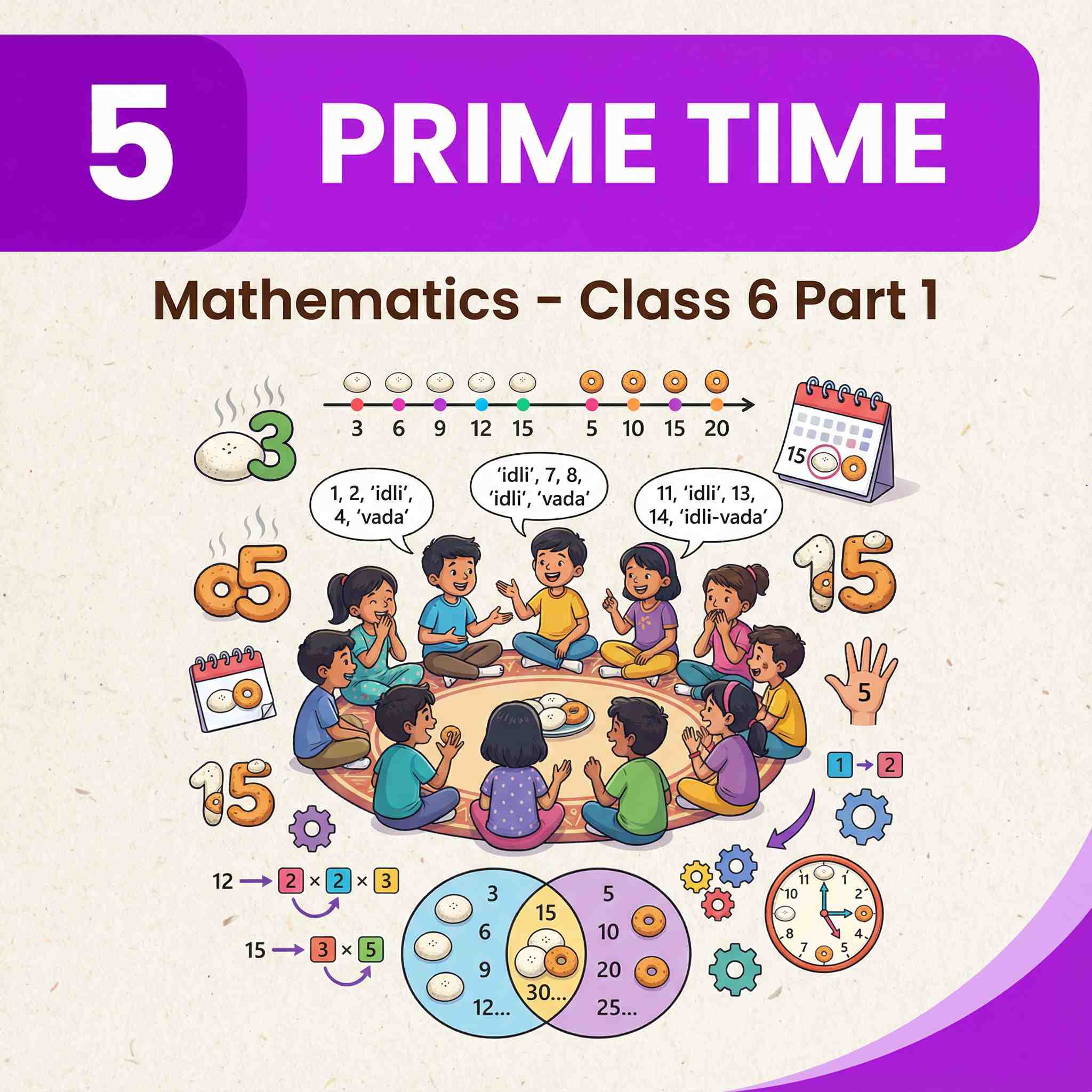
Complete Summary, Explanations, and Solutions for Prime Time – Ganita Prakash Class VI, Chapter 5 – Factors, Multiples, Prime Numbers, Co-primes, Questions, Answers
Detailed summary and explanation of Chapter 5 'Prime Time' from the Ganita Prakash Mathematics textbook for Class VI, covering common multiples and common factors, prime and composite numbers, Sieve of Eratosthenes, co-prime numbers, prime factorization, divisibility tests for 2, 3, 4, 5, 8, and 10, twin primes, perfect numbers—along with all NCERT questions, answers, and step-by-step solutions.
Updated: 6 months ago
Categories: NCERT, Class VI, Mathematics, Ganita Prakash, Chapter 5, Number Theory, Prime Numbers, Factors, Multiples, Summary, Questions, Answers
Tags: Prime Time, Ganita Prakash, NCERT, Class 6, Mathematics, Number Theory, Prime Numbers, Composite Numbers, Factors, Divisors, Multiples, Common Factors, Common Multiples, Co-prime Numbers, Prime Factorization, Sieve of Eratosthenes, Twin Primes, Perfect Numbers, Divisibility Tests, Divisibility Rules, Divisibility by 2, Divisibility by 4, Divisibility by 5, Divisibility by 8, Divisibility by 10, Summary, Explanation, Questions, Answers, Solutions, Chapter 5
Class 6 NCERT Maths Chapter 5: Prime Time Complete Notes, Solutions, Questions & Answers 2025
Prime Time
NCERT Class 6 Mathematics Chapter 5 | Complete Guide | Prime Numbers 2025
Chapter at a Glance – Prime Time
This chapter explores prime numbers as building blocks, common multiples/factors through games, and co-primes. Includes visualizations like Sieve and thread art.
Main Topics Covered
Common multiples & factors: Idli-Vada game, LCM/HCF concepts.
Factors & divisors: Jump Jackpot game.
Prime numbers: Definition, Sieve of Eratosthenes, identification.
Composite numbers & perfect numbers.
Co-prime numbers: Safe pairs, relation to LCM=product.
Ans. Smallest 2 (twins), largest 8 (113-107? <100:89-97? 97-89=8).
3. Primes per row in table.
Ans. No equal. Decades: 1-10:4, 11-20:4, etc. Least 90s:2, most 1-10:4.
4. Primes:23,51,37,26?
Ans. 23,37 prime;51=3x17,26=2x13 composite.
5. Prime pairs <20 sum multiple 5.
Ans. (2,3)=5,(2,13)=15,(2,18 no),(3,7)=10 etc.
6. Pairs like 13&31 <100.
Ans. 17&71,37&73,79&97 etc.
7. Seven consecutive composites <100.
Ans. 90-96:90,91,92,93,94,95,96.
8. Twin primes <100.
Ans. (3,5),(5,7),(11,13),(17,19),(29,31),(41,43),(59,61),(71,73).
9. Statements true/false.
Ans. a. False (units 2,3,5,7). b. False (product composite). c. False (have 1&itself). d. False (2 prime). e. True (next after prime >3 even, composite).
10. Product exactly three distinct primes.
Ans. 105=3×5×7.
11. Three-digit primes from 2,4,5 each once.
Ans. 245 no,425 no,524 no,542 no,425 no. None prime.
12. 2p+1 prime for prime p.
Ans. p=3:7, p=5:11, p=11:23, p=17:35 no, p=19:39 no. Examples:3,5,11.
5.3 Co-prime Numbers
Safe pairs:15&39,4&15,18&29,20&55.
Ans. a. No (HCF=3), b. Yes (1), c. Yes (1), d. No (5).
Co-prime pairs.
Ans. a. Yes (1), b. Yes, c. No (5), d. No (17? Wait 17&69=17×4+1, HCF=1 yes), e. No (9).
1-2. Idli-vada observations.
Ans. 1. Co-prime: LCM=product e.g. 3&4=12. 2. Not: LCM
Co-prime art observations.
Ans. Complete if pegs & gap co-prime (e.g. 13&3).
Extra Practice Questions (Exam-Ready) – Chapter 5
35+ Questions • Categorized by Marks • With Detailed Solutions • Difficulty Tags
1-Mark Questions (Very Short Answer)
1. LCM of 2&5.
10
2. HCF of 12&18.
6
3. Is 9 prime?
No
4. Factors of 30.
1,2,3,5,6,10,15,30
5. Co-prime:8&15?
Yes
6. Even prime.
2
7. Twin primes example.
3&5
8. Perfect number <10.
6
2-Mark Questions (Short Answer)
9. Multiples of 4 between 20-40.
24,28,32,36
10. Common factors 24&36.
1,2,3,4,6,12
11. Primes 40-60.
41,43,47,53,59
12. LCM 6&8.
24
13. Co-prime pairs <20.
e.g. 9&10,14&15
14. Sum factors 6.
12=2×6
3-Mark Questions (Reasoning)
15. Why 1 neither prime/composite?
Only one factor.
16. Explain Sieve for primes <20.
Cross multiples 2,3,5; left:2,3,5,7,11,13,17,19.
17. Why co-prime LCM=product?
No common factors to share.
18. Rectangular arrangements 18.
1x18,2x9,3x6,6x3,9x2,18x1.
19. Consecutive composites 8.
24-31:24 to 31.
20. 2p+1 prime examples.
p=3:7,p=5:11,p=11:23.
4–5 Mark Questions (Application)
21. Smallest multiple 1-12 except 11.
27720/11? Calculate LCM.
22. Idli-vada to 120: counts.
Idli:40,Vada:24,Idli-vada:8.
23. Factors 100.
1,2,4,5,10,20,25,50,100.
24. Co-prime art for 10 pegs gap 3.
Complete since HCF=1.
25. Product three distinct primes <200.
2×3×5=30,2×3×7=42, etc.
Challenge Questions (6+ Marks)
26. Prove no primes end with 4.
Even>2 divisible by 2.
27. Find 10 twin primes <200.
List: (101,103),etc.
28. Sieve diagram <50.
Primes:2-47.
29. LCM HCF relation proof small.
For a,b: LCM×HCF=a×b.
30. Perfect number next after 28.
496.
31. Co-prime examples 5 pairs.
e.g. 21&22.
32. Jump sizes for three numbers.
HCF of three.
33. Why infinite primes?
Euclid's proof (advanced).
34. Goldbach conjecture small.
Even= sum two primes.
35. Mersenne primes.
2^p-1 prime for prime p.
Common Mistakes & How to Avoid
Mistake 1: 1 as Prime
Classifying 1 as prime.
Avoid: Remember 1 has one factor.
Mistake 2: Even Primes >2
Thinking even numbers prime.
Avoid: All even >2 divisible by 2.
Mistake 3: LCM/HCF Mixup
Confusing least/greatest.
Avoid: LCM multiple, HCF factor.
Mistake 4: Missing Factors
Forgetting 1 & number itself.
Avoid: Always include.
Mistake 5: Co-prime with Common 1 Only
Ignoring check.
Avoid: List factors.
Mistake 6: Sieve Errors
Crossing wrong multiples.
Avoid: Start from 2, cross multiples.
Mistake 7: Perfect Sum Include Number?
Including number in proper factors.
Avoid: Proper exclude itself, but definition sum all=2x.
Expanded: Practice listing for small numbers.
History & Fun Facts
Ancient Origins
Sieve by Eratosthenes ~200 BC Greece.
Primes studied by Euclid (infinite primes proof).
Perfect numbers linked to Mersenne primes.
Real-Life Applications
Cryptography: Primes in RSA encryption.
Computing: Factorization hard for security.
Nature: Cicadas cycles prime years.
Art: Co-prime thread designs.
Fun Facts
Largest known prime: 2^82,589,933 -1 (millions digits).
2 is only even prime.
Twin primes conjecture: Infinite pairs.
Goldbach: Every even >2 sum two primes (unproven).
Perfect numbers even, none odd known.
Primes in music rhythms, poetry.
Did You Know?
Virahanka numbers relate? No, but primes fundamental.