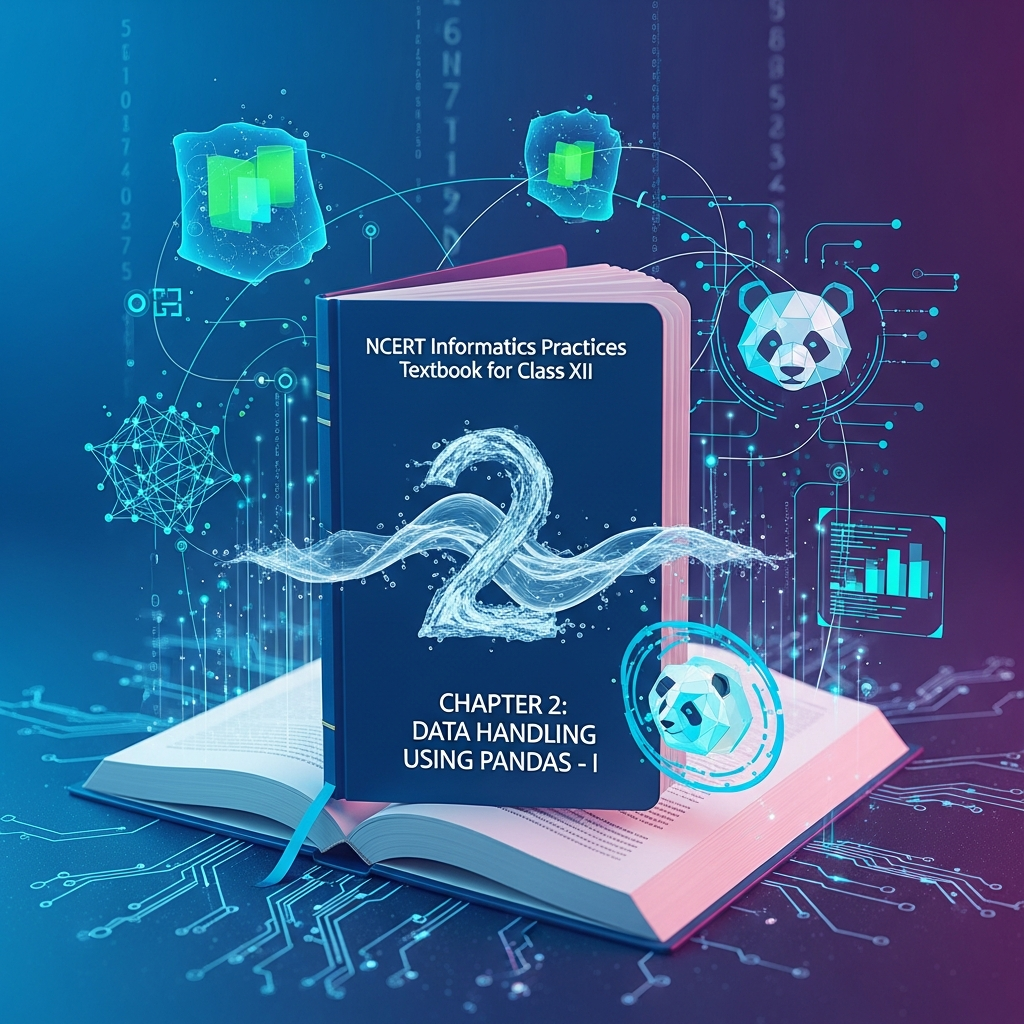
Complete Summary and Solutions for Data Handling Using Pandas – I – NCERT Class XII Informatics Practices, Chapter 2 – Explanation, Questions, Answers Detailed summary and explanation of Chapter 2 'Data Handling Using Pandas – I' from the NCERT Informatics Practices textbook for Class XII. The chapter introduces Python libraries (NumPy, Pandas, Matplotlib) and focuses on Pandas as a high-level data manipulation tool built on NumPy and Matplotlib, explaining its core data structures Series and DataFrame, their creation from lists, arrays, dictionaries, and scalar values, and how to use indexing and slicing for data access. It also covers basic DataFrame operations, importing and exporting data between CSV files and DataFrames, and compares Pandas Series with NumPy ndarrays for tabular data analysis. All NCERT exercises, questions, and answers related to this chapter are included for exam-oriented practice. Updated: 8 months ago
Categories: NCERT, Class XII, Informatics Practices, Chapter 2, Python, Pandas, NumPy, Matplotlib, Data Handling, Series, DataFrame, CSV, Data Analysis, Summary, Questions, Answers, Explanation
Tags: Data Handling Using Pandas, Pandas Series, Pandas DataFrame, NumPy, Matplotlib, Python Libraries, CSV Import Export, Tabular Data, Data Analysis, NCERT, Class 12, Informatics Practices, Summary, Explanation, Questions, Answers, Chapter 2
Data Handling Using Pandas - I - Class 12 Informatics Practices Chapter 2 Ultimate Study Guide 2025
Full Chapter Summary & Detailed Notes
Key Definitions & Terms
Text Book Questions & Answers
Key Concepts
Historical Development
Technique Examples
Interactive Quiz (10 Q)
Quick Revision Notes & Mnemonics
Key Terms & Processes
Processes Step-by-Step
Full Chapter Summary & Detailed Notes - Data Handling Using Pandas - I Class 12 NCERT
Overview & Key Concepts
Chapter Goal : Introduce Pandas for data manipulation/analysis. Exam Focus: Libraries (NumPy/Pandas/Matplotlib), Series creation/access/attributes/methods, NumPy vs Pandas, installation. 2025 Updates: Pandas 2.0 features (e.g., PyArrow backend), data science integration. Fun Fact: Pandas named from 'Panel Data'. Core Idea: Efficient data structures for real-world analysis.Wider Scope : From libraries to Series; sources: Activities (e.g., monuments series), Think/Reflect (alias names). Expanded: Practical code applications.Expanded Content : Point-wise for recall; add 2025 relevance like efficient large data handling.
Introduction to Python Libraries
Definition : Collections of modules for tasks without detailed code. Ex: NumPy (numerical), Pandas (analysis), Matplotlib (visualization).Purpose : Manipulate/transform/visualize data efficiently.Example : NumPy multidimensional arrays; Pandas Series/DataFrame/Panel.Expanded : Built on NumPy; Pandas for tabular data.
Conceptual Diagram: Series Structure
Index-value pairs; visualizes 1D labeled array.
Why This Guide Stands Out
Comprehensive: All code/attributes point-wise, 2025 with Pandas updates; analyzed for data tasks.
NumPy vs Pandas
Differences : 1. NumPy homogeneous arrays, Pandas heterogeneous DataFrames. 2. Pandas simpler for file/plot/select/join/GROUP BY. 3. Pandas column names for tracking. 4. Pandas tabular, NumPy numeric arrays.Do You Know? : Pandas built on NumPy/Matplotlib.Expanded : Use Pandas for mixed data types.
Exam Activities
Create series (monuments/states); count non-null.
Installing Pandas
Command : pip install pandas (requires Python/NumPy).Alias : import pandas as pd (not mandatory, but conventional).Expanded : Similar to NumPy install.
Data Structures in Pandas
Series : 1D labeled array (any type, default 0-based index).DataFrame : 2D labeled structure (tabular).Expanded : Efficient storage/retrieval/modification.
Creation of Series
From Scalars : pd.Series([values]); custom index.From NumPy Arrays : pd.Series(np.array); length match required.From Dictionary : Keys as indices.Expanded : Examples with code outputs.
Accessing Elements of Series
Indexing : Positional (0-based), Labelled (custom).Slicing : [start:end] (positional excludes end, labels include).Expanded : Modify via slicing; reverse order.
Attributes of Series
name : Assign series name.index.name : Name index.values : List of values.size : Number of elements.empty : True if empty.Expanded : Table with examples.
Methods of Series
head(n) : First n elements.tail(n) : Last n elements.Expanded : For analysis/visualization.
Summary Key Points
Pandas: Data manipulation; Series (1D), creation/access/attributes/methods. Vs NumPy: Heterogeneous/tabular.
Impact: Efficient analysis; challenges: Length errors.
Project & Group Ideas
Group: Create series from data; individual: Attribute poster.
Debate: Pandas vs NumPy in projects.
Code role-play: Slicing scenarios.
Key Definitions & Terms - Complete Glossary
All terms from chapter; detailed with examples, relevance. Expanded: 30+ terms grouped; added advanced like "Heterogeneous Data", "Labelled Index" for depth/easy flashcards.
Python Libraries
Modules for tasks. Ex: Pandas analysis. Relevance: No detailed code.
NumPy
Numerical computing arrays. Ex: Multidimensional. Relevance: Homogeneous data.
Pandas
Data manipulation tool. Ex: Series/DataFrame. Relevance: Tabular analysis.
Matplotlib
Visualization library. Ex: Plots/histograms. Relevance: Data graphs.
Series
1D labeled array. Ex: Index-value. Relevance: Any type data.
DataFrame
2D labeled table. Ex: Columns/rows. Relevance: Heterogeneous.
Positional Index
0-based integer. Ex: series[0]. Relevance: Default access.
Labelled Index
Custom labels. Ex: series['Feb']. Relevance: Meaningful.
Slicing
Extract part. Ex: [1:3]. Relevance: Subsets.
name Attribute
Series name. Ex: 'Capitals'. Relevance: Identification.
index.name
Index name. Ex: 'Countries'. Relevance: Context.
values
List of values. Ex: ['NewDelhi'...]. Relevance: Extraction.
size
Element count. Ex: 4. Relevance: Length check.
empty
True if no elements. Ex: pd.Series(). Relevance: Validation.
head()
First n elements. Ex: head(5). Relevance: Preview.
tail()
Last n elements. Ex: tail(3). Relevance: End view.
Heterogeneous Data
Mixed types. Ex: Int/string. Relevance: Pandas strength.
Homogeneous Data
Same type. Ex: All floats. Relevance: NumPy requirement.
ValueError
Length mismatch. Ex: Array/index. Relevance: Error handling.
pip install
Package installation. Ex: pandas. Relevance: Setup.
import as pd
Alias usage. Ex: pd.Series. Relevance: Convention.
ndarray
NumPy array. Ex: np.array([1,2]). Relevance: Base for Series.
dtype
Data type. Ex: int64. Relevance: Type info.
Scalar Values
Single values. Ex: pd.Series([10]). Relevance: Basic creation.
Dictionary Keys
Become indices. Ex: {'India':'NewDelhi'}. Relevance: Mapped.
Reverse Slicing
Backward order. Ex: [::-1]. Relevance: Reversal.
Modification via Slicing
Update subsets. Ex: [1:3]=50. Relevance: Bulk change.
NaN
Not a Number. Ex: np.nan. Relevance: Missing data.
Non-Null Count
Valid values. Ex: Activity 2.3. Relevance: Data cleaning.
Panel
3D structure. Ex: Deprecated. Relevance: Historical.
Tabular Format
Rows/columns. Ex: DataFrame. Relevance: Real-world data.
Numeric Array
NumPy focus. Ex: np.arange. Relevance: Calculations.
Figure-8 Landing
Not in chapter; skip.
Tip: Group by structure; examples for recall. Depth: Code debates. Errors: Length mismatch. Interlinks: To NumPy chapter. Advanced: Pandas updates. Real-Life: Data analysis. Graphs: Attribute tables. Coherent: Intro → Creation → Access. For easy learning: Flashcard per term with code.
Text Book Questions & Answers - NCERT Exercises
Based on activities/think-reflect (no explicit questions). Answers point-wise for exams.
Activity-Based Questions
Activity 2.1: Create a series with five famous monuments of India and their States as index.
Answer:
Code: import pandas as pd; monuments = pd.Series(['Taj Mahal', 'Red Fort', 'Qutub Minar', 'Gateway of India', 'Hawa Mahal'], index=['Uttar Pradesh', 'Delhi', 'Delhi', 'Maharashtra', 'Rajasthan'])
Output: Uttar Pradesh Taj Mahal
Activity 2.2: Get NewDelhi as output using positional index from seriesCapCntry.
Answer:
seriesCapCntry[0] # Assuming index order: India first.
Activity 2.3: Count and display only non-null values in series with NaN.
Answer:
Code: import pandas as pd; import numpy as np; s2=pd.Series([12,np.nan,10]); print(s2.count()) # Output: 2
Think and Reflect: While importing Pandas, is it mandatory to use pd as alias? What if other name?
Answer:
Not mandatory; e.g., import pandas as p; p.Series(). But pd is conventional for readability.
Tip: Practice code (creation/access); full marks: Code + output.
Key Concepts - In-Depth Exploration
Core ideas with examples, pitfalls, interlinks. Expanded: All concepts with steps/examples/pitfalls.
Libraries Comparison
Steps: 1. NumPy numeric arrays, 2. Pandas tabular. Ex: Heterogeneous data. Pitfall: Homogeneous assumption. Interlink: Installation. Depth: Built-on relation.
Series Creation
Steps: 1. Scalars/arrays/dicts, 2. Custom index. Ex: pd.Series([1,2], index=['a','b']). Pitfall: Length error. Interlink: Access. Depth: Scalar repetition.
Indexing Types
Steps: 1. Positional [0], 2. Labelled ['Feb']. Ex: series['Mar']=3. Pitfall: Wrong type. Interlink: Slicing. Depth: List access.
Slicing Differences
Steps: 1. Positional excludes end, 2. Labels include. Ex: [1:3] vs ['USA':'France']. Pitfall: Inclusion error. Interlink: Modification. Depth: Reverse [::-1].
Attributes Usage
Steps: 1. Assign name/index.name, 2. Get values/size. Ex: series.name='Capitals'. Pitfall: Empty check. Interlink: Methods. Depth: Property access.
Methods Application
Steps: 1. head(5) preview, 2. tail(3) end. Ex: series.head(). Pitfall: Large data. Interlink: NaN handling. Depth: Analysis start.
NaN Handling
Steps: 1. Include np.nan, 2. Count non-null. Ex: series.count(). Pitfall: Ignore in calcs. Interlink: Attributes. Depth: Missing data.
Installation Process
Steps: 1. pip install pandas, 2. Import as pd. Ex: Command line. Pitfall: No Python. Interlink: Libraries. Depth: Dependencies.
Data Structures
Steps: 1. Series 1D, 2. DataFrame 2D. Ex: Efficient ops. Pitfall: Confuse dims. Interlink: NumPy. Depth: Visualization link.
Modification
Steps: 1. Slicing assign, 2. Update values. Ex: series[1:3]=50. Pitfall: Label exclusion. Interlink: Slicing. Depth: Bulk updates.
Advanced: Pandas 2.0, large data. Pitfalls: Errors. Interlinks: To DataFrame. Real: Analysis apps. Depth: 10 concepts details. Examples: Code. Graphs: Output tables. Errors: ValueError. Tips: Code evidence; compare (Pandas/NumPy).
Historical Development - Detailed Guide
Evolution of Pandas/NumPy; expanded with points; links to creators/versions. Added global milestones.
NumPy Origins (2005+)
Travis Oliphant 2006: Unified Numeric/Numarray. Multidimensional arrays for science. Depth: From MATLAB inspiration.
Pandas Creation (2008)
Wes McKinney at AQR: For financial data. Panel Data name origin. Depth: Open-source 2009.
Key Milestones
2010: DataFrame enhancements. 2023: Pandas 2.0 (PyArrow, nullables). 2025: AI integration hints. Depth: From finance to general use.
Matplotlib (2003)
John Hunter: MATLAB-like plots. Built on NumPy. Depth: Visualization evolution.
Modern Updates
Pandas 2.0: Faster with Arrow. Integration: Jupyter/PyData. Depth: Efficiency for big data.
Global Impact
Data science standard. Community contributions. Depth: Python ecosystem.
Tip: Link to timelines. Depth: Creator impacts. Examples: Versions. Graphs: Year chronology. Advanced: Future trends. Easy: Bullets milestones.
Technique Examples - From Text with Simple Explanations
Expanded with evidence, interpretations; focus on application, analysis. Added creation/access/slicing breakdowns.
Example 1: Series from Scalars
Simple Explanation: Basic creation.
import pandas as pd
series1 = pd.Series([10,20,30])
print(series1)
Output: 0 10\n1 20\n2 30\ndtype: int64
Example 2: Custom Index Series
Simple Explanation: Labeled data.
series2 = pd.Series(["Kavi","Shyam","Ravi"], index=[3,5,1])
print(series2)
Output: 3 Kavi\n5 Shyam\n1 Ravi\ndtype: object
Example 3: From NumPy Array
Simple Explanation: Array conversion.
import numpy as np
array1 = np.array([1,2,3,4])
series3 = pd.Series(array1)
print(series3)
Output: 0 1\n1 2\n2 3\n3 4\ndtype: int32
Example 4: Positional Indexing
Simple Explanation: Integer access.
seriesNum = pd.Series([10,20,30])
print(seriesNum[2])  # 30
Example 5: Slicing Modification
Simple Explanation: Update subset.
seriesAlph = pd.Series(np.arange(10,16,1), index=['a','b','c','d','e','f'])
seriesAlph[1:3] = 50
print(seriesAlph)
Output: a 10\nb 50\nc 50\n...
Example 6: Attributes Usage
Simple Explanation: Property access.
seriesCapCntry.name = 'Capitals'
print(seriesCapCntry.name)  # Capitals
Tip: Run code; troubleshoot (e.g., errors). Added for creation/access.
Interactive Quiz - Master Pandas Series
10 MCQs in full sentences; 80%+ goal. Covers creation, access, attributes, methods.
Start Quiz
Quick Revision Notes & Mnemonics
Concise summaries for subtopics. Tables for scan: Key points, examples, mnemonics. Covers creation, access, attributes.
Subtopic
Key Points
Examples
Mnemonics/Tips
Libraries NumPy: Arrays. Pandas: Tabular. Matplotlib: Plots. Pandas heterogeneous.
NPM (NumPy, Pandas, Matplotlib). Tip: "Numbers Process Meaningfully".
Series Creation Scalars/arrays/dicts. Custom index. pd.Series([10,20]).
SAD (Scalars, Arrays, Dicts). Tip: "Sad without data? Create SAD".
Accessing Positional/labelled. Slicing: Exclude/include. series[1:3].
PLS (Positional, Labelled, Slicing). Tip: "Please Label Slices".
Attributes name/index.name. values/size/empty. series.size=4.
NIVSE (Name, Index, Values, Size, Empty). Tip: "Never Ignore Values So Empty".
Methods head(5).
HT (Head, Tail). Tip: "Head To Tail view".
Overall Tip: Use NPM-SAD-PLS-NIVSE-HT for full scan (5 mins). Flashcards: Front (term), Back (points + mnemonic). Covers 100% chapter – easy for exams!
Key Terms & Processes - All Key
Expanded table 30+ rows; quick ref. Added advanced (e.g., dtype, NaN). Overflow fixed.
Term/Process Description Example Usage
Python Libraries Module collections Pandas/NumPy Tasks simplify NumPy Numeric arrays np.array Homogeneous Pandas Data manipulation pd.Series Tabular Matplotlib Plots/graphs plt.plot Visualization Series 1D labeled pd.Series([1,2]) Any type DataFrame 2D tabular pd.DataFrame Heterogeneous Positional Index 0-based series[0] Default Labelled Index Custom series['a'] Meaningful Slicing Subset extract [1:3] Parts name Series label ='Capitals' ID index.name Index label ='Countries' Context values Value list ['NewDelhi'...] Extract size Count 4 Length empty No elements True/False Check head First n head(5) Preview tail Last n tail(3) End Heterogeneous Mixed types Int/string Pandas Homogeneous Same type All ints NumPy ValueError Mismatch Length error Handle pip install Install cmd pip install pandas Setup import as pd Alias pd.Series Convention ndarray NumPy array np.array Base dtype Data type int64 Info Scalar Single value [10] Basic Dictionary Key:value {'India':'NewDelhi'} Mapped index Reverse Slicing Backward [::-1] Order Modification Update [1:3]=50 Bulk NaN Not a Number np.nan Missing Non-Null Valid count count() Clean Panel 3D (deprecated) Old structure Historical Tabular Format Rows/cols DataFrame Real data Numeric Array NumPy focus np.arange Calcs
Tip: Examples memory; sort category. Easy: Table scan. Added 10 rows depth.
Processes Step-by-Step
Step-by-step breakdowns of core processes. Code descriptions; focus on actionable steps with examples.
Process 1: Installing and Importing Pandas
Step 1: Ensure Python/NumPy installed.
Step 2: Run pip install pandas.
Step 3: Import: import pandas as pd.
Step 4: Test: pd.Series().
Visual: Install → Import → Use.
Process 2: Creating Series from Array
Step 1: Import np/pd.
Step 2: Create np.array([1,2,3]).
Step 3: pd.Series(array, index=['a','b','c']).
Step 4: Check lengths match.
Visual: Array → Series → Index.
Process 3: Accessing and Slicing
Step 1: Create series.
Step 2: Positional: series[1].
Step 3: Slicing: series[1:3].
Step 4: Modify: series['b':'d']=50.
Visual: Create → Access → Slice → Update.
Process 4: Using Attributes
Step 1: series.name='Data'.
Step 2: Print series.values.
Step 3: Check series.size.
Step 4: If series.empty: handle.
Visual: Assign → Get → Check.
Process 5: Handling NaN
Step 1: Include np.nan in series.
Step 2: Use series.count() for non-null.
Step 3: series.dropna() if needed.
Step 4: Analyze remaining.
Visual: Include → Count → Clean.
Process 6: Methods Application
Step 1: Create long series.
Step 2: series.head(5).
Step 3: series.tail(3).
Step 4: Preview data.
Visual: Create → Head → Tail.
Tip: Follow like checklist; apply to code. Easy: Number + code per step.
As an Amazon Associate, ProSyllabus earns from qualifying purchases. Prices shown are subject to change.
This chapter is part of the CBSE Class 12 Board Examination Board Examination Explore every chapter — NCERT notes, important questions & MCQ quizzes Playing as guest — sign in so your rank, XP and attempts aren't lost #1
The Last Lesson
8/10 avg score
10/10 best
leaderboard ranks ›#2
Economics (Class 12) Practice Quiz | CBSE Class 12 Board Examination
0.2/10 avg score
1/10 best
leaderboard ranks ›#3
Matrices
3.8/10 avg score
7/10 best
leaderboard ranks ›#4
Challenges of Nation Building
7.7/10 avg score
8/10 best
leaderboard ranks ›#5
Human Geography: Nature and Scope
5.3/10 avg score
8/10 best
leaderboard ranks ›#6
Money and Banking
8.7/10 avg score
10/10 best
leaderboard ranks ›#7
The End of Bipolarity
6/10 avg score
10/10 best
leaderboard ranks ›#8
Bricks, Beads and Bones — The Harappan Civilisation
8.5/10 avg score
9/10 best
leaderboard ranks ›#9
Inverse Trigonometric Functions
#10
The Enemy
10/10 avg score
10/10 best
leaderboard ranks ›#11
Keeping Quiet
10/10 avg score
10/10 best
leaderboard ranks ›#12
My Mother at Sixty-six
8/10 avg score
8/10 best
leaderboard ranks ›#13
Poets and Pancakes
9/10 avg score
9/10 best
leaderboard ranks ›#14
The Rattrap
9/10 avg score
9/10 best
leaderboard ranks ›#15
Lost Spring
9/10 avg score
9/10 best
leaderboard ranks ›#16
Introducing Indian Society
6/10 avg score
6/10 best
leaderboard ranks ›#17
Security in the Contemporary World
1/10 avg score
1/10 best
leaderboard ranks ›#18
Tertiary and Quaternary Activities
9/10 avg score
9/10 best
leaderboard ranks ›#19
Secondary Activities
8/10 avg score
8/10 best
leaderboard ranks ›#20
Kings, Farmers and Towns — Early States and Economies (c. 600 BCE-600 CE)
10/10 avg score
10/10 best
leaderboard ranks ›#21
Theory of Consumer Behaviour
6/10 avg score
6/10 best
leaderboard ranks ›#24
Nature and Significance of Management
6/10 avg score
6/10 best
leaderboard ranks ›#25
Continuity and Differentiability
1/10 avg score
1/10 best
leaderboard ranks ›#26
Determinants
7/10 avg score
7/10 best
leaderboard ranks ›#28
Principles of Inheritance and Variation
10/10 avg score
10/10 best
leaderboard ranks ›#29
Reproductive Health
9/10 avg score
9/10 best
leaderboard ranks ›#30
Human Reproduction
10/10 avg score
10/10 best
leaderboard ranks ›#32
Solutions
7/10 avg score
7/10 best
leaderboard ranks ›#33
Principles of Management
1/10 avg score
1/10 best
leaderboard ranks ›#34
Accountancy (Class 12) Practice Quiz | CBSE Class 12 Board Examination
#35
Electrostatic Potential and Capacitance Fundamentals | CBSE Class 12 Board Examination
3/10 avg score
3/10 best
leaderboard ranks ›#38
Journey to the End of the Earth
#44
An Elementary School Classroom in a Slum
#49
Social Influence and Group Processes
#50
Attitude and Social Cognition
#55
Variations in Psychological Attributes
#57
Mass Media and Communications
#58
Globalisation and Social Change
#59
Change and Development in Industrial Society
#60
Change and Development in Rural Society
#61
The Constitution and Social Change
#64
The Challenges of Cultural Diversity
#65
Patterns of Social Inequality and Exclusion
#66
The Market as a Social Institution
#67
Social Institutions: Continuity and Change
#68
The Demographic Structure of the Indian Society
#69
Recent Developments in Indian Politics
#71
The Crisis of Democratic Order
#72
Challenges to and Restoration of the Congress System
#73
India's External Relations
#74
Politics of Planned Development
#75
Era of One-party Dominance
#76
Environment and Natural Resources
#77
International Organisations
#79
Contemporary Centres of Power
#80
Geographical Perspective on Selected Issues and Problems
#81
Planning and Sustainable Development in the Indian Context
#82
Mineral and Energy Resources
#84
Land Resources and Agriculture
#86
Population: Distribution, Density, Growth and Composition
#87
International Trade (India)
#88
Transport and Communication (India)
#91
The World Population: Distribution, Density and Growth
#92
Framing the Constitution — The Beginning of a New Era
#93
Mahatma Gandhi and the Nationalist Movement — Civil Disobedience and Beyond
#94
Rebels and the Raj — The Revolt of 1857 and its Representations
#95
Colonialism and the Countryside — Exploring Official Archives
#96
Peasants, Zamindars and the State — Agrarian Society and the Mughal Empire (c. sixteenth-seventeenth centuries)
#97
An Imperial Capital: Vijayanagara (c. fourteenth to sixteenth century)
#98
Bhakti-Sufi Traditions — Changes in Religious Beliefs and Devotional Texts (c. eighth to eighteenth century)
#99
Through the Eyes of Travellers — Perceptions of Society (c. tenth to seventeenth century)
#100
Thinkers, Beliefs and Buildings — Cultural Developments (c. 600 BCE-600 CE)
#101
Kinship, Caste and Class — Early Societies (c. 600 BCE-600 CE)
#102
Open Economy Macroeconomics
#103
Government Budget and the Economy
#104
Determination of Income and Employment
#105
National Income Accounting
#107
The Theory of the Firm under Perfect Competition
#119
Analysis of Financial Statements
#120
Financial Statements of a Company
#121
Issue and Redemption of Debentures
#122
Accounting for Share Capital
#123
Dissolution of Partnership Firm
#124
Reconstitution of a Partnership Firm – Retirement/Death of a Partner
#125
Reconstitution of a Partnership Firm – Admission of a Partner
#126
Accounting for Partnership: Basic Concepts
#129
Three Dimensional Geometry
#134
Application of Derivatives
#135
Biodiversity and its Conservation
#137
Organisms and Populations
#138
Biotechnology and its Applications
#139
Biotechnology: Principles and Processes
#140
Microbes in Human Welfare
#143
Molecular Basis of Inheritance
#144
Sexual Reproduction in Flowering Plants
#147
Aldehydes, Ketones and Carboxylic Acids
#148
Alcohols, Phenols and Ethers
#149
Haloalkanes and Haloarenes
#151
The d- and f-Block Elements
#153
Semiconductor Electronics: Materials, Devices and Simple Circuits
#156
Dual Nature of Radiation and Matter
#158
Ray Optics and Optical Instruments
#161
Electromagnetic Induction
#163
Moving Charges and Magnetism
#164
Electrostatic Potential and Capacitance
#165
Electric Charges and Fields
#166
CBSE Class 12 — Genetics and Evolution
#167
CBSE Class 12 — Matrices and Determinants
#168
CBSE Class 12 — Solutions and Colligative Properties
#170
CBSE Class 12 — Electrostatics and Electric Field
#171
Humanities Subjects Practice Quiz | CBSE Class 12 Board Examination
Group Discussions No forum posts available.
Easily Share with Your Tribe