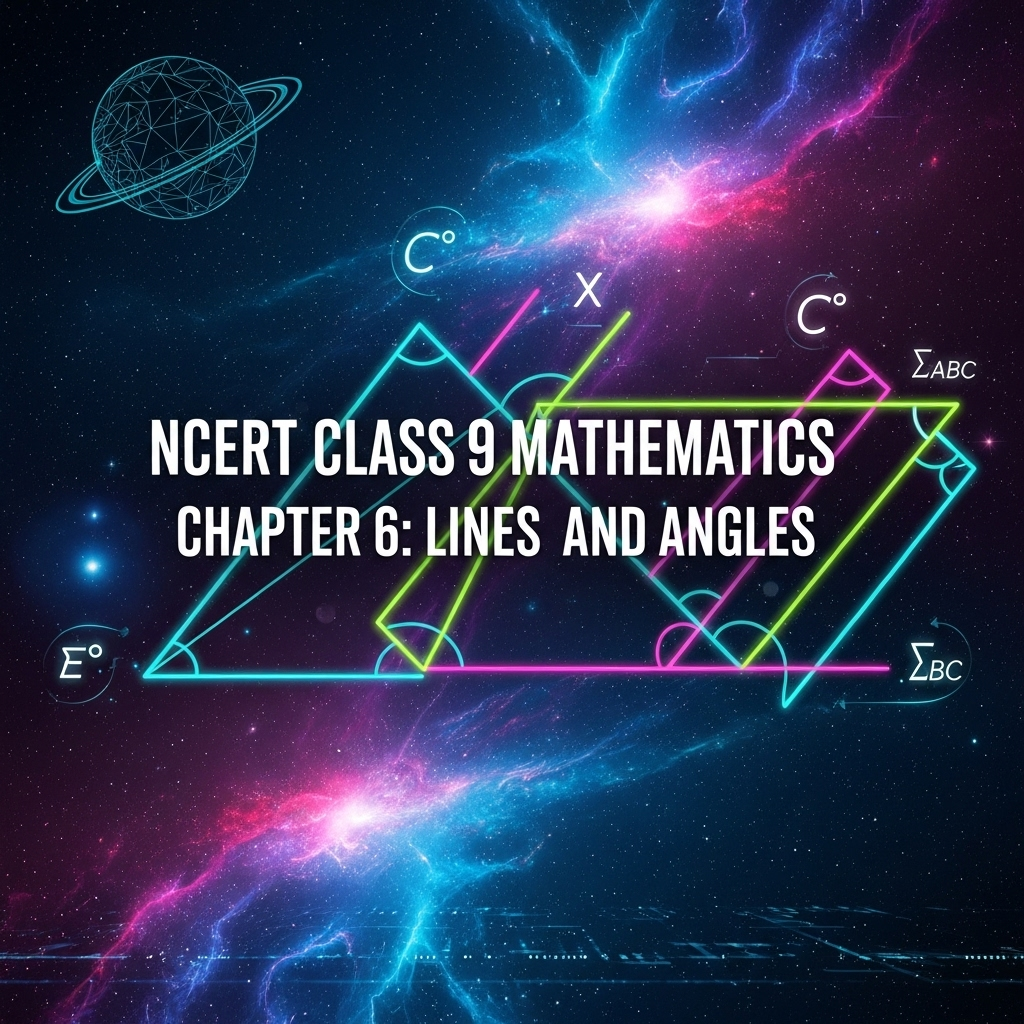
Complete Solutions and Summary of Lines and Angles – NCERT Class 9, Mathematics, Chapter 6 – Summary, Questions, Answers, Extra Questions
Detailed summary and explanation of Chapter 6 ‘Lines and Angles’ with all question answers, extra questions, and solutions from NCERT Class IX, Mathematics.
Updated: 9 months ago
Categories: NCERT, Class IX, Mathematics, Summary, Extra Questions, Lines and Angles, Chapter 6
Tags: Lines, Angles, Types of Angles, Adjacent Angles, Linear Pair, Vertically Opposite Angles, Parallel Lines, Axioms, Theorems, Corresponding Angles, Interior Angles, Supplementary Angles, NCERT, Mathematics, Class 9, Chapter 6, Answers, Extra Questions
Lines and Angles - Complete Study Guide
Lines and Angles
Chapter 6: Mathematics - Complete Study Guide
Chapter Overview
LineTwo Points
AngleTwo Rays
Acute<90°
Obtuse>90°
What You'll Learn
Basic Terms
Line-segment, ray, collinear, angles.
Intersecting Lines
Vertical, adjacent angles.
Parallel Lines
Corresponding, alternate angles.
Applications
Proofs using properties.
Key Highlights
Lines and angles properties: intersecting form vertical/adjacent, parallel with transversal form corresponding/alternate/co-interior. Angle sum on line 180°, triangle 180°.
Comprehensive Chapter Summary
1. Introduction
Minimum two points draw line.
Axioms, prove statements.
Properties angles intersecting lines.
Properties angles parallel lines transversal.
Use properties prove statements deductive.
Verified statements activities earlier.
Daily life angles plane surfaces.
Model hut bamboo, parallel slanted sticks.
Architect plan intersecting parallel angles.
Science ray diagrams refraction.
Forces directed segments net effect.
Height tower distance ship line sight angle.
Revise terms definitions lines angles.
More properties deduce subsequent.
Applications architecture, physics, engineering.
Importance understanding spatial relations.
Example: Hut Model
Bamboo parallel slanted angles.
2. Basic Terms and Definitions
Line-segment: Part line two end points.
Ray: Part line one end point.
Collinear points: Three+ on same line.
Non-collinear: Not on same line.
Angle: Two rays same end point.
Arms: Rays forming angle.
Vertex: Common end point.
Acute: 0° < x < 90°.
Right: 90°.
Obtuse: 90° < x < 180°.
Straight: 180°.
Reflex: 180° < x < 360°.
Notation: AB line-segment, AB ray, AB line.
Context determines meaning.
Small letters l,m for lines.
Visual examples types.
Importance basic building blocks.
Points
Collinear non-collinear.
Angles
Acute right obtuse straight reflex.
Example: Angles
Types fig.
Key Concepts and Definitions
Line-segment
Part two ends.
Ray
Part one end.
Collinear
Points on line.
Angle
Two rays vertex.
Acute
<90°.
Obtuse
>90° <180°.
Reflex
>180° <360°.
Important Facts
Right90°
Straight180°
Full360°
LineTwo Points
AngleTwo Rays
Questions and Answers from Chapter
Short Questions (1 Mark)
Q1. Minimum points for line?
Answer: Two.
Q2. What is line-segment?
Answer: Part two ends.
Q3. What is ray?
Answer: Part one end.
Q4. Collinear points?
Answer: On same line.
Q5. Non-collinear?
Answer: Not on line.
Q6. Angle formed by?
Answer: Two rays same end.
Q7. Arms of angle?
Answer: Rays.
Q8. Vertex?
Answer: Common end.
Q9. Acute range?
Answer: 0° < x < 90°.
Q10. Right angle?
Answer: 90°.
Q11. Obtuse range?
Answer: 90° < x < 180°.
Q12. Straight angle?
Answer: 180°.
Q13. Reflex range?
Answer: 180° < x < 360°.
Q14. Notation line-segment?
Answer: AB.
Q15. Notation ray?
Answer: AB.
Q16. Notation line?
Answer: AB.
Q17. Letters for lines?
Answer: l,m,n.
Q18. Angle x acute?
Answer: <90°.
Q19. Reflex t?
Answer: >180°.
Q20. Straight s?
Answer: 180°.
Medium Questions (3 Marks)
Q1. Define line-segment, ray.
Answer: Line-segment: Part line two ends. Ray: Part one end.
Q2. Define collinear, non-collinear.
Answer: Collinear: Three+ same line. Non: not.
Q3. Define angle, arms, vertex.
Answer: Angle: Two rays same end. Arms: Rays. Vertex: End.