Complete Solutions and Summary of Nomadic Empires – NCERT Class 11, History, Chapter 3 – Summary, Questions, Answers, Extra Questions
Study of the rise of the Mongol Empire under Genghis Khan, the transformation of Central Asian nomads into world conquerors, military organisation, administrative innovations, Eurasian trade (Silk Route), religious and ethnic diversity, decline and legacy of nomadic rule, and contrasting perspectives on their impact.
Updated: 8 months ago
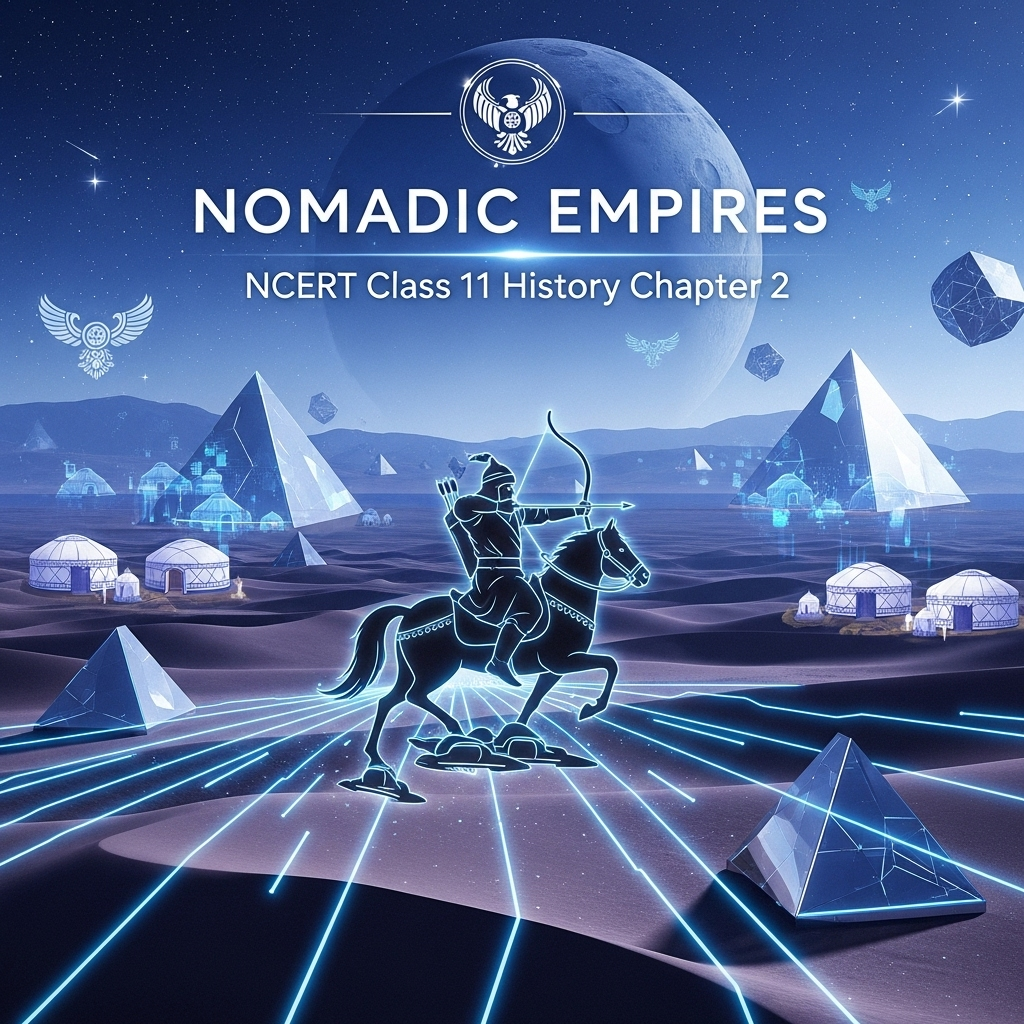
Nomadic Empires
Theme 3: History - Ultimate Study Guide | NCERT Class 11 Notes, Questions, Examples & Quiz 2025
Full Theme Summary & Detailed Notes - Nomadic Empires Class 11 NCERT
Overview & Key Concepts
- Theme Goal: Explores nomadic empires, focusing on Mongols under Genghis Khan. Contradiction of nomadic societies forming empires, organization, conquests, impact. Timeline 12th-14th centuries. Exam Focus: Genghis Khan's life, military strategies, social structure, sources. 2025 Updates: Recent archaeological finds; Indian context invasions. Fun Fact: Largest contiguous empire. Core Idea: Nomads created stable empires through military innovation. Real-World: Steppe warfare influences. Ties: Leads to Theme 4 Central Islamic Lands.
- Wider Scope: Steppe ecology; nomadic vs settled societies.
Introduction to Nomadic Empires
The term 'nomadic empires' can appear contradictory: nomads are arguably quintessential wanderers, organised in family assemblies with a relatively undifferentiated economic life and rudimentary systems of political organisation. The term 'empire', on the other hand, carries with it the sense of a considerable location, a stability derived from complex social and economic structures and the governance of an extensive territorial dominion through an elaborate administrative system. But the juxtaposition on which these definitions are framed may be too narrowly and ahistorically conceived. They certainly collapse when we study some imperial formations constructed by nomadic groups. In Theme 4 we studied state formations in the central Islamic lands whose origins lay in the Bedouin nomadic traditions of the Arabian peninsula. This chapter studies a different group of nomads: the Mongols of Central Asia who established a transcontinental empire under the leadership of Genghis Khan, straddling Europe and Asia during the thirteenth and fourteenth centuries. Relative to the agrarian-based imperial formations in China, the neighbouring nomads of Mongolia may have inhabited a humbler, less complex, social and economic world. But the Central Asian nomadic societies were not 'islands' that were impervious to historical change. These societies interacted, had an impact on and learnt from the larger world of which they were very much a part. This chapter studies the manner in which the Mongols under Genghis Khan adapted their traditional social and political customs to create a fearsome military machine and a sophisticated method of governance. The challenge of ruling a dominion spanning a melange of people, economies, and confessional systems meant that the Mongols could not simply impose their steppe traditions over their recently innovated and compromised, creating a nomadic empire that had a huge impact on the history of Eurasia even as it changed the character and composition of their own society forever. The steppe dwellers themselves usually produced no literature, so our knowledge of nomadic societies comes mainly from chronicles, travelogues and documents produced by city-based literateurs. These authors often produced extremely ignorant and biased reports of nomadic life. The imperial success of the Mongols, however, attracted many to serve them. It is on the basis of such varied records that we propose to understand the unique character of the nomadic Mongol empire. Depth: Sources chronicles. Real-Life: Museums artifacts. Exam Tip: Contradiction nomadic empire. Extended: Genghis Khan unification. Graphs: Map empire. Historical: 1206 proclamation. NCERT: Nomads wanderers.
- Examples: Bedouin Arabs, Mongols.
- Point: Nomads impacted settled societies.
Extended Discussion: Reconstruction from biased sources. Errors: Nomads primitive? No sophisticated. Scope: Eurasia. Principles: Adaptation. Real: Steppe nomads today. Additional: Transcontinental empire. Depth: Governance methods. Interlinks: Conquests. Advanced: Yasa code. Symbols: Khan title.
Social and Political Background
Mongols are quite different and the Italian and Latin versions of Marco Polo's travels to the Mongol court do not match. Since the Mongols produced little literature on their own and were instead 'written about' by literati from foreign cultural milieus, historians have to often double as philologists to pick out the meanings of phrases for their closest approximation to Mongol usage. The work of scholars like Igor de Rachewiltz on The Secret History of the Mongols and Gerhard Doerfer on Mongol and Turkic terminologies that infiltrated into the Persian language brings out the difficulties involved in studying the history of the Central Asian nomads. As we will notice through the remainder of this chapter, despite their disparate nature, the sources do allow us to understand some of the workings of the Mongol empire and the ways in which it was awaiting the diligent scholar's scrutiny. The Mongols were a diverse body of people, linked by similarities of language to the Tatars, Khitan and Manchus to the east, and the Turkic tribes to the west. Some of the Mongols were pastoralists while others were hunter-gatherers. The pastoralists tended horses, sheep and, to a lesser extent, cattle, goats and camels. They nomadised in the steppes of Central Asia in a tract of land in the area of the modern state of Mongolia. This was (and still is) a majestic landscape with wide horizons, rolling plains, ringed by the snow-capped Altai mountains to the west, the arid Gobi desert in the south and drained by the Onon and Selenga rivers and myriad springs from the melting snows of the hills in the north and the west. Luxuriant grasses for pasture and considerable small game were available in a good season. The hunter-gatherers resided to the north of the pastoralists in the Siberian forests. They were a humbler body of people than the pastoralists, making a living from trade in furs of animals trapped in the summer months. There were extremes of temperature in the entire region: harsh, long winters followed by brief, dry summers. Agriculture was possible in the pastoral regions during short parts of the year but the Mongols (unlike some of the Turks further west) did not take to farming. Neither the pastoral nor the hunting-gathering economies could sustain dense population settlements and as a result the region possessed no cities. The Mongols lived in tents, gers, and travelled with their herds from their winter to summer pasture lands. Ethnic and language ties united the Mongol people but the scarce resources meant that their society was divided into patrilineal lineages; the richer families were larger, possessed more animals and pasture lands and were able to retain many retainers who were often a more heterogeneous group than the master's own kinsmen – bonded by their indebtedness to the rich patron, they included warriors and specialised craftsmen. Periodic natural calamities – either unusually harsh, cold winters that decimated flocks or dry summers that limited pasturage – could lead to death and sudden impoverishment. Conflicts between patrilineages would arise as people competed for the more limited resources, leading to warfare and, as we know from documents produced in the affluent sedentary societies, raids on settlements, caravan traffic and occasionally, even on cities in the south. Groups of families would occasionally ally for offensive and defensive purposes around richer and more powerful lineages but, barring the few exceptions, these confederacies were short-lived and unable to present a common or unified front. The Mongols were divided into several confederacies like the Kereyits, Merkits, Naimans, Tatars and others. The size of Genghis Khan's confederation of Mongol and Turkish tribes was perhaps matched in size only by that which had been stitched together in the fifth century by Attila (d. 453). Unlike Attila, however, Genghis Khan's political system was far more durable and survived its founder. It was stable enough to counter larger armies with superior equipment in China, Iran and eastern Europe. And, as they established control over these regions, the Mongols administered complex agrarian economies and urban settlements - sedentary societies - that were quite distant from their own social experience and habitat. Although the social and political organisations of the nomadic and agrarian economies were very different, the two societies were hardly foreign to each other. In fact, the scant resources of the steppe lands drove nomadic herdsmen to trade and barter with their sedentary neighbours in China. This was a mutually beneficial relationship as agricultural produce and iron utensils from China were exchanged for horses, furs and game trapped in the steppe. Commerce was not without its tensions, especially as the two groups of traders were from very different backgrounds and could be easily duped or short-changed. When trade negotiations broke down, raids and plunder were a recurrent method employed by the nomads to extract resources from the agrarian societies. This would be a persistent theme in the interaction between nomadic and settled societies. Depth: Steppe ecology. Real-Life: Nomadic tribes today. Exam Tip: Differences nomadic settled. Extended: Lineages patrilineal. Graphs: Timeline. Pitfalls: Mongols barbaric? Sophisticated. Applications: Military history. Interlinks: Conquests. Advanced: Yasa. Historical: 1206 unification. NCERT: Diverse body people.
- Examples: Onon Selenga rivers, Gers tents.
- Point: Resource scarcity led to conflicts.
Extended: Trade with China. Errors: Isolated? Interacted. Scope: Central Asia. Principles: Adaptation. Real: Siberian forests. Additional: Hunter-gatherers furs. Depth: Patrilineal lineages. Interlinks: Military. Advanced: Confederacies. Symbols: Ger tent.
Career of Genghis Khan
Genghis Khan was born some time around 1162 near the Onon river in the north of present-day Mongolia. Named Temujin, he was the son of Yesugei, the chieftain of the Kiyat, a group of families related to the Borjigid clan. His father was murdered at an early age and his mother, Oelun-eke, raised Temujin, his brothers and step-brothers in great hardship. The following decade was full of reversals - Temujin was captured and enslaved and soon after his marriage, his wife, Borte, was kidnapped, and he had to fight to recover her. During these years of hardship he also managed to make important friends. The young Boghurc hu was his blood-brother (anda) and he received help from him. In another anda, Temujin allied with Jamuqa of the Jadaran clan. Jamuqa's name is derived from the word jada/quda in Mongolian which means 'stone'. His parents perhaps hoped that the magic associated with the stone would make the young child secure and steadfast. Temujin felt confident enough to move against other tribes: the powerful Tatars (his father's assassins), his old enemies the Kereyits, and the Naimans with whom Jamuqa had allied. He defeated them one by one and soon after 1203 took to campaigning against powerful adversaries in China. His rise meteoric. At a great pan-Mongol assembly or quriltai held in 1206, he was proclaimed the 'Great Khan of the Mongols' (Qa'an) with the title Genghis Khan, the 'Oceanic Khan' or 'Universal Ruler'. Just before the quriltai of 1206, Genghis Khan had reorganized the Mongol people into a more effective, disciplined military force. The first of his concerns was to conquer China, divided at this time into three realms: the Hsi Hsia people of Tibetan origin in the north-western provinces; the Jurchen whose Chin dynasty ruled north China from Peking; the Sung dynasty who controlled south China. By 1209, the first had been humbled after their initial ferocity. The 'Universal Ruler' was chary of allowing the vanquished to retain positions of power. The Hsi Hsia king was honoured with the title 'khan' but treated practically as a member of Genghis Khan's extended confederacy. He had to disband his army but, given his kingdom's wealth from trade, he was in a position to pay impressive tribute to the powerful conqueror. The Mongol general noted that 'the Hsi Hsia was powerful, had a large population and fine cities'. The Chin monarch, similarly, had a false sense of security behind his 'Golden' fortifications. Genghis Khan must have spent long hours reflecting on the best strategy to bring down the 'Great Wall of China' which had been breached in 1213 and Peking sacked in 1215. Long drawn-out battles against capital cities and fortifications were not suited to steppe warriors. In 1218 the Mongol territories extended as far west as Bukhara and Samarkand, Balkh, Gurganj, Merv, Nishapur and Herat surrendered to the Mongol forces. Towns that resisted were ravaged. Mongol control over trade between China and Iran was a prerequisite to their larger designs and here the Qara Khita who had come to control the lucrative overland trade in north-western China and who had an intimidating reputation in the steppe as a pagan, nomadic people, had already been humbled. At the time of their defeat the Qara Khitai had been in conflict with the Shah of Khwarazm over the oasis town of Bukhara. The Mongol victory over the Khitai naturally brought them into conflict with local kingdoms. In 1219 the Mongols under Genghis Khan invaded Transoxiana and the effects were cataclysmic: thousands were slaughtered, while artisans and craftsmen were separated from the general population and sent to Mongolia; agricultural lands were devastated. At Nishapur, where a Mongol prince was killed during the siege operation, Genghis Khan commanded that the town should be laid waste in such a manner that the site could be ploughed upon; and that in the exaction of vengeance not even cats and dogs should be left alive'. Depth: Early hardships. Real-Life: Leadership lessons. Exam Tip: 1206 proclamation. Extended: Andas alliances. Graphs: Timeline. Pitfalls: Barbaric? Strategic. Applications: Empire building. Interlinks: Conquests. Advanced: Quriltai assembly. Historical: 1162 birth. NCERT: Born Temujin.
- Examples: Oelun-eke mother, Boghurc hu anda.
- Point: From hardship to unification.
Extended: Campaigns China. Errors: Lucky? Strategic. Scope: Rise power. Principles: Alliances. Real: Mongol descendants. Additional: Qa'an title. Depth: Military reorganization. Interlinks: After Genghis. Advanced: Yasa. Symbols: Quriltai.
Mongols After Genghis Khan
We can divide Mongol expansion after Genghis Khan's death into two distinct phases: the first which spanned the years 1236-42 when the major gains were in the Russian steppes, Bulghar, Kiev, Poland and Hungary. The second phase including the years 1255-1300 led to the conquest of all of China (1279), Iraq, Iran and Syria. The frontier of the empire stabilized after these campaign. The Mongol military forces met with few reversals in the decades after 1203 but, quite noticeably, after 1260s the original impetus of campaigns could not be sustained in the West. Although Vienna was within a week's riding distance and western Europe open for the taking, the Mongols did not pursue their quest. Europe and China were the terminal points for what would become the largest empire in human history. The Mongols after Genghis Khan. The enormous swath of land from the Pacific Ocean to the Caspian Sea was under Mongol rule for over a century but the unity of the empire barely survived the founder's death. The empire was partitioned soon after and by the end of the thirteenth century there were four independent lineages (khanates) that ruled over the erstwhile united dominion. The westernmost khanate, in the region around the Volga known as the Qipchaq Khanate or the Golden Horde, was founded by the descendants of Jochi. The Yuan dynasty in China was under the descendants of Toluy, Genghis Khan's youngest son. Central Asia and Iran fell to the lot of the descendants of Chaghatai and Ogedei. The Mongol presence was formidable even in distant Russia. The princes there held their positions under Mongol overlordship and paid tribute to the khan of the Golden Horde. The enormous extent of the Mongol empire, however, was an anachronism. The communication systems that had given the empire its coherence had been the mounted courier with a relay system (yam) that had been organised by Ogedei. The nomadic forces had been able to overwhelm China, Iran and eastern Europe because of the speed and relative inexpense of their operations. When, however, the yam system and its couriers were expected to maintain intimate contact between China and Tabriz or Astrakhan the system not only became cumbersome but also expensive. The frontiers of the empire had stabilised after the first half of the thirteenth century. Cities were destroyed, agricultural lands laid waste, trade and handicraft production disrupted. Tens of thousands of people - the exact figures are lost in the exaggerated reports of the time - were killed, even more enslaved. All classes of people, from the elites to the peasantry suffered. In the resulting instability, the underground canals, called qanats, in the arid Iranian plateau and in the subterranean canals called qarez (or karez) in the arid Iranian plateau region, fell into disuse and the desert crept in. This led to an ecological devastation from which parts of Khurasan never recovered. Once the dust from the campaigns had settled in Europe and China were territorially linked. In the peace ushered in by Mongol conquest Depth: Succession divisions. Real-Life: Khanates legacies. Exam Tip: Phases conquests. Extended: Yam system. Graphs: Map khanates. Pitfalls: Unified forever? Partitioned. Applications: Communication history. Interlinks: Social impact. Advanced: Golden Horde. Historical: 1279 China conquest. NCERT: Two phases expansion.
- Examples: Golden Horde, Yuan dynasty.
- Point: Empire partitioned into khanates.
Extended: Impact on Russia. Errors: Decline immediate? Gradual. Scope: Largest empire. Principles: Overextension. Real: Silk Road. Additional: Qanats irrigation. Depth: Ecological devastation. Interlinks: Military. Advanced: Succession rules. Symbols: Yam relay.
Summary
- Nomadic empires Mongols, Genghis Khan unification, conquests Eurasia, military innovation, social organization, partition khanates.
Why This Guide Stands Out
Complete: All subtopics (5+), examples (10+), Q&A, quiz. History-focused with timelines/maps. Free 2025.
Key Themes & Tips
- Contradiction: Nomadic to empire.
- Sources: Biased chronicles.
- Tip: Timelines memorize; military strategies; social structure explain.
Exam Case Studies
Genghis Khan rise; conquest impacts; yam system.
Project & Group Ideas
- Model Mongol ger.
- Debate nomadic vs settled.


As an Amazon Associate, ProSyllabus earns from qualifying purchases. Prices shown are subject to change.
Test your CBSE Class 11 Annual Assessment prep
Quizzes
10 questions · ~10 minutes · instant rank & AI diagnosis
Accountancy (Class 11) Practice Quiz | CBSE Class 11 Annual Assessment
Sets and Venn Operations Fundamentals — Free CBSE Class 11 Annual Assessment Quiz
Class 11 English — The Tale of Melon City (Practice Quiz)
Class 11 English — Birth (Practice Quiz)
Class 11 English — Mother's Day (Practice Quiz)
Class 11 English — The Address (Practice Quiz)
Class 11 English — The Summer of the Beautiful White Horse (Practice Quiz)
Class 11 English — Father to Son (Practice Quiz)
Class 11 English — Silk Road (Practice Quiz)
Class 11 English — The Adventure (Practice Quiz)
Class 11 English — Childhood (Practice Quiz)
Class 11 English — The Ailing Planet: the Green Movement's Role (Practice Quiz)
Class 11 English — The Voice of the Rain (Practice Quiz)
Class 11 English — The Laburnum Top (Practice Quiz)
Class 11 English — Discovering Tut: the Saga Continues (Practice Quiz)
Class 11 English — We're Not Afraid to Die... if We Can All Be Together (Practice Quiz)
Class 11 English — A Photograph (Practice Quiz)
Class 11 English — The Portrait of a Lady (Practice Quiz)
Class 11 Psychology — Motivation and Emotion (Practice Quiz)
Class 11 Psychology — Thinking (Practice Quiz)
Class 11 Psychology — Human Memory (Practice Quiz)
Class 11 Psychology — Learning (Practice Quiz)
Class 11 Psychology — Sensory, Attentional and Perceptual Processes (Practice Quiz)
Class 11 Psychology — Human Development (Practice Quiz)
Class 11 Psychology — Methods of Enquiry in Psychology (Practice Quiz)
Class 11 Psychology — What is Psychology? (Practice Quiz)
Class 11 Sociology — Indian Sociologists (Practice Quiz)
Class 11 Sociology — Introducing Western Sociologists (Practice Quiz)
Class 11 Sociology — Environment and Society (Practice Quiz)
Class 11 Sociology — Social Change and Social Order in Rural and Urban Society (Practice Quiz)
Class 11 Sociology — Social Structure, Stratification and Social Processes in Society (Practice Quiz)
Class 11 Sociology — Doing Sociology: Research Methods (Practice Quiz)
Class 11 Sociology — Culture and Socialisation (Practice Quiz)
Class 11 Sociology — Understanding Social Institutions (Practice Quiz)
Class 11 Sociology — Terms, Concepts and Their Use in Sociology (Practice Quiz)
Class 11 Sociology — Sociology and Society (Practice Quiz)
Class 11 Political Science — The Philosophy of the Constitution (Practice Quiz)
Class 11 Political Science — Constitution as a Living Document (Practice Quiz)
Class 11 Political Science — Local Governments (Practice Quiz)
Class 11 Political Science — Federalism (Practice Quiz)
Class 11 Political Science — Judiciary (Practice Quiz)
Class 11 Political Science — Legislature (Practice Quiz)
Class 11 Political Science — Executive (Practice Quiz)
Class 11 Political Science — Election and Representation (Practice Quiz)
Class 11 Political Science — Rights in the Indian Constitution (Practice Quiz)
Class 11 Political Science — Constitution: Why and How? (Practice Quiz)
Class 11 Political Science — Secularism (Practice Quiz)
Class 11 Political Science — Nationalism (Practice Quiz)
Class 11 Political Science — Citizenship (Practice Quiz)
Class 11 Political Science — Rights (Practice Quiz)
Class 11 Political Science — Social Justice (Practice Quiz)
Class 11 Political Science — Equality (Practice Quiz)
Class 11 Political Science — Freedom (Practice Quiz)
Class 11 Political Science — Political Theory: An Introduction (Practice Quiz)
Class 11 Geography — Natural Hazards and Disasters (Practice Quiz)
Class 11 Geography — Natural Vegetation (Practice Quiz)
Class 11 Geography — Climate (Practice Quiz)
Class 11 Geography — Drainage System (Practice Quiz)
Class 11 Geography — Structure and Physiography (Practice Quiz)
Class 11 Geography — India – Location (Practice Quiz)
Class 11 Geography — Biodiversity and Conservation (Practice Quiz)
Class 11 Geography — Movements of Ocean Water (Practice Quiz)
Class 11 Geography — Water (Oceans) (Practice Quiz)
Class 11 Geography — World Climate and Climate Change (Practice Quiz)
Class 11 Geography — Water in the Atmosphere (Practice Quiz)
Class 11 Geography — Atmospheric Circulation and Weather Systems (Practice Quiz)
Class 11 Geography — Solar Radiation, Heat Balance and Temperature (Practice Quiz)
Class 11 Geography — Composition and Structure of Atmosphere (Practice Quiz)
Class 11 Geography — Landforms and their Evolution (Practice Quiz)
Class 11 Geography — Geomorphic Processes (Practice Quiz)
Class 11 Geography — Distribution of Oceans and Continents (Practice Quiz)
Class 11 Geography — Interior of the Earth (Practice Quiz)
Class 11 Geography — The Origin and Evolution of the Earth (Practice Quiz)
Class 11 Geography — Geography as a Discipline (Practice Quiz)
Class 11 History — Paths to Modernisation (Practice Quiz)
Class 11 History — Displacing Indigenous Peoples (Practice Quiz)
Class 11 History — Changing Cultural Traditions (Practice Quiz)
Class 11 History — The Three Orders (Practice Quiz)
Class 11 History — Nomadic Empires (Practice Quiz)
Class 11 History — An Empire Across Three Continents (Practice Quiz)
Class 11 History — Writing and City Life (Practice Quiz)
Class 11 Economics — Comparative Development Experiences of India and its Neighbours (Practice Quiz)
Class 11 Economics — Environment and Sustainable Development (Practice Quiz)
Class 11 Economics — Employment: Growth, Informalisation and Other Issues (Practice Quiz)
Class 11 Economics — Rural Development (Practice Quiz)
Class 11 Economics — Human Capital Formation in India (Practice Quiz)
Class 11 Economics — Liberalisation, Privatisation and Globalisation: An Appraisal (Practice Quiz)
Class 11 Economics — Indian Economy 1950-1990 (Practice Quiz)
Class 11 Economics — Indian Economy on the Eve of Independence (Practice Quiz)
Class 11 Economics — Use of Statistical Tools (Practice Quiz)
Class 11 Economics — Index Numbers (Practice Quiz)
Class 11 Economics — Correlation (Practice Quiz)
Class 11 Economics — Measures of Central Tendency (Practice Quiz)
Class 11 Economics — Presentation of Data (Practice Quiz)
Class 11 Economics — Organisation of Data (Practice Quiz)
Class 11 Economics — Collection of Data (Practice Quiz)
Class 11 Economics — Introduction (Practice Quiz)
Class 11 Business Studies — International Business (Practice Quiz)
Class 11 Business Studies — Internal Trade (Practice Quiz)
Class 11 Business Studies — MSME and Business Entrepreneurship (Practice Quiz)
Class 11 Business Studies — Sources of Business Finance (Practice Quiz)
Class 11 Business Studies — Formation of a Company (Practice Quiz)
Class 11 Business Studies — Social Responsibilities of Business and Business Ethics (Practice Quiz)
Class 11 Business Studies — Emerging Modes of Business (Practice Quiz)
Class 11 Business Studies — Business Services (Practice Quiz)
Class 11 Business Studies — Private, Public and Global Enterprises (Practice Quiz)
Class 11 Business Studies — Forms of Business Organisation (Practice Quiz)
Class 11 Business Studies — Business, Trade and Commerce (Practice Quiz)
Class 11 Accountancy — Financial Statements - II (Practice Quiz)
Class 11 Accountancy — Financial Statements - I (Practice Quiz)
Class 11 Accountancy — Depreciation, Provisions and Reserves (Practice Quiz)
Class 11 Accountancy — Trial Balance and Rectification of Errors (Practice Quiz)
Class 11 Accountancy — Bank Reconciliation Statement (Practice Quiz)
Class 11 Accountancy — Recording of Transactions - II (Practice Quiz)
Class 11 Accountancy — Recording of Transactions - I (Practice Quiz)
Class 11 Accountancy — Theory Base of Accounting (Practice Quiz)
Class 11 Accountancy — Introduction to Accounting (Practice Quiz)
Class 11 Maths — Probability (Practice Quiz)
Class 11 Maths — Statistics (Practice Quiz)
Class 11 Maths — Limits and Derivatives (Practice Quiz)
Class 11 Maths — Introduction to Three Dimensional Geometry (Practice Quiz)
Class 11 Maths — Conic Sections (Practice Quiz)
Class 11 Maths — Straight Lines (Practice Quiz)
Class 11 Maths — Sequences and Series (Practice Quiz)
Class 11 Maths — Binomial Theorem (Practice Quiz)
Class 11 Maths — Permutations and Combinations (Practice Quiz)
Class 11 Maths — Linear Inequalities (Practice Quiz)
Class 11 Maths — Complex Numbers and Quadratic Equations (Practice Quiz)
Class 11 Maths — Relations and Functions (Practice Quiz)
Class 11 Maths — Sets (Practice Quiz)
Class 11 Biology — Chemical Coordination and Integration (Practice Quiz)
Class 11 Biology — Neural Control and Coordination (Practice Quiz)
Class 11 Biology — Locomotion and Movement (Practice Quiz)
Class 11 Biology — Excretory Products and their Elimination (Practice Quiz)
Class 11 Biology — Body Fluids and Circulation (Practice Quiz)
Class 11 Biology — Breathing and Exchange of Gases (Practice Quiz)
Class 11 Biology — Plant Growth and Development (Practice Quiz)
Class 11 Biology — Respiration in Plants (Practice Quiz)
Class 11 Biology — Photosynthesis in Higher Plants (Practice Quiz)
Class 11 Biology — Cell Cycle and Cell Division (Practice Quiz)
Class 11 Biology — Biomolecules (Practice Quiz)
Class 11 Biology — Cell: The Unit of Life (Practice Quiz)
Class 11 Biology — Structural Organisation in Animals (Practice Quiz)
Class 11 Biology — Anatomy of Flowering Plants (Practice Quiz)
Class 11 Biology — Morphology of Flowering Plants (Practice Quiz)
Class 11 Biology — Animal Kingdom (Practice Quiz)
Class 11 Biology — Plant Kingdom (Practice Quiz)
Class 11 Biology — Biological Classification (Practice Quiz)
Class 11 Biology — The Living World (Practice Quiz)
Class 11 Chemistry — Hydrocarbons (Practice Quiz)
Class 11 Chemistry — Organic Chemistry – Some Basic Principles and Techniques (Practice Quiz)
Class 11 Chemistry — Redox Reactions (Practice Quiz)
Class 11 Chemistry — Equilibrium (Practice Quiz)
Class 11 Chemistry — Chemical Bonding and Molecular Structure (Practice Quiz)
Class 11 Chemistry — Classification of Elements and Periodicity in Properties (Practice Quiz)
Class 11 Chemistry — Some Basic Concepts of Chemistry (Practice Quiz)
Class 11 Physics — Waves (Practice Quiz)
Class 11 Physics — Oscillations (Practice Quiz)
Class 11 Physics — Kinetic Theory (Practice Quiz)
Class 11 Chemistry — Thermodynamics (Practice Quiz)
Class 11 Physics — Thermal Properties of Matter (Practice Quiz)
Class 11 Physics — Mechanical Properties of Fluids (Practice Quiz)
Class 11 Physics — Mechanical Properties of Solids (Practice Quiz)
Class 11 Physics — Gravitation (Practice Quiz)
Class 11 Physics — Systems of Particles and Rotational Motion (Practice Quiz)
Class 11 Physics — Work, Energy and Power (Practice Quiz)
Class 11 Physics — Motion in a Plane (Practice Quiz)
Class 11 Physics — Motion in a Straight Line (Practice Quiz)
Class 11 Physics — Units and Measurement (Practice Quiz)
Class 11 Maths — Trigonometric Functions (Practice Quiz)
Class 11 Chemistry — Structure of Atom (Practice Quiz)
Class 11 Physics — Laws of Motion (Practice Quiz)
Business Studies (Class 11) Practice Quiz | CBSE Class 11 Annual Assessment
Economics (Class 11) Practice Quiz | CBSE Class 11 Annual Assessment
Humanities Subjects Practice Quiz | CBSE Class 11 Annual Assessment
Motion in a Straight Line Practice Quiz | CBSE Class 11 Annual Assessment
Thermodynamic Processes and Laws Advanced Challenge | CBSE Class 11 Annual Assessment

Group Discussions
No forum posts available.


Social and Political Background - Detailed Guide
Diverse tribes ecology (sim 4+ pages equiv).
Diverse Tribes
Mongols Turks. Deriv: Language. Ex: Tatars Khitan. Depth: Links.
Pastoralists
Horses sheep. Deriv: Steppe. Ex: Nomadised. Depth: Seasons.
Hunter-Gatherers
Furs trade. Deriv: Forests. Ex: Siberian. Depth: Humbler.
Patrilineal Lineages
Rich poor. Deriv: Resources. Ex: Retainers. Depth: Conflicts.
Trade Raids
With settled. Deriv: Scarcity. Ex: Iron horses. Depth: Tensions.
Confederacies
Short-lived alliances. Deriv: Offensive. Ex: Pre-Genghis. Depth: Fragile.
Tip: Ecology describe. Depth: Interactions. Examples: Rivers mountains. Graphs: Map. Advanced: Ecology.
Principles: Resource driven. Errors: Backward? Adaptive. Real: Steppe life.
Extended: No cities. Numerical: Tribes.