Complete Summary and Solutions for Oceans and Continents – NCERT Class VI Social Science, Chapter 2 – Distribution, Features, Impact on Life, Questions, Answers
Detailed summary and explanation of Chapter 2 ‘Oceans and Continents’ from the NCERT Class VI Social Science textbook, covering Earth as the ‘blue planet’, distribution of water and land between hemispheres, definitions of oceans, seas, bays and gulfs, the five oceans and their relative sizes, marine flora and fauna, ocean-origin disasters (cyclones, tsunamis) and disaster management, the counting and relative sizes of the seven continents, major islands (including Indian island groups), and the role of oceans and continents in climate, water cycle, oxygen production, human migration, trade and culture—along with all NCERT questions, answers, activities, and map-based exercises.
Updated: 6 months ago
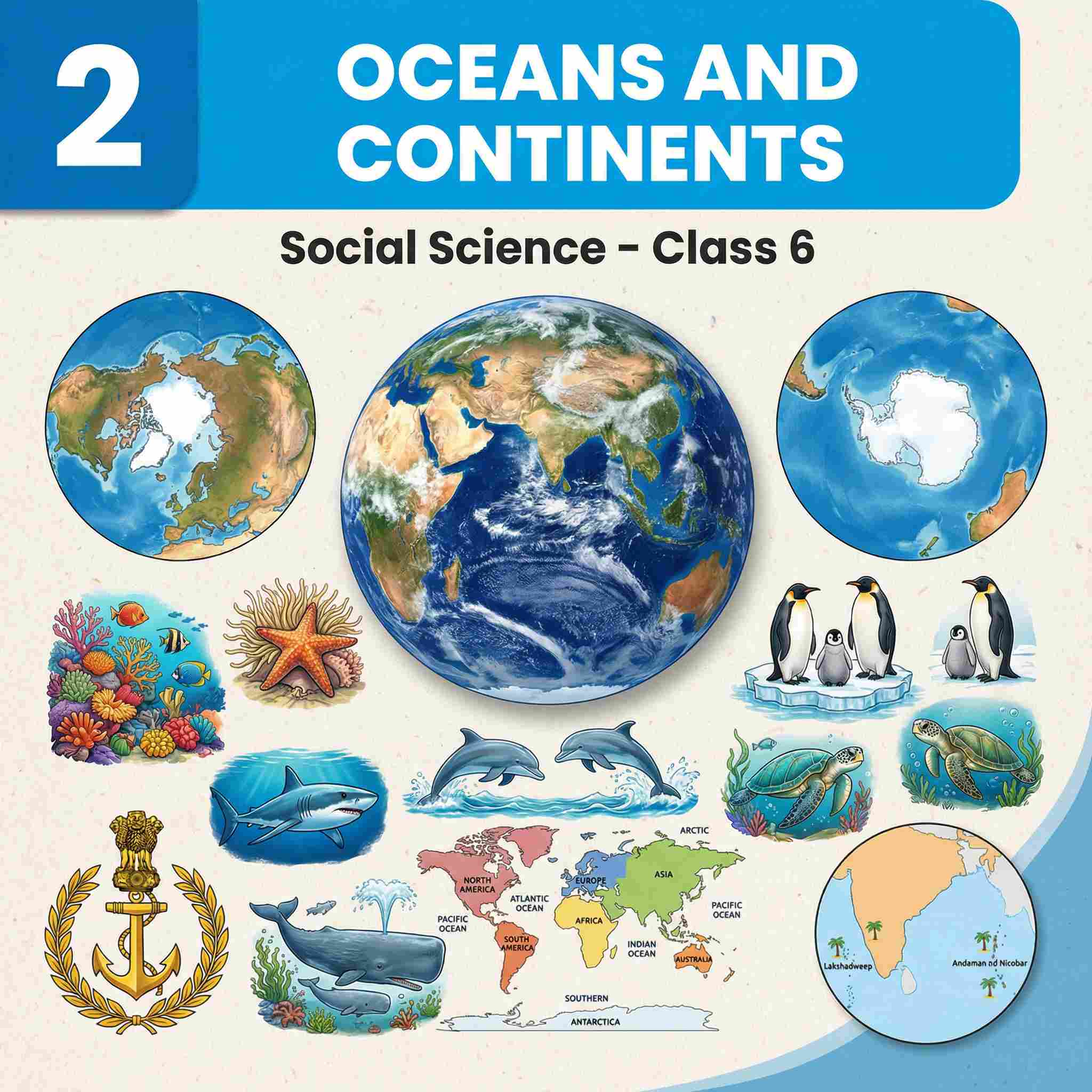
Oceans and Continents
Class 6 Social Science Chapter 2 | Complete NCERT Guide | Names, Distribution, Impact on Life, Disasters, Islands 2025
Full Chapter Summary & Detailed Notes - Oceans and Continents
Introduction to Oceans and Continents
The chapter begins with a quote from Jules Verne emphasizing the ocean's vastness and importance. From space, Earth appears blue due to water covering three-fourths of its surface, earning it the name 'blue planet'. Large water bodies are oceans, and large landmasses are continents. They shape Earth's climate and life.
“The ocean is everything. It covers seven-tenths of the terrestrial globe...” — Jules Verne (1870)
Big Questions
- What are oceans and continents? Names and distribution?
- How do they impact life on Earth, including human life?
Distribution of Water and Land
Oceans and continents are unevenly distributed between hemispheres. Northern Hemisphere has more land, Southern more water.
Let's Explore (From Polar Maps)
- Circular lines: Parallels of latitude; Radiating lines: Meridians of longitude.
- Southern Hemisphere holds more water.
- Northern: ~40% water, 60% land; Southern: ~80% water, 20% land.
- All oceans are connected.
Water Scarcity
Seawater is salty, unfit for most use. Freshwater is scarce (glaciers, rivers, etc.). Think: Ways to save water at home/school.
Oceans
Five oceans: Pacific (largest), Atlantic, Indian, Southern, Arctic (smallest). They are interconnected. Marine life: Flora (algae, seaweeds), Fauna (fish, dolphins, whales).
Let's Explore Table
| Ocean | Northern | Southern |
|---|---|---|
| Pacific | ✔ | ✔ |
| Atlantic | ✔ | ✔ |
| Indian | ✔ | |
| Southern | ✔ | |
| Arctic | ✔ |
Indian Ocean Details
Bounded by Asia (north), Africa (west), Australia (east). India's parts: Arabian Sea (west), Bay of Bengal (east).
Oceans and Disasters
Clouds bring rain (monsoons), but also storms/cyclones. Tsunami: Huge wave from undersea earthquake/volcano. 2004 Indian Ocean tsunami killed over 200,000; affected India (Andamans, Tamil Nadu, Kerala).
Early warning: Indian Ocean Tsunami Warning System. Disaster Management: NDMA in India.
Continents
Count varies (4-7). Common: Seven (Africa, Antarctica, Asia, Australia, Europe, North America, South America).
| Count | Continents |
|---|---|
| Four | Africa-Eurasia, America, Antarctica, Australia |
| Five | Africa, America, Antarctica, Australia, Eurasia |
| Six | Africa, Antarctica, Australia, Eurasia, North America, South America |
| Seven | Africa, Antarctica, Asia, Australia, Europe, North America, South America |
Olympic rings symbolize five inhabited continents.
Relative Sizes (Diagram)
- Largest: Asia; Smallest: Australia.
- North America > South America; Africa > North America; Antarctica > Australia.
- Eurasia much larger than South America.
- Order: Australia, Antarctica, South America, North America, Africa, Europe, Asia.
Islands
Smaller land surrounded by water. Largest: Greenland. India: >1,300 islands, including Andaman & Nicobar (Bay of Bengal), Lakshadweep (Arabian Sea). Indian Antarctica Programme: Dakshin Gangotri base since 1983.
Oceans and Life
Oceans produce >50% oxygen ('lungs of planet'). Part of water cycle; no oceans = desert Earth. Human uses: Migration, trade, fishing, culture (sea gods, legends).
World Oceans Day (June 8): Remind role in life; pollution (plastic, overfishing) threatens marine life. Our responsibility to protect.
Key Takeaways
- Earth's surface: Oceans (interconnected), continents (7 common count).
- Northern Hemisphere more land.
- Oceans support marine life, regulate climate; threatened by humans.
Golden Exam Answer
“Oceans cover three-fourths of Earth and are interconnected. There are five oceans: Pacific (largest), Atlantic, Indian, Southern, Arctic. Continents are seven: Asia (largest), Africa, North America, South America, Europe, Antarctica, Australia (smallest).”


As an Amazon Associate, ProSyllabus earns from qualifying purchases. Prices shown are subject to change.
Test your CBSE Class 6 Annual Assessment prep
Quizzes
10 questions · ~10 minutes · instant rank & AI diagnosis
Class 6 Hindi — हिंद महासागर में छोटा-सा हिंदुस्तान (Practice Quiz)
Whole Numbers Operations Fundamentals | CBSE Class 6 Annual Assessment
Class 6 Social Science — Economic Activities Around Us (Practice Quiz)
Class 6 Social Science — The Value of Work (Practice Quiz)
Class 6 Social Science — Grassroots Democracy – Part 3: Local Government in Urban Areas (Practice Quiz)
Class 6 Social Science — Grassroots Democracy – Part 2: Local Government in Rural Areas (Practice Quiz)
Class 6 Social Science — Grassroots Democracy – Part 1: Governance (Practice Quiz)
Class 6 Social Science — Family and Community (Practice Quiz)
Class 6 Social Science — Unity in Diversity, or 'Many in the One' (Practice Quiz)
Class 6 Social Science — India's Cultural Roots (Practice Quiz)
Class 6 Social Science — The Beginnings of Indian Civilisation (Practice Quiz)
Class 6 Social Science — India, That Is Bharat (Practice Quiz)
Class 6 Social Science — Timeline and Sources of History (Practice Quiz)
Class 6 Social Science — Landforms and Life (Practice Quiz)
Class 6 Social Science — Oceans and Continents (Practice Quiz)
Class 6 Social Science — Locating Places on the Earth (Practice Quiz)
Class 6 Sanskrit — वृक्षाः सत्पुरुषाः इव (Practice Quiz)
Class 6 Sanskrit — माधवस्य प्रियम् अङ्गम् (Practice Quiz)
Class 6 Sanskrit — आलस्यं हि मनुष्याणां शरीरस्थः महान् रिपुः (Practice Quiz)
Class 6 Sanskrit — पृथिव्यां त्रीणि रत्नानि (Practice Quiz)
Class 6 Sanskrit — त्वम् आपणं गच्छ (Practice Quiz)
Class 6 Sanskrit — यः जानाति सः पण्डितः (Practice Quiz)
Class 6 Sanskrit — बुद्धिः सर्वार्थसाधिका (Practice Quiz)
Class 6 Sanskrit — अतिथिदेवो भव (Practice Quiz)
Class 6 Sanskrit — सः एव महान् चित्रकारः (Practice Quiz)
Class 6 Sanskrit — शूराः वयं धीराः वयम् (Practice Quiz)
Class 6 Sanskrit — अहं प्रातः उत्तिष्ठामि (Practice Quiz)
Class 6 Sanskrit — संख्यागणना ननु सरला (Practice Quiz)
Class 6 Sanskrit — अहं च त्वं च (Practice Quiz)
Class 6 Sanskrit — एषः कः? एषा का? एतत् किम्? (Practice Quiz)
Class 6 Sanskrit — संयुक्तव्यञ्जनानि (Practice Quiz)
Class 6 Sanskrit — वयं वर्णमालां पठामः (Practice Quiz)
Class 6 Hindi — पेड़ की बात (Practice Quiz)
Class 6 Hindi — चेतक की वीरता (Practice Quiz)
Class 6 Hindi — परीक्षा (Practice Quiz)
Class 6 Hindi — मैया मैं नहिं माखन खायो (Practice Quiz)
Class 6 Hindi — सत्रिया और बिहू नृत्य (Practice Quiz)
Class 6 Hindi — जलाते चलो (Practice Quiz)
Class 6 Hindi — मेरी माँ (Practice Quiz)
Class 6 Hindi — रहीम के दोहे (Practice Quiz)
Class 6 Hindi — हार की जीत (Practice Quiz)
Class 6 Hindi — पहली बूँद (Practice Quiz)
Class 6 Hindi — गोल (Practice Quiz)
Class 6 Hindi — मातृभूमि (Practice Quiz)
Class 6 English — Culture and Tradition (Practice Quiz)
Class 6 English — Sports and Wellness (Practice Quiz)
Class 6 English — Nurturing Nature (Practice Quiz)
Class 6 English — Friendship (Practice Quiz)
Class 6 English — Fables and Folk Tales (Practice Quiz)
Class 6 Maths — The Other Side of Zero (Practice Quiz)
Class 6 Maths — Symmetry (Practice Quiz)
Class 6 Maths — Playing with Constructions (Practice Quiz)
Class 6 Maths — Fractions (Practice Quiz)
Class 6 Maths — Perimeter and Area (Practice Quiz)
Class 6 Maths — Prime Time (Practice Quiz)
Class 6 Maths — Data Handling and Presentation (Practice Quiz)
Class 6 Maths — Number Play (Practice Quiz)
Class 6 Maths — Lines and Angles (Practice Quiz)
Class 6 Maths — Patterns in Mathematics (Practice Quiz)
Class 6 Science — Beyond Earth (Practice Quiz)
Class 6 Science — Nature's Treasures (Practice Quiz)
Class 6 Science — Living Creatures: Exploring their Characteristics (Practice Quiz)
Class 6 Science — Methods of Separation in Everyday Life (Practice Quiz)
Class 6 Science — A Journey through States of Water (Practice Quiz)
Class 6 Science — Temperature and its Measurement (Practice Quiz)
Class 6 Science — Materials Around Us (Practice Quiz)
Class 6 Science — Measurement of Length and Motion (Practice Quiz)
Class 6 Science — Exploring Magnets (Practice Quiz)
Class 6 Science — Mindful Eating: A Path to a Healthy Body (Practice Quiz)
Class 6 Science — Diversity in the Living World (Practice Quiz)
Class 6 Science — The Wonderful World of Science (Practice Quiz)
Understanding Nouns and Pronouns Fundamentals | CBSE Class 6 Annual Assessment
Parts of a Plant Fundamentals | CBSE Class 6 Annual Assessment
Group Discussions
No forum posts available.


