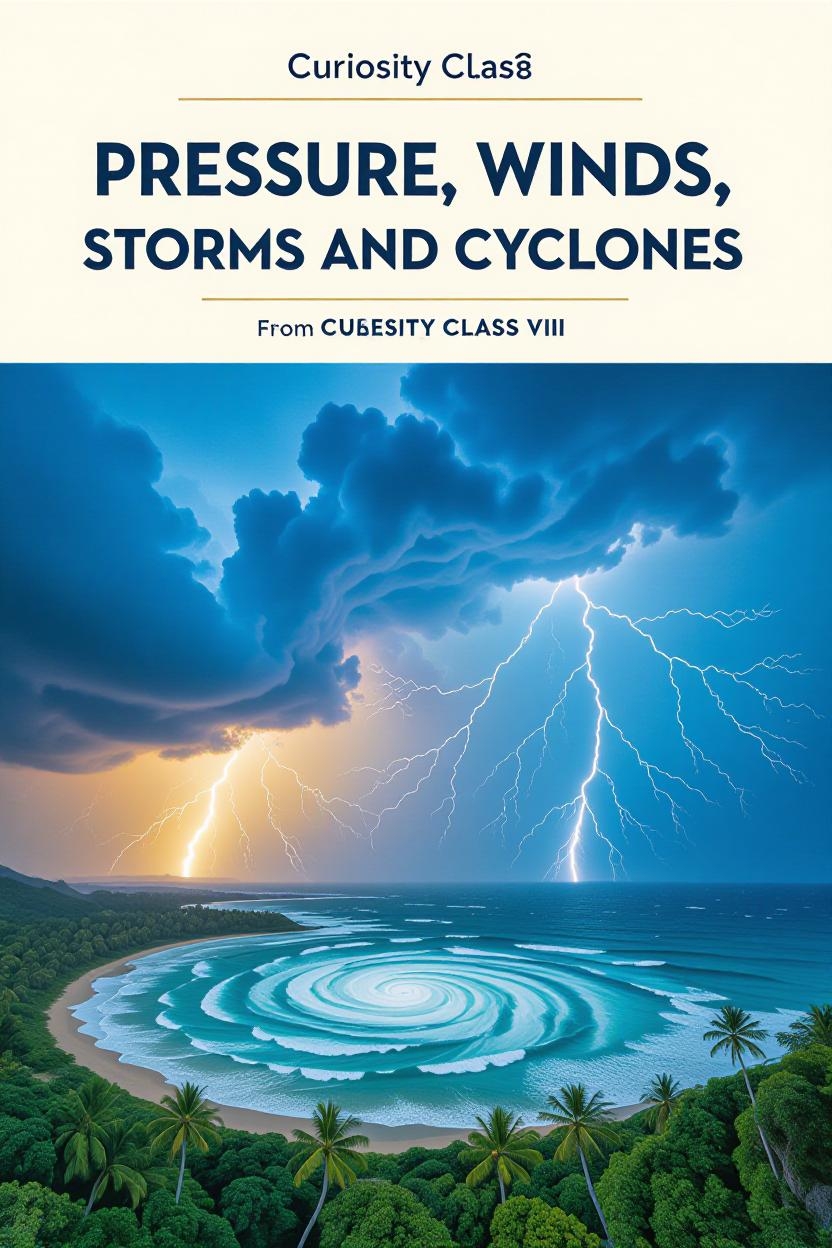
Chapter Overview
Pa
Unit of Pressure (Pascal)
1013 mb
Average Atmospheric Pressure
270 km/h
Amphan Cyclone Winds (2020)
3-12 m
Cyclone Storm Surge Height
What You'll Learn
Pressure Fundamentals
Understanding force per unit area and its applications in daily life.
Wind Formation
Exploring how pressure differences create winds and their effects.
Storms and Thunderstorms
Learning about storm formation, lightning, and safety measures.
Cyclones
Studying cyclone development, impacts, and protective actions.
Scientific Context
This chapter explores the concepts of pressure in solids, liquids, and gases, and how pressure differences lead to winds, storms, and cyclones. It discusses atmospheric pressure's magnitude and effects, wind formation from high to low pressure regions, and the destructive power of cyclones like Amphan in 2020. Activities demonstrate these principles, emphasizing safety during natural events.
Key Highlights
Pressure is force per unit area (Pa = N/m²). Winds blow from high to low pressure. Storms involve thunder and lightning from charge separation. Cyclones form over warm oceans, causing floods and destruction, monitored by IMD for alerts.
Comprehensive Chapter Summary
1. Introduction to Pressure
The chapter begins by observing wind effects like swirling leaves and swaying trees, attributing them to wind pressure. It introduces pressure as force per unit area through the story of Megha and Pawan carrying bags, showing how broad straps reduce pressure compared to narrow ones.
2. Pressure in Solids and Liquids
Definition and Unit
Pressure = Force / Area, measured in Pascal (Pa = N/m²). Examples include easier cutting with sharp edges due to higher pressure on smaller areas.
Liquid Pressure
Liquids exert pressure depending on column height, not volume. Overhead tanks increase tap pressure. Liquids exert pressure in all directions, as shown by water spurting from holes.
Dam Design
Dams have broader bases to withstand higher horizontal pressure at the bottom from water depth.
3. Atmospheric Pressure
Air Pressure Demonstration
Activities with paper plates and suckers show air exerts pressure. Atmospheric pressure is about 2250 N on a 15 cm × 15 cm area, balanced by internal body pressure.
Unit of Air Pressure
Practical unit is millibar (mb = 100 Pa) or hectopascal (hPa).
Balloon Inflation
Air exerts pressure in all directions, inflating balloons uniformly.
4. Wind Formation and Effects
Wind from Pressure Differences
Air moves from high to low pressure, creating winds like sea and land breezes. Higher pressure differences increase wind speed.
5. Storms and Thunderstorms
Formation Process
Warm air rises, cools, forms clouds; rubbing creates charges leading to lightning and thunder. Regional names like Kalboishakhi.
Safety Measures
Avoid tall objects, crouch low, stay indoors or in vehicles during lightning. Lightning conductors protect buildings.
6. Cyclones
Cyclones form over warm oceans from rising moist air, spinning due to Earth's rotation. They cause high winds, surges, floods. IMD monitors for warnings; prepare emergency kits and move to shelters.
Questions and Answers from Chapter
Short Questions
Q1. In which vessel will the water level be highest when pouring stops?
Answer: Equal in all three vessels.
Q2. Which rubber sucker will stick?
Answer: M will stick but N will not stick.
Q3. How to increase water pressure on ground floor?
Answer: Increase the height ‘H’ at which the tank is placed.
Q4. Compare pressure and force at bottom of vessels A and B.
Answer: PA = PB, FA < FB.
Q5. Air flows from a region of higher pressure to a region of lower pressure. [T/F]
Answer: True.
Q6. Liquids exert pressure only at the bottom of a container. [T/F]
Answer: False.
Q7. Weather is stormy at the eye of a cyclone. [T/F]
Answer: False.
Q8. During a thunderstorm, it is safer to be in a car. [T/F]
Answer: True.
Q9. In which case does the boy sink more in sand?
Answer: Standing vertically.
Q10. Calculate pressure exerted by elephant (20000 N, 0.25 m² per foot).
Answer: 20000 N / (4 × 0.25 m²) = 20000 Pa.
Q11. Which boat experiences more pressure?
Answer: Boat B by 1000 Pa.
Q12. Would lightning occur if air and clouds were good conductors?
Answer: No.
Q13. Will both balloons bulge equally with water?
Answer: Yes.
Q14. Identify land side in Fig. 6.25.
Answer: Side B.
Q15. Why holes in banners?
Answer: Reduce wind pressure.
Medium Questions
Q1. Explain why water level is equal in connected vessels.
Answer: Liquid pressure depends on height; equal height means equal pressure at bottom, so levels equalize. (3 marks)
Q2. Why does sucker stick to smooth but not rough surface?
Answer: Air is pushed out on smooth surface creating low pressure inside; rough allows air entry. (3 marks)
Q3. How tank height affect ground floor pressure?
Answer: Higher tank increases water column height, thus pressure at taps. (3 marks)
Q4. Compare pressure/force in wide/narrow vessels.
Answer: Same height means same pressure; wider base means more force. (3 marks)
Q5. Why air flows high to low pressure?
Answer: Pressure difference causes movement until equalized. (3 marks)
Q6. Why liquids exert pressure on sides too?
Answer: Liquids exert pressure in all directions. (3 marks)
Q7. Why eye of cyclone is calm?
Answer: Lowest pressure but no winds; surrounding has high winds. (3 marks)
Q8. Why safer in car during thunderstorm?
Answer: Metal body conducts lightning to ground safely. (3 marks)
Q9. Why boy sinks more standing?
Answer: Smaller area increases pressure on sand. (3 marks)
Q10. Calculate elephant pressure and explain.
Answer: Total area 1 m², pressure 20000 Pa; distributed over feet. (3 marks)
Q11. Which boat more pressure and why?
Answer: Boat B; smaller area despite less weight. (3 marks)
Q12. Lightning if good conductors?
Answer: No; charges would flow without buildup. (3 marks)
Q13. Balloons bulge with water?
Answer: Both bulge; pressure depends on height. (3 marks)
Q14. Identify land side and explain.
Answer: B; sea breeze blows to land. (3 marks)
Q15. Activity to show air flow.
Answer: Balloon-straw setup shows flow high to low. (3 marks)
Long Questions
Q1. Explain why water level is equal in all vessels (Fig. 6.21).
Answer: In connected vessels, water seeks equilibrium where pressure at the base is equal. Since pressure depends on height of liquid column, levels equalize regardless of shape. If unequal, higher column exerts more pressure, flowing until balanced.
Q2. Discuss sucker sticking on surfaces.
Answer: On smooth surface, air is expelled creating low pressure inside; atmospheric pressure pushes it. Rough surface allows air entry, equalizing pressure, so no stick.
Q3. How tank height affects pressure.
Answer: Pressure increases with height of water column. Higher tank means taller column to ground floor, increasing pressure for stronger flow.
Q4. Compare PA/PB and FA/FB in vessels.
Answer: Same height means PA = PB. Wider base (B) means FB > FA since force = pressure × area.
Q5. Air flows higher to lower pressure.
Answer: Pressure difference causes net force, moving air until equalized, as in balloon activity.
Q6. Liquids exert pressure only at bottom? Explain.
Answer: False; exert in all directions, as shown by side holes spurting water.
Q7. Weather stormy at cyclone eye? Explain.
Answer: False; eye is calm low-pressure center; storms surround it.
Q8. Safer in car during thunderstorm? Why?
Answer: True; metal conducts lightning to ground, protecting inside.
Q9. Boy sinking in sand: Explain cases.
Answer: Standing: smaller area, higher pressure, sinks more. Lying: larger area, lower pressure, sinks less.
Q10. Calculate and explain elephant pressure.
Answer: Total area 1 m² (4 feet), pressure 20000 Pa. Demonstrates weight distribution reduces pressure per area.
Q11. Boats pressure comparison.
Answer: Boat A: 3500 N / 7 m² = 500 Pa. Boat B: 2100 N / 3.5 m² = 600 Pa. B higher by 100 Pa due to smaller area.
Q12. Lightning if good conductors: Explain.
Answer: No; charges flow continuously without buildup for spark.
Q13. Balloons with water: Explain bulging.
Answer: Both bulge; pressure same at same height despite shapes.
Q14. Explain storm to cyclone.
Answer: Warm ocean air rises, condenses releasing heat, lowers pressure, air rushes in spinning due to rotation; intensifies into cyclone.
Q15. Thunderstorm formation and process.
Answer: Warm moist air rises, cools forming clouds; rubbing creates charges; separation leads to lightning when insulation breaks.
Q16. Explain the formation of wind with reference to pressure differences.
Answer: Winds form due to air moving from high pressure to low pressure regions. For example, in the balloon activity, air escapes from inflated to uninflated balloon until pressures equalize. This is seen in sea breeze (day: land low pressure, sea high) and land breeze (night: sea low, land high). Higher pressure difference increases speed, as escaping air speed is higher with greater difference.
Q17. Describe how high-speed winds result in lowering of air pressure and its effects on houses.
Answer: High-speed winds create low pressure, as shown in balloon blowing activity where balloons move together due to surrounding high pressure pushing them. Over houses, low pressure above roofs vs higher inside can blow off weak roofs if pressure difference is large. To prevent, keep doors/windows open so wind flows through, reducing difference and protecting roofs.
Q18. Explain the process of charge separation leading to lightning in thunderstorms.
Answer: In thunderstorms, warm moist air rises, cools, condenses into droplets forming clouds. Strong up/down winds rub droplets and ice particles, charging them (positive lighter ice up, negative heavier droplets down). Cloud bottom negative induces positive on ground. When charge buildup large, air insulation breaks, causing lightning flash between cloud parts, clouds, or cloud-ground, heating air for thunder.
Q19. Describe the formation and structure of a cyclone.
Answer: Cyclones form over warm ocean waters: heated water warms moist air above, which rises creating low pressure. Surrounding air rushes in, warms, rises; condensation releases heat, further lowering pressure. Earth's rotation causes spin. Structure: low-pressure eye (calm center), surrounding high-speed winds and rain. On land, loses moist air source, weakens but causes destruction.
Q20. Discuss the destructive effects of cyclones and safety precautions.
Answer: Cyclones cause high winds (e.g., 270 km/h Amphan 2020), pushing water into 3-12 m surges flooding coasts/inland, river overflows, landslides. Seawater contaminates water/soil, blocks roads, power outages. Safety: monitor IMD alerts, prepare emergency kits, move to shelters. Satellites track paths to reduce impacts.
Q21. Explain why dams have broader bases and relate to liquid pressure.
Answer: Dams broader at base to support structure and withstand horizontal pressure from water, highest at bottom due to column height. Liquid pressure increases with depth, acting horizontally on walls and vertically on floor. Broad base handles large bottom pressure without failure.