Complete Summary and Explanation of The Ever-Evolving World of Science – NCERT Class 7 Science Chapter 1 – Full Chapter Notes, Concepts, Activities, and Solution
A detailed, student-friendly explanation of NCERT Class 7 Science Chapter 1, ‘The Ever-Evolving World of Science,’ covering curiosity, scientific thinking, real-life observations, experiments, natural changes, metals and non-metals introduction, heat flow, water cycle, light, shadows, measurement of time, day and night, and the interconnected nature of science. Includes all NCERT activities, solutions, key points, and simplified notes for easy learning.
Updated: 5 months ago
Categories: NCERT, Class 7, Science, Chapter 1, Ever-Evolving World of Science, Scientific Thinking, Experiments, Physics Basics, Biology Basics, Environmental Science, Light and Shadow, Natural Changes, Education, School Notes, Summary, Explanation
Tags: Class 7 Science, The Ever-Evolving World of Science, NCERT Summary, Grade 7 Science Notes, Scientific Thinking, Experiments for Students, Metals and Non-metals Introduction, Changes Around Us, Heat and Water Cycle, Light and Shadow, Day and Night, Eclipse Basics, Measuring Time, Nature and Science, Student Learning Blog, Simple Science Explanation, NCERT Activities Class 7, Chapter 1 Summary, Class 7 Chapter 1 Notes
The Ever-Evolving World of Science - Class 7 Science Chapter 1 Ultimate Study Guide 2025
The Ever-Evolving World of Science
Chapter 1: Curiosity Textbook of Science - Grade 7 | Ultimate Study Guide | NCERT Class 7 Notes, Activity, Examples & Quiz 2025
Full Chapter Summary & Detailed Notes - The Ever-Evolving World of Science Class 7 NCERT
Overview & Key Concepts
Chapter Goal: Inspire curiosity, exploration, and scientific thinking in Grade 7. Exam Focus: Importance of questioning, experiments, interconnections in science (physics, chemistry, biology, earth sciences). 2025 Updates: Emphasis on sustainable world and responsibility. Fun Fact: Paper planes inspired flight inventions. Core Idea: Science as a process of discovery, not just facts.
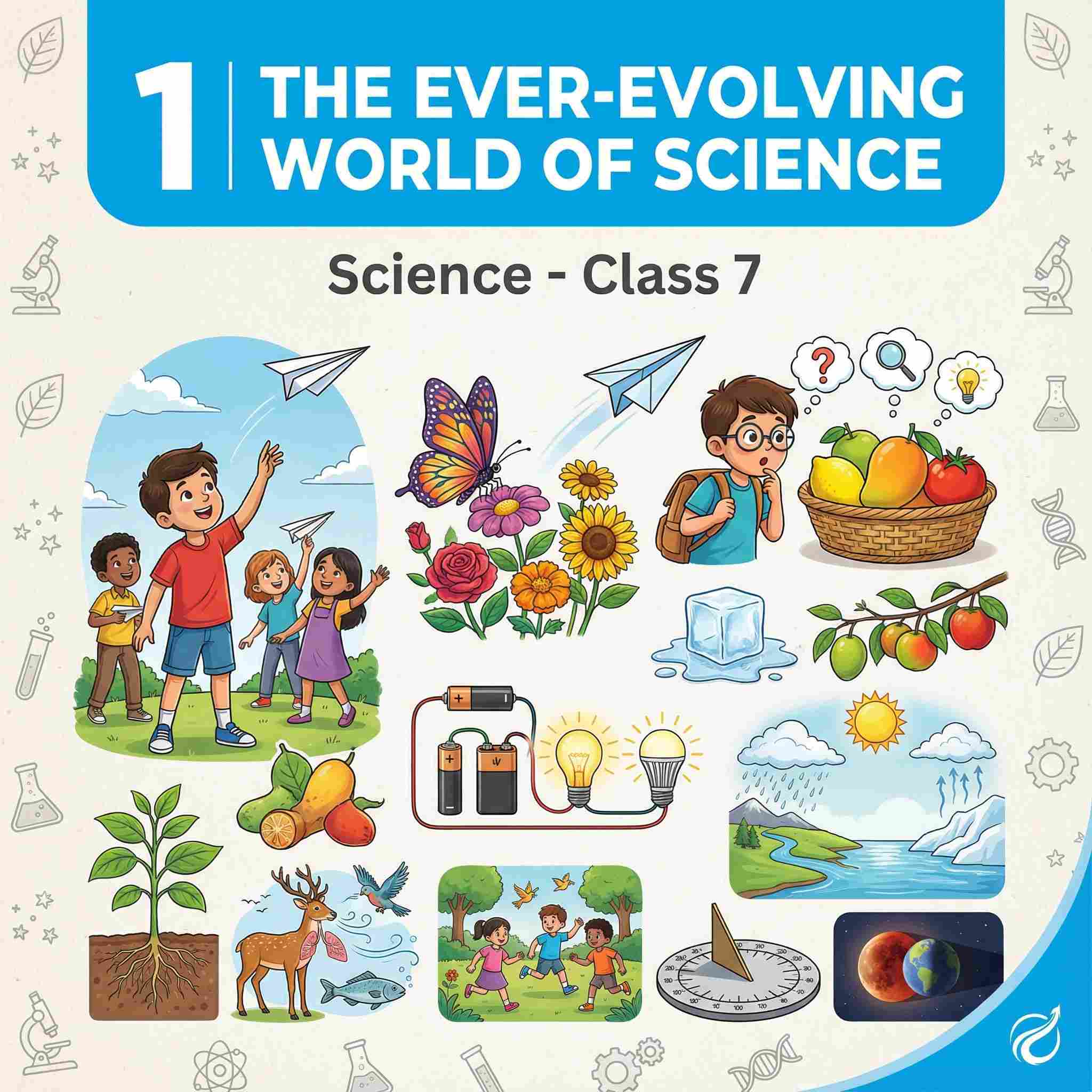
Wider Scope: From daily observations to global phenomena; sources: Illustrations (butterfly/paper plane, fruits, batteries, plants). Expanded: Links to environmental challenges.
Expanded Content: Point-wise for recall; add 2025 relevance like inquiry-based learning.
Introduction to Science Exploration
Purpose: Question, experiment, explore the world (small/large, near/far).
Book Features: Playful page numbers (butterfly/paper plane flight); invitation to imagination.
Example: Paper planes inspired scientific flight explorations (bird wings to aircraft).
Hands-on tests. Ex: Confirm ideas. Relevance: Lead to questions.
Observations
Careful watching. Ex: Shadows for time. Relevance: Start discoveries.
Imagination
Flight of ideas. Ex: Paper plane. Relevance: Reach skies.
Tip: Group by theme; examples for recall. Depth: Debates on responsibility. Errors: Facts vs process. Interlinks: To Grade 6. Advanced: Sustainability apps. Real-Life: Daily questions. Graphs: Topic links. Coherent: Process → Previews. For easy learning: Flashcard per term with example.
Text Book Activity, Questions & Answers - NCERT Exercises
Direct from chapter (Activity 1.1) and added chapter-related Q&A. Answers based on content, point-wise for exams.
Activity 1.1: Question the Answer
Task: Come up with curious, creative questions for these answers. (Avoid obvious like math sums.)
Examples:
Answer: Because the cat’s teeth were crooked. Question: Why did the orthodontist refuse to treat the lion?
Answer: Just add some milk. Question: How can I make my coffee cooler without waiting?
Answer: Don’t panic, I have my towel. Question: What should you say if lost in space?
Answer: 42 Question: What is the ultimate answer to life, the universe, and everything? (But make it more interesting!)
Chapter-Related Questions & Answers
1. What is the main purpose of the science textbook according to the chapter?
Answer:
It is an invitation to question, perform experiments, and explore the world, not just a book of facts.
It helps students become explorers, making small discoveries and understanding the environment.
2. How are the page numbers in the book special?
Answer:
They follow the playful flight of a butterfly and the soaring of a paper plane.
This symbolizes how learning takes flight when curiosity leads the way.
3. What does the chapter say about science as a process?
Answer:
Science is a way of thinking that welcomes curiosity, asks questions, and is open to the unknown.
It involves deeper questions like how things work, why events happen, and patterns in nature.
4. Give examples of topics previewed in the chapter.
Answer:
Properties of materials (sour fruits, haldi stains, metals/non-metals).
Changes (reversible/irreversible, heat flow, water cycle).
Life processes (body changes, animal/plant nutrition/breathing).
Time, light, shadows, and Earth movements (clocks, eclipses, day/night).
5. Why is responsibility important in science according to the chapter?
Answer:
Human activities are linked to nature and society.
Science can address environmental challenges and create a sustainable world.
Tip: Practice long answers (process/responsibility); full marks: Examples + points.
Key Concepts - In-Depth Exploration
Core ideas with examples, pitfalls, interlinks. Expanded: All concepts with steps/examples/pitfalls.
Overall Tip: Use WHY-OQE-MCLTE-HLR-QA for full scan (5 mins). Flashcards: Front (term), Back (points + mnemonic). Covers 100% chapter – easy for exams!