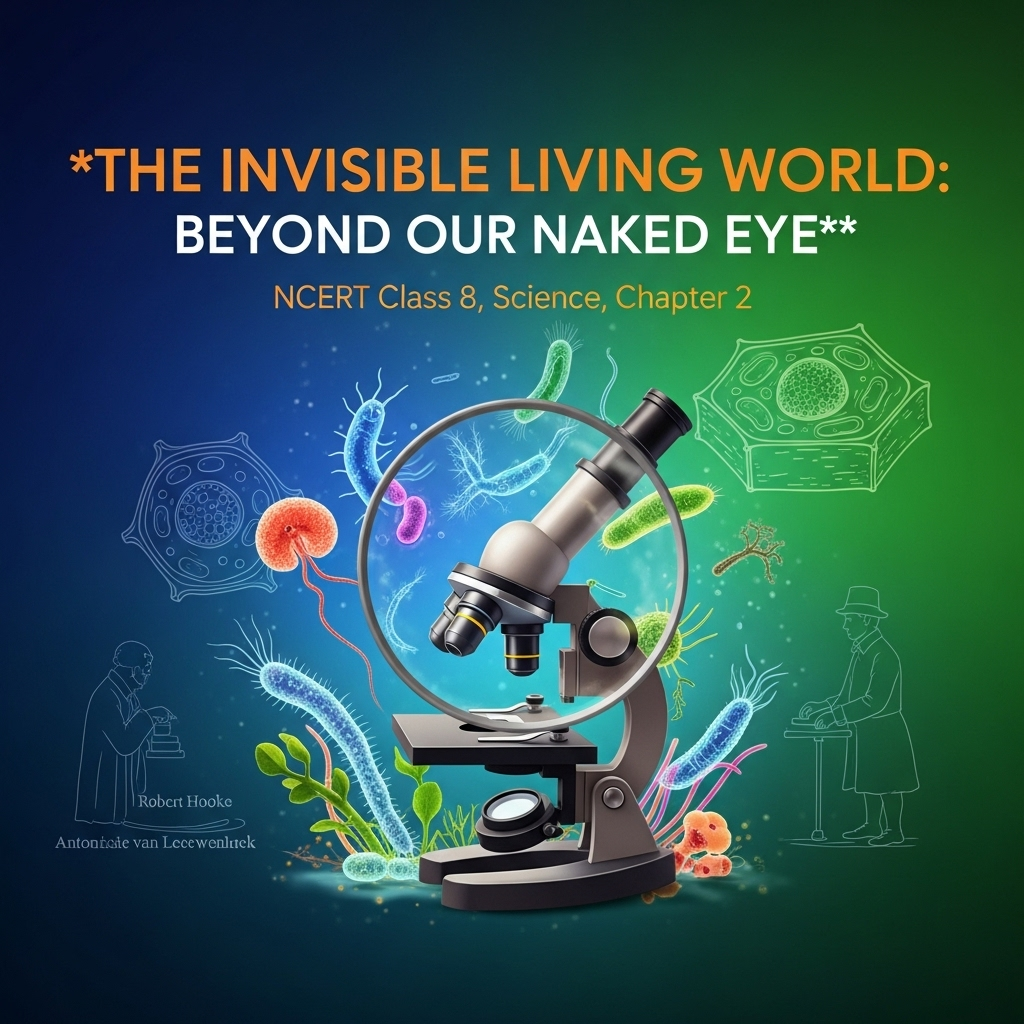
Chapter Overview
1665
Robert Hooke Discovers Cells
1660s
Antonie van Leeuwenhoek Observes Microbes
130-170mm
Largest Cell: Ostrich Egg Yolk
Micro
Means Very Small Organisms
What You'll Learn
Discovery of Microscopes
Understanding how lenses and microscopes revealed the hidden world of tiny organisms.
Cell Structure
Exploring the basic parts of cells and differences between plant and animal cells.
Microorganisms
Learning about bacteria, fungi, protozoa, algae, and their roles in nature.
Beneficial Microbes
Discovering how microbes help in decomposition, food preparation, and nutrient recycling.
Historical Context
This chapter explores the invisible world of microorganisms discovered through microscopes. Robert Hooke in 1665 first described cells in cork, while Antonie van Leeuwenhoek observed bacteria and protozoa. It discusses how these tiny beings, invisible to the naked eye, play crucial roles in life processes, from decomposition to food fermentation, and introduces activities to observe them using simple tools.
Key Highlights
All living beings are made of cells, the basic unit of life. Microorganisms like bacteria and fungi are essential for environmental cleaning and food production, such as curd and bread. The chapter emphasizes diversity in cell shapes related to functions and levels of organization from cell to organism.
Comprehensive Chapter Summary
1. Introduction to the Invisible World
The chapter begins by probing questions about the hidden world beyond the naked eye, discussing how lenses and microscopes revealed tiny organisms. It highlights the variety of living beings, called organisms, and introduces the discovery of cells and microbes.
2. Discovery of the Microscope and Cells
Robert Hooke (1665)
Published Micrographia, describing cork cells as honeycomb-like compartments, coining the term "cell."
Antonie van Leeuwenhoek (1660s)
Known as the Father of Microbiology for observing bacteria and blood cells with improved lenses.
Activity 2.1: Observing with a Flask
Using a water-filled flask as a magnifying glass to see enlarged letters and small organisms like ants.
3. What Is a Cell?
Activity 2.2: Onion Peel
Observing rectangular plant cells with cell wall, membrane, cytoplasm, and nucleus under a microscope.
Activity 2.3: Cheek Cells
Observing polygon-shaped animal cells, noting similarities and differences with plant cells, like absence of cell wall.
Cell Components
Cell membrane (porous boundary), cytoplasm (site of life processes), nucleus (regulates activities), cell wall (in plants for rigidity).
4. Variation in Cell Shape and Structure
Examples
Muscle cells (spindle-shaped for contraction), nerve cells (branched for message transmission), plant cells vary for functions like water transport.
5. Levels of Organization
Hierarchy
Cell → Tissue → Organ → Organ System → Organism; Multicellular vs. Unicellular organisms.
Largest Cell
Ostrich egg yolk as a single cell, measuring 130-170 mm.
6. What Are Microorganisms?
Microorganisms are tiny, unicellular or multicellular beings like bacteria, protozoa, fungi, algae. Activities 2.4 and 2.5 involve observing them in pond water and soil suspension.
7. Connection to Microbes
Environmental Role
Decomposition of waste into manure (Activity 2.7), nitrogen fixation by Rhizobium in root nodules.
8. Microbes in Food
Activity 2.8: Yeast in Dough
Yeast ferments sugar, releasing CO2 to make dough fluffy for bread.
Activity 2.9: Curd Formation
Lactobacillus ferments milk sugar into lactic acid, forming curd.
9. Amazing Microalgae
Microalgae like Spirulina produce oxygen, serve as food, and clean water; conservation is key.
10. Cell as Basic Unit of Life
Cells vary in prokaryotes (bacteria with nucleoid) and eukaryotes; electron microscopes reveal more details.
Questions and Answers from Chapter
Short Questions
Q1. What is a cell?
Answer: A cell is the basic unit of life.
Q2. Who discovered cells?
Answer: Robert Hooke in 1665.
Q3. What is the function of the nucleus?
Answer: It regulates cell activities.
Q4. What are microorganisms?
Answer: Tiny organisms invisible to the naked eye.
Q5. Name a unicellular organism.
Answer: Amoeba.
Q6. What is the role of yeast in bread making?
Answer: It releases CO2 to make dough fluffy.
Q7. What bacterium helps in curd formation?
Answer: Lactobacillus.
Q8. What is the largest known cell?
Answer: Ostrich egg yolk.
Q9. What is a foldscope?
Answer: A low-cost paper microscope.
Q10. What pigment makes algae green?
Answer: Chlorophyll.
Q11. Name a bacterium that fixes nitrogen.
Answer: Rhizobium.
Q12. What are viruses?
Answer: Microscopic and acellular entities.
Q13. What is cytoplasm?
Answer: Space between membrane and nucleus.
Q14. What is the cell wall made of?
Answer: It provides rigidity to plants.
Q15. What is a nucleoid?
Answer: Nuclear region in bacteria.
Medium Questions
Q1. What similarities do you find in Fig. 2.3c and Fig. 2.3d?
Answer: Both show compact arrangements: onion peel cells are rectangular and closely packed like bricks in a wall, illustrating cells as building blocks. (3 marks)
Q2. What similarities and differences did you observe between the cells of onion peel in Activity 2.2 and human cheek cells in Activity 2.3?
Answer: Similarities: Both have cell membrane, cytoplasm, nucleus. Differences: Onion cells have cell wall, rectangular; cheek cells lack cell wall, polygon-shaped. (3 marks)
Q3. What are the similarities and differences you see in muscle cell and nerve cell?
Answer: Similarities: Both have membrane, cytoplasm, nucleus. Differences: Muscle cell spindle-shaped for contraction; nerve cell branched for message transmission. (3 marks)
Q4. What do you observe any difference in the contents of the container?
Answer: Peels turn into dark nutrient-rich manure due to microbial decomposition by fungi and bacteria in soil. (3 marks)
Q5. What did you observe? (From Activity 2.3)
Answer: Polygon-shaped cheek cells with membrane, cytoplasm, nucleus; form protective lining in mouth. (3 marks)
Q6. Did you also observe any of these microorganisms or something different?
Answer: Observations may include protozoa (Amoeba, Paramecium), algae, fungi, bacteria as per Tables 2.1 and 2.2. (3 marks)
Q7. What similarities and differences did you observe between the cells of onion peel and human cheek cells?
Answer: Similarities: Basic parts like membrane, cytoplasm, nucleus. Differences: Plant cells have wall, animal cells do not. (3 marks)
Q8. What do you think the body of an animal is made of?
Answer: Like plants, animal bodies are made of cells, as observed in cheek cells. (3 marks)
Q9. What are the levels of organisation in the body of a living organism?
Answer: Cell → Tissue → Organ → Organ System → Organism. (3 marks)
Q10. What did you observe? (From Activity 2.4)
Answer: Tiny moving organisms like protozoa and algae in pond water. (3 marks)
Q11. Why do microorganisms not infect the pickles and murabbas?
Answer: High salt or sugar concentration acts as preservatives, preventing microbial growth. (3 marks)
Q12. Did you find any change in the volume, smell, or texture of the dough?
Answer: Dough with yeast rises, becomes fluffy, and smells different due to CO2 and alcohol production. (3 marks)
Q13. What can be a possible explanation for this? (Balloon inflation in yeast experiment)
Answer: Yeast produced a gas (CO2) inside the test tube which inflated the balloon. (3 marks)
Q14. What do you think she wants to find out? (Lime water test)
Answer: To confirm if the gas is CO2, as it turns lime water milky. (3 marks)
Q15. What is she trying to test? (Pits with and without dried leaves)
Answer: Effect of mixing dried leaves on decomposition rate for better manure formation. (3 marks)
Long Questions
Q1. How do you think your observation of this hidden world might change the way you think about size, complexity, or even what counts as ‘living’?
Answer: Observing the hidden world reveals that tiny microorganisms, invisible to the naked eye, are complex living beings capable of movement, reproduction, and interactions. This changes perceptions by showing life exists at microscopic scales with intricate structures like cells, challenging ideas of size defining complexity. For instance, unicellular bacteria perform all life processes in one cell, proving 'living' includes simple yet functional entities that impact larger ecosystems through decomposition and nutrient recycling.
Q2. Have you thought how these tiny living beings interact with each other?
Answer: Tiny living beings interact in various ways: bacteria like Rhizobium form symbiotic relationships with plant roots for nitrogen fixation, benefiting both. Fungi and bacteria decompose waste together, recycling nutrients. In food chains, protozoa like Amoeba prey on smaller microbes, while algae produce oxygen used by others. These interactions maintain ecological balance, as seen in soil and pond ecosystems where microbes clean environments and support larger life forms.
Q3. What similarities and differences did you observe between the cells of onion peel in Activity 2.2 and human cheek cells in Activity 2.3?
Answer: Similarities include the presence of cell membrane, cytoplasm, and nucleus in both. Differences: Onion peel cells are rectangular, closely arranged with a cell wall for rigidity; human cheek cells are polygon-shaped, without cell wall, forming a protective lining. These observations highlight plant cells' extra layer for support versus animal cells' flexibility, relating to their functions in organisms.
Q4. What are the importance of these structures in a cell? What functions do they perform? Are these functions important for the maintenance of life?
Answer: Cell membrane separates cells and regulates material entry/exit, essential for homeostasis. Cytoplasm hosts life processes like metabolism. Nucleus controls growth and activities. Cell wall provides plant rigidity. These are vital for survival: without membrane, cells couldn't maintain integrity; cytoplasm enables reactions; nucleus ensures reproduction. All maintain life by supporting functions like nutrition and waste removal.
Q5. Does the shape and structure of a cell relate to its function?
Answer: Yes, shape relates to function: spindle muscle cells contract for movement; branched nerve cells transmit messages; tube-like plant cells transport water. In digestion, thin muscle cells churn food, while lining cells secrete juices. This specialization ensures efficient performance in multicellular organisms.
Q6. What would have happened if microorganisms did not exist on Earth?
Answer: Without microorganisms, waste wouldn't decompose, leading to accumulation and nutrient depletion in soil. No manure or biogas, hindering plant growth and energy sources. Food like bread, curd wouldn't ferment. Nitrogen fixation absent, reducing soil fertility. Ecosystems would collapse, as microbes recycle nutrients and clean environments.
Q7. How does the diversity of microorganisms play a role in our daily life? How do they help clean the environment?
Answer: Diversity enables roles like decomposition (fungi, bacteria turn waste to manure), fermentation (yeast in bread, Lactobacillus in curd), nitrogen fixation (Rhizobium). They clean by breaking down plant/animal waste, recycling nutrients back to soil, preventing pollution and supporting plant growth.
Q8. What do you predict will happen after 3–4 days? (Yeast balloon experiment)
Answer: Balloon on test tube B inflates due to CO2 from yeast respiration. Explanation: Yeast ferments sugar, producing gas. This demonstrates microbial respiration and gas production, key in baking and biogas.
Q9. Can you think of the reasons? (Farmer not adding nitrogen fertilizer)
Answer: Bean crops have root nodules with Rhizobium bacteria that fix atmospheric nitrogen, naturally enriching soil. This reduces need for chemical fertilizers, promoting sustainable farming and soil health.
Q10. What is she trying to test? (Pits A and B)
Answer: Testing if mixing dried leaves with peels enhances decomposition. Pit A forms better manure due to balanced carbon-nitrogen ratio, showing microbial activity needs optimal conditions for efficient waste breakdown.
Q11. Identify the following microorganisms: (i) I live in every kind of environment, and inside your gut.
Answer: Bacteria. They aid digestion in gut, decompose waste, and adapt to diverse environments, illustrating their ubiquity and beneficial roles.
Q12. Identify the following microorganisms: (ii) I make bread and cakes soft and fluffy.
Answer: Yeast. It ferments sugar, releasing CO2 bubbles that expand dough, essential in baking processes.
Q13. Identify the following microorganisms: (iii) I live in the roots of pulse crops and provide nutrients for their growth.
Answer: Rhizobium bacteria. They form nodules, fix nitrogen, enhancing soil fertility without chemicals.
Q14. What happens to the sugar solution in flask A? (Experimental set-up Fig. 2.15)
Answer: Yeast ferments sugar, producing CO2 that passes to lime water in B, turning it milky. Without yeast, no reaction occurs, proving microbial role in gas production.
Q15. A student observes that when curd is left out for a day, it becomes more sour. What can be two possible explanations for this observation?
Answer: Continued Lactobacillus activity produces more lactic acid; or additional microbial contamination increases fermentation. Optimal temperature accelerates the process, making curd sourer.