Checked 25 November 2026. NCEES's FE Electrical and Computer CBT exam specifications (July 2020), FE exam page, Exam Scoring page, calculator policy, exam preparation materials page and MyNCEES practice exam listings, read 25 November 2026, and the NCEES Examinee Guide (November 2026). NCEES says its practice exams will be retired when new FE Electrical and Computer specifications take effect; check the FE page and MyNCEES before you buy.
The best FE Electrical practice is a timed problem worked from the FE Reference Handbook, in every one of the 17 knowledge areas, at about 2.9 minutes a question. The FE Electrical and Computer exam has 110 questions in 5 hours 20 minutes of exam time, closed book with NCEES's electronic handbook on screen. NCEES sells two FE Electrical and Computer Interactive Practice Exams through MyNCEES, 50 questions each at $50.00 each, and the handbook itself is free. Below: how the computer-based exam looks and runs, what a problem looks like in each area, the question formats to practice, a pace calculator, two worked problems with solutions, and a log that suggests your study priorities by area.
ProSyllabus is an independent study site, not part of NCEES. The knowledge areas, ranges and exam rules are NCEES's; the problem descriptions, worked examples, session plans, pace calculator, chart and practice log are ours.
NCEES FE exam page, FE Electrical and Computer CBT exam specifications and exam preparation materials page and MyNCEES listings, read 25 November 2026. Pace: 320 minutes divided by 110 questions, our calculation.
Try four FE Electrical and Computer practice questions from our full mock, each with a worked solution:
FreeTests: Circuit Analysis (DC and AC Steady State) · Power Systems · Digital Systems · Control Systems
FE Electrical and Computer Practice Exam · Free sample, 4 questions: free sample
Answer 4 questions against the clock, like the real exam. You then see the right answer, the reason and your time on each. About 12 minutes · free · no sign-in.
4 questions to answer
Start nowabout 12 minThis one is free · no sign-in needed
Your result shows how long each question took you.
How the computer-based FE Electrical exam looks and runs
The FE is a computer-based exam taken year-round at NCEES-approved Pearson test centers. NCEES's FE exam page sets out a 6-hour appointment; this is what happens in it, in order:
| Step | Time | What happens on screen |
|---|---|---|
| Nondisclosure agreement | 2 minutes | You agree to the NCEES nondisclosure agreement. Declining it ends the exam, and you forfeit the appointment and exam fees. |
| Tutorial | 8 minutes | How to move between questions, flag items for review, open the reference handbook and use the other exam functions. |
| Section 1 | No set time: all 5 h 20 min are available from the start | Approximately half of the 110 questions. The whole exam time is on the clock from the start; there are no individually timed sections. |
| Review and submit section 1 | From the same clock | You review the section, then click "End Review" to submit it. After that you cannot see those questions again. |
| Scheduled break | 25 minutes | You have the option of taking it, and may take less than 25 minutes. You may leave the building. Unused break time does not add exam time, and the exam clock automatically begins again when the break expires. |
| Section 2, review and submit | Whatever is left of the 5 h 20 min | The rest of the questions, then a final review. If time runs out first, every answer you have marked is still submitted and scored. |
What you see and use at the workstation
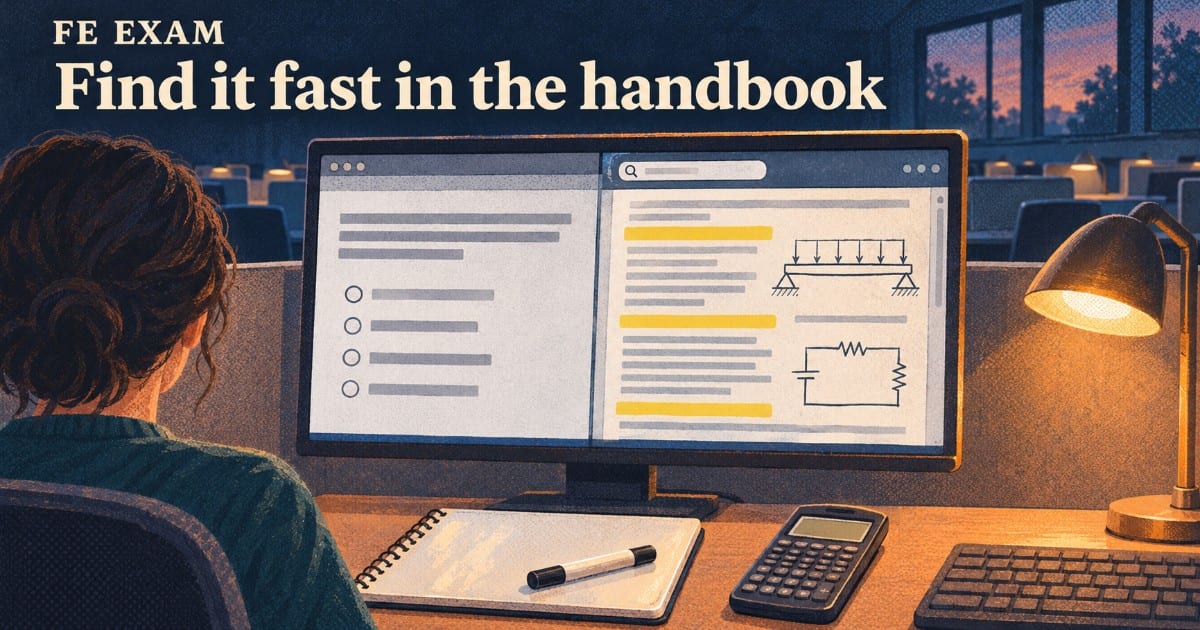
- A 24-inch monitor, wide enough to show the question and the FE Reference Handbook side by side. The handbook is a searchable PDF, typically best viewed at 100% zoom (you can zoom in or out when that helps); you search it with the box on the left of the reference, because Ctrl + F does not work.
- An on-screen TI-30XS calculator, as well as the one NCEES-approved calculator you may bring into the room.
- Two reusable booklets and three markers for scratch work, handed out at check-in. You can replace a booklet at any time by raising your hand.
- A way to flag questions for review, so you can come back to them before you submit the section.
- Proctors who watch the room (audio and video may be recorded), can give you noise-canceling headphones or earplugs, and cannot answer questions about exam content.
NCEES Examinee Guide (November 2026) and FE exam page.
Practice in the same conditions: the handbook as a PDF on screen rather than printed, searched with the PDF viewer's own search box, working on a few sheets of paper with one calculator. Searching, writing and keying in all come out of each 2.9-minute question, so they need practice as much as the engineering does.
What an FE Electrical problem looks like, area by area
NCEES's FE Electrical and Computer CBT exam specifications list the topics for each knowledge area but not sample questions. The table turns those topics into the kind of problem you should practice for each area. The descriptions are ours, built only from NCEES's topic list. See also our guide to the FE Electrical and Computer exam topics.
| Knowledge area | A typical practice problem asks you to (our description) |
|---|---|
| Mathematics | Multiply, divide or convert complex numbers between polar and rectangular form; solve a first- or second-order differential equation with initial conditions; find a determinant, inverse or eigenvalue of a small matrix; take a derivative, integral or gradient; count arrangements or reason about sets. |
| Probability and Statistics | Find the mean, mode or standard deviation of a small data set; a normal probability from a z-value; a binomial or conditional probability; an expected value as a weighted average of outcomes. |
| Ethics and Professional Practice | A short scenario: what a code of ethics or the NCEES Model Law requires, which protection (copyright, patent, trade secret, trademark) fits a piece of work, or which safety practice applies (grounding, safety data sheets, PPE, radiation). Concept, not calculation. |
| Engineering Economics | Present, future or annual worth of a cash flow with interest factors; a cost estimate; a break-even quantity; the better of two alternatives by cost-benefit or trade-off; which item is a project risk. |
| Properties of Electrical Materials | Resistance of a conductor from resistivity, length and area, and how it changes with temperature; conductivity of a doped semiconductor; capacitance from permittivity; which band or p-n effect explains a device behavior. |
| Circuit Analysis (DC and AC Steady State) | A node voltage or loop current by KCL and KVL; an equivalent resistance or impedance; a Thevenin or Norton equivalent; the RMS or average value of a waveform; a phasor current or voltage through an impedance. |
| Linear Systems | The time constant and a voltage or current at time t in an RC or RL circuit; the resonant frequency, bandwidth or quality factor of an RLC circuit; a Laplace transform or its inverse; the poles, zeros or transfer function of a circuit. |
| Signal Processing | The minimum sampling rate for a signal, or the frequency a tone aliases to; the cutoff frequency or gain of a first-order analog filter; the first few outputs of a difference equation; the Z-transform or transfer function of a digital filter. |
| Electronics | A diode circuit current or voltage; the operating point or region of a BJT or MOSFET; the gain of a single-stage or differential amplifier; the output of an ideal inverting, non-inverting or summing op-amp; a sensor or measurement reading; the average output of a rectifier or the duty cycle of a converter. |
| Power Systems | Real, reactive and apparent power and power factor; line and phase quantities in a wye or delta connection; voltage drop, losses or efficiency on a line; a transformer turns ratio or reflected impedance; the slip, speed or torque of an induction motor; a synchronous or dc machine relation. |
| Electromagnetics | The force or field from point charges; the magnetic field around a current-carrying conductor; an induced voltage from a changing flux; wave speed or wavelength in a medium; the reflection coefficient, standing-wave ratio or input impedance of a transmission line. |
| Control Systems | Reduce a block diagram to a closed-loop transfer function; read gain or phase margin from a Bode plot; judge stability from pole locations; find percent overshoot, settling time or steady-state error. |
| Communications | The modulation index or bandwidth of an AM or FM signal; the bit rate of a PCM system from its sampling rate and bits per sample; a Fourier series coefficient; how many channels a time- or frequency-division system carries. |
| Computer Networks | Which device routes or switches traffic; which topology fits a layout; LAN, WAN or internet; which OSI or TCP/IP layer a protocol belongs to; which control detects or prevents an intrusion; what a security test or a term in the security triad means. Mostly concept. |
| Digital Systems | Convert between binary, octal, hexadecimal, decimal and two's complement; simplify a function with Boolean algebra or a Karnaugh map; find the output of a gate network; trace a flip-flop or counter; give the next state of a state machine; spot a hazard in a timing diagram. |
| Computer Systems | Memory size from the number of address lines and the word width; a microprocessor or memory-hierarchy concept; how a device is interfaced (bus, handshake, interrupt). |
| Software Engineering | The big-O of a sort or search; which data structure suits a task; the output of a loop, conditional or recursive function traced by hand; what a testing step checks. |
Three patterns run through the table. First, most areas are calculation areas: find the right relation in the handbook, put in the numbers with consistent units and pick or type the answer. The exam uses both SI and US customary units, so practice both. Second, a lot of the electrical work is complex arithmetic. Phasors in circuits, power and impedance, and poles in linear systems and controls all involve complex numbers, and switching between polar and rectangular form speeds up many of these problems, so practice it on the calculator you will take in. Third, a few areas lean toward judgment rather than numbers: ethics, most of computer networks and parts of software engineering and computer systems. For those, practice reading a short description and choosing the best answer.
Question formats you should practice
The NCEES Examinee Guide says most questions are traditional multiple choice with a single correct answer, but the computer-based FE also uses alternative item types. It names four:
| Format | How NCEES describes it | How to practice it |
|---|---|---|
| Multiple correct options | "allows multiple choices to be correct" | Judge every option on its own. A question on network security controls or Boolean identities may have two right answers. |
| Point and click | "requires examinees to click on part of a graphic to answer" | Practice locating things on figures: the crossover point on a Bode plot, a gate in a logic diagram, the instant a hazard appears on a timing diagram. |
| Drag and drop | "requires examinees to click on and drag items to match, sort, rank, or label" | Practice ordering and matching: protocols to OSI layers, sorting algorithms by big-O, components to a circuit symbol. |
| Fill in the blank | "provides a space for examinees to enter a numerical response to the question" | Work every practice problem to a number before you look at the choices. This type has no answer choices to compare against. |
All questions, including these, are scored correct or incorrect, with no partial credit. The exam also contains a limited number of unscored pretest items placed at random, which you cannot identify, so treat every question as one that counts.
The official NCEES practice material for FE Electrical
NCEES's exam preparation materials page lists two interactive practice exams for FE Electrical and Computer. The table combines that page, the two MyNCEES product listings and the NCEES documents you can use alongside them:
| Material | Price | What NCEES says |
|---|---|---|
| FE Electrical and Computer Interactive Practice Exam Vol. 1 | $50.00 | 50 items and solutions representative of the computer-based exam experience, format and content, none of them from the former e-book. Options for a timed test, immediate solution review and item specification information. You can access and reset it as many times as you like. Non-refundable and non-transferable. |
| FE Electrical and Computer Interactive Practice Exam Vol. 2 | $50.00 | 50 different items and solutions, the questions from the former FE Electrical and Computer Practice Exam e-book, which is no longer available for purchase. Same features and terms as Vol. 1. |
| FE Reference Handbook | Free | NCEES says to create an account or log in to MyNCEES to download your free copy. The current version is on screen during the exam as a searchable PDF. |
| FE Electrical and Computer CBT exam specifications | PDF linked from the FE page | The 17 knowledge areas, their topics and the number of questions in each, effective with the July 2020 exams. |
| Sample diagnostic report | In the Examinee Guide PDF | In the Examinee Guide, worked through for the FE Electrical and Computer exam: performance by knowledge area against the average of passing examinees. |
Together the two volumes hold 100 questions, ten fewer than one exam, so neither is a full-length mock on its own. NCEES also lists item specification information among their features. Both were produced based on the July 2020 specifications, and their MyNCEES listings say they will be retired when new FE Electrical and Computer specifications take effect, with access for earlier buyers ending six months after that launch. As of 25 November 2026 we found no announced date, and the FE page still links the July 2020 specifications. NCEES also lists Exam Prep Errata on its FE page, worth checking if a solution in one of its products looks wrong.
Because NCEES does not publish its passing score, a percentage on any practice exam, NCEES's or anyone else's, is not a pass prediction. NCEES scores the real exam on the number correct, converted to a scaled score that adjusts for minor differences in difficulty between exam forms. Use practice results to compare your areas with each other and to track whether they improve.
How to practice with the FE Reference Handbook
NCEES provides an electronic reference handbook during the exam. The Examinee Guide says it appears on screen as a searchable PDF beside the question on a 24-inch monitor, searched with the box on the left side of the reference; the Ctrl + F shortcut is not available. For a full study plan, see our FE Electrical review. For practice problems, the routine is short:
A handbook routine for every practice problem
- Work from the current handbook downloaded from your MyNCEES dashboard, not from a textbook or your own formula sheet. The aim is to know where each relation sits and what its symbols mean in the handbook's own notation.
- Before you search, decide which knowledge area the problem belongs to and what the relation you need is called. Searching for a term the handbook does not use costs minutes.
- When a search finally works, write down the term that found it. A short list of working search terms per area is worth more than another page of notes.
- Copy the relation onto paper with its units. On exam day you get two reusable booklets and three markers for scratch work, so practice on similar paper with a marker if you can.
- Use one NCEES-approved calculator for all practice, and, if your model has a complex-number mode, learn it until a polar-to-rectangular conversion takes seconds. The approved models for exams through 2027 are Casio fx-115 and fx-991 models, the HP 33s and HP 35s, and TI-30X and TI-36X models. The on-screen TI-30XS is a backup, not a reason to skip learning your own.
NCEES Examinee Guide (November 2026), FE exam page and calculator policy.
Try the routine on four of our practice questions, handbook open beside them:
FreeTests: Circuit Analysis (DC and AC Steady State) · Power Systems · Digital Systems · Control Systems
FE Electrical and Computer Practice Exam · Free sample, 4 questions: free sample
Answer 4 questions against the clock, like the real exam. You then see the right answer, the reason and your time on each. About 12 minutes · free · no sign-in.
4 questions to answer
Start nowabout 12 minThis one is free · no sign-in needed
Your result shows how long each question took you.
How to practice against the clock
You get the whole 5 hours 20 minutes at the start, with no individually timed sections. After about half the questions you review and submit the first section, and you cannot go back to it. Then you may take the scheduled break. An even pace is 320 / 110 = 2.9 minutes a question (our calculation). Build up to the full exam with sessions of increasing length:
| Format | Questions | Time at exam pace (our calculation) | What it trains |
|---|---|---|---|
| Untimed, one area | 10-20 | No clock | Finding the relation in the handbook and getting the method right. Use it for an area you have not studied yet, such as networks for a power engineer. |
| Timed set, one area | 10 | 29 minutes | Speed inside one area once the method is sound. |
| Timed mixed set | 20 | 58 minutes | Switching between a circuit, a Karnaugh map and a networks question in a row, so no single area feels unfamiliar. |
| Half exam | 55 | 160 minutes | The first section: about half the questions, then review and submit, with no way back. |
| Full mock | 110 | 320 minutes (5 h 20 min) | Stamina, the break, and how your accuracy holds up late in the exam. |
Two habits make the clock manageable. First, bank time on the quick questions. A networks term, a number-base conversion or an ethics scenario can take under a minute, which pays for a long phasor or transient problem. Set a cut-off: if a problem is not heading to an answer after about four minutes, choose your best answer, flag it and move on (the tutorial at the start of the exam shows how to flag). NCEES makes no deduction for wrong answers, so an unanswered question can only cost you. Second, review flagged questions before you submit each section, because a submitted section is closed. If time runs out before you submit, any answers you have marked are still submitted and scored.
FE Electrical pace calculator
Use it during or after any timed practice set. Enter the size of the set, the time it allows, and where you are now. It tells you whether you are ahead of an even pace and how long you have for each question that is left.
Our arithmetic, not an NCEES rule. The scheduled break is outside the 5 hours 20 minutes, so leave it out of "minutes used"; an unscheduled break comes off your exam time, so count it in.
An even pace does not mean the same time on every area. Share the 320 minutes by the midpoint of each area's NCEES question range and this is roughly what each area is worth on the clock (our calculation):
Midpoint of each NCEES question range as a share of all midpoints (127), times 320 minutes. Our calculation; the specifications give ranges, not exact counts for any one exam form.
Mathematics and Circuit Analysis together are worth about 70 minutes of exam time, more than any other pair. They are also where complex-number speed on the calculator pays back most. Smaller areas still count: a 4-6 question area is worth about 13 minutes, and every scored question counts the same (the unscored pretest items cannot be told apart, so treat all of them as scored).
Two worked FE Electrical problems
These two are our own, one from Digital Systems (8-12 questions) and one from Signal Processing (5-8). Time yourself: each should take about three minutes, close to the exam's even pace.
Digital Systems: minimizing a function with a Karnaugh map
- Simplify F(A, B, C, D) = Σm(0, 2, 5, 7, 8, 10, 13, 15) to a minimum sum of products, then name the single gate that produces it.
- Write each minterm in binary as ABCD. The first group is 0000, 0010, 1000 and 1010: in all four, B = 0 and D = 0, while A and C take every combination. The second group is 0101, 0111, 1101 and 1111: in all four, B = 1 and D = 1.
- On the 4 × 4 map, the first group is the four corner cells, which are adjacent because the map wraps around at both edges; it forms one group of four, B'D'. The second group is the 2 × 2 block in the middle, giving BD. Every 1 is covered and no group can be larger.
- F = B'D' + BD. That is 1 exactly when B and D are equal, so F = B XNOR D: one two-input XNOR gate, with A and C not needed at all.
- Check: there are 8 minterms, and B = D holds in exactly 8 of the 16 rows (4 values of A and C for each of B = D = 0 and B = D = 1). The usual slip is missing the corner group because the map's wraparound is easy to forget, which leaves a longer expression than the minimum.
Our own example, not an NCEES question.
Signal Processing: sampling and aliasing
- A signal contains two tones, 2 kHz and 7 kHz. It is sampled at 10 kHz with no anti-aliasing filter, then reconstructed with an ideal low-pass filter that passes everything below half the sampling rate. Which frequencies come out, and what sampling rate is needed to avoid aliasing?
- Half the sampling rate (the folding frequency) is 10 / 2 = 5 kHz. The 2 kHz tone is below it, so it is sampled correctly and comes out as 2 kHz.
- The 7 kHz tone is above 5 kHz, so it aliases. Its alias is the distance to the nearest multiple of the sampling rate: |7 − 10| = 3 kHz. A 7 kHz and a 3 kHz cosine sampled at 10 kHz give identical samples, so the reconstruction filter cannot tell them apart.
- The output contains 2 kHz and 3 kHz. To avoid aliasing, the sampling rate must be greater than twice the highest frequency present: f_s > 2 × 7 = 14 kHz. 14 kHz itself is the Nyquist rate, the bound you must exceed.
- The usual slips are answering 7 − 5 = 2 kHz (measuring from the folding frequency instead of from the sampling rate) and stating the Nyquist rate as the highest frequency itself rather than twice it.
Our own example, not an NCEES question.
Track your practice by knowledge area
NCEES reports the real exam as pass or fail. If you fail, the diagnostic report shows your performance in each knowledge area on a 0-15 scaled score, against the average of passing examinees. The sample report in the NCEES Examinee Guide is an FE Electrical and Computer one, and its advice is worth copying for practice. It puts the areas where the examinee was furthest behind (Ethics and Professional Practice, Properties of Electrical Materials and Electromagnetics, 12 questions) first, with strong focus. Second, with very strong focus, come the areas where they were consistently but less far below (Mathematics, Probability and Statistics, Power and Computer Networks), because those held 27 questions and so gave more opportunity to improve. A practice log gives you that view before the exam, while it can still change the result:
Your FE Electrical practice log
After each practice session, add the questions you attempted and got right in each knowledge area. Keep a running total. The log shows your accuracy per area and suggests up to three study priorities: the areas with the highest error rate weighted by the size of their NCEES question range.
| Knowledge area | Tried | Right | Accuracy |
|---|---|---|---|
| Mathematics | - | ||
| Probability and Statistics | - | ||
| Ethics and Professional Practice | - | ||
| Engineering Economics | - | ||
| Properties of Electrical Materials | - | ||
| Circuit Analysis (DC and AC Steady State) | - | ||
| Linear Systems | - | ||
| Signal Processing | - | ||
| Electronics | - | ||
| Power Systems | - | ||
| Electromagnetics | - | ||
| Control Systems | - | ||
| Communications | - | ||
| Computer Networks | - | ||
| Digital Systems | - | ||
| Computer Systems | - | ||
| Software Engineering | - |
Ranking (our method, not NCEES's): the share you got wrong in an area multiplied by the midpoint of its NCEES question range, so a weak 11-17-question area ranks above an equally weak 4-6-question one. An area needs at least 5 questions logged to be ranked. Numbers are saved only in this browser on this device.
The log uses the second half of that reasoning: it weights each area by the midpoint of its NCEES range, so a large area where you are a little behind can rank close to, or above, a small area where you are far behind. Still give strong focus to any area where you are far behind, as NCEES's sample does. Log at least 20 questions in an area before you trust its accuracy; a handful of questions can swing it a long way. With 17 areas, that means a few hundred practice questions before the log is reliable everywhere, so start it early.
Take a full FE Electrical practice exam
Area-by-area sets build the methods; a full mock tests whether they hold up for 5 hours 20 minutes. Our FE Electrical and Computer practice exam is an independent 110-question mock in 5 hours 20 minutes, with every knowledge area inside NCEES's published range and a worked solution for every question. The result page breaks your score down by knowledge area, so you can enter the numbers straight into the log above. Try four of its questions free first:
FreeTests: Circuit Analysis (DC and AC Steady State) · Power Systems · Digital Systems · Control Systems
FE Electrical and Computer Practice Exam · Free sample, 4 questions: free sample
Answer 4 questions against the clock, like the real exam. You then see the right answer, the reason and your time on each. About 12 minutes · free · no sign-in.
4 questions to answer
Start nowabout 12 minThis one is free · no sign-in needed
Your result shows how long each question took you.
A sensible order: one full mock early to find your weak areas, area sets in those areas with the handbook, a second full mock to check the change, then book your date. NCEES allows one attempt per testing window and no more than three in any 12-month period (some licensing boards have a more restrictive policy), and each attempt carries the $225 exam fee, so it pays to be ready on the first one.
Frequently asked questions
Is there an official FE Electrical practice exam?
Yes. NCEES sells the FE Electrical and Computer Interactive Practice Exam Vol. 1 and Vol. 2 through MyNCEES, $50.00 each, with 50 different questions and solutions in each. NCEES says they are representative of the computer-based exam, with a timed option, immediate solution review and item specification information, and you can access them as many times as you like until NCEES deactivates them, six months after new specifications launch.
Is there an FE Electrical practice exam PDF?
Not as a current NCEES product: its FE Electrical and Computer Practice Exam e-book is no longer available for purchase; those questions are now the interactive Vol. 2, and both of its listed FE Electrical and Computer practice exams are interactive. NCEES PDFs you can use for practice include the FE Reference Handbook (a free copy through MyNCEES), the exam specifications and the Examinee Guide with its sample diagnostic report.
Are there free FE Electrical practice problems?
NCEES's free materials are the FE Reference Handbook (through MyNCEES), the FE Electrical and Computer exam specifications and the sample diagnostic report in its Examinee Guide; its practice exams are paid. This guide has two worked problems of our own, and our FE Electrical and Computer practice exam has a free four-question sample with worked solutions.
How many questions are on the FE Electrical and Computer exam?
110 questions in 5 hours 20 minutes of exam time. The FE exam page and the specification give a 6-hour appointment; the Examinee Guide's table gives 5 hours 55 minutes: a 2-minute nondisclosure agreement, an 8-minute tutorial, the 5 hours 20 minutes of exam time and a 25-minute scheduled break.
How long should each FE Electrical question take?
An even pace is 320 minutes divided by 110 questions, about 2.9 minutes a question (our calculation). A networks or number-system question can take under a minute; a transient or three-phase calculation can take four or five, so skip and flag rather than stall.
What types of questions are on the FE Electrical exam?
Mostly traditional multiple choice with one correct answer, plus alternative item types: multiple correct options, point and click, drag and drop, and fill in the blank (a typed number). All are scored correct or incorrect, with no partial credit.
Can I use my own calculator on the FE Electrical exam?
Yes, one NCEES-approved model: for exams through 2027, Casio fx-115 and fx-991 models, the HP 33s and HP 35s, and TI-30X and TI-36X models. An on-screen TI-30XS is also available during the exam.
Will the FE Electrical exam specifications change?
The current FE Electrical and Computer specifications took effect in July 2020. NCEES says its two practice exams will be retired when new specifications take effect, but as of 25 November 2026 we found no announced date, and the FE page still links the July 2020 specifications.
What score do I need to pass the FE Electrical exam?
NCEES does not publish the passing score. Your number of correct answers is converted to a scaled score, and there is no deduction for wrong answers, so answer every question.
Does the FE Electrical exam include computer questions?
Yes. Digital Systems (8-12 questions), Computer Systems (5-8), Computer Networks (4-6) and Software Engineering (4-6) are all in the specification, so practice them even if your degree was in power or electronics.
How soon do I get my FE Electrical result?
NCEES says computer-based exam results are typically available 7-10 days after the exam (the FE page says 7-10 business days), by email notice to view them in MyNCEES. Results are pass or fail; a fail comes with a diagnostic report by knowledge area.
Sources
- official — NCEES: Fundamentals of Engineering (FE) Electrical and Computer CBT exam specifications, effective beginning with the July 2020 examinations (knowledge areas, topics, question ranges, SI and US customary units)
- official — NCEES: exam preparation materials (FE Electrical and Computer Interactive Practice Exam Vol. 1 and Vol. 2, $50.00 each, and what the interactive practice exams include), read 25 November 2026
- official — MyNCEES: FE Electrical and Computer Interactive Practice Exam Vol. 1 (50 items and solutions, no overlap with the former e-book, built on the July 2020 specifications, retired when new specifications take effect), read 25 November 2026
- official — MyNCEES: FE Electrical and Computer Interactive Practice Exam Vol. 2 (50 items and solutions from the former FE Electrical and Computer Practice Exam e-book, different from Vol. 1), read 25 November 2026
- official — NCEES: FE exam page (110 questions, 6-hour appointment, which the Examinee Guide table gives as 5 hr 55 min, with 5 hours 20 minutes of exam time, electronic reference handbook, free FE Reference Handbook through MyNCEES, $225 exam fee, one attempt per testing window, Exam Prep Errata), read 25 November 2026
- official — NCEES: Exam Scoring (number correct, no deductions for wrong answers, scaled score, passing score not published, results in 7-10 days, which the FE page gives as 7-10 business days, diagnostic report), read 25 November 2026
- official — NCEES: calculator policy (approved models for exams through 2027), read 25 November 2026
- official — NCEES Examinee Guide, November 2026 (24-inch monitor, on-screen searchable reference handbook and search box, on-screen TI-30XS calculator, reusable booklets and markers, tutorial, two sections, "End Review", breaks, alternative item types, no partial credit, pretest items, sample FE Electrical and Computer diagnostic report)
official = a document published by the conducting body. reported = a news or coaching site we could not check against an original. Where sources disagree this page says so rather than picking one.